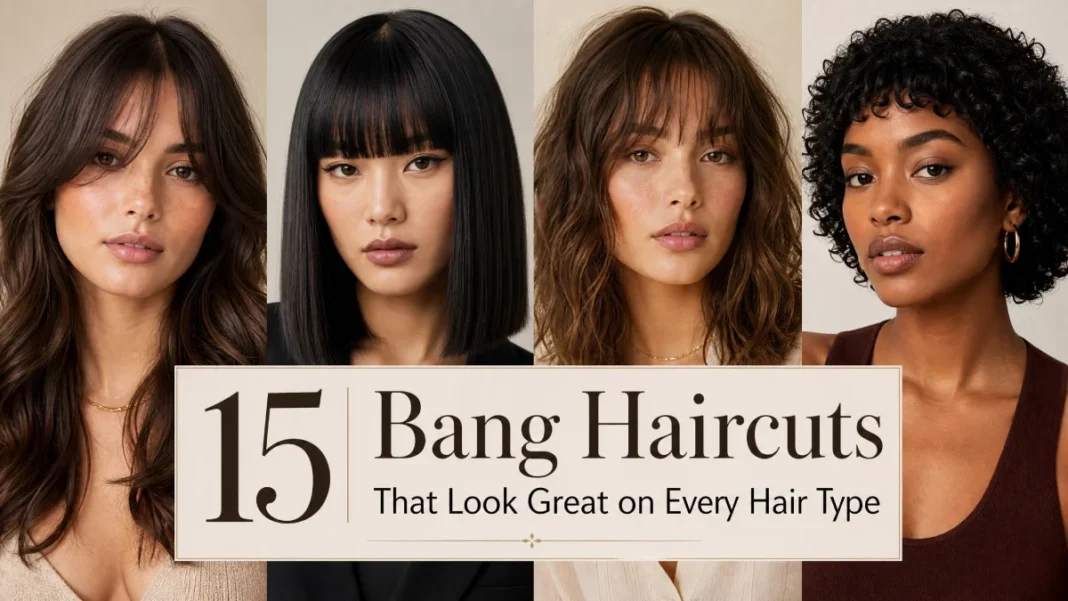
The right bang haircut sculpts your features without a drop of makeup. Yet most people hesitate before making the cut, worried about face shape, texture, and daily upkeep.
Bangs are more versatile than most people realize. There’s a fringe style for every hair type, from pin-straight to tightly coiled. The key is knowing your hair’s behavior before you sit in the salon chair.
According to celebrity hairstylist Anthony Montoya, bangs work as contour does in makeup. Stylist Mary Kendall says face-framing fringe is now her most requested service, and data from the Professional Beauty Association shows bang-related salon visits rose 32% between 2022 and 2024.
This guide covers 15 bang types, with adaptation advice for fine, thick, wavy, curly, and coily textures, plus face shape pairings, styling techniques, and real maintenance schedules.
Before picking a style, start with a framework: your personal bang map.
How to Pick the Right Bangs for Your Hair Type and Face Shape
Understanding Your Hair Texture First
Your natural texture dictates how bangs behave day to day. Ignoring this leads to what stylists call “texture denial” — choosing a style that fights your hair.
Fine hair lacks natural volume, so bangs tend to fall flat against the forehead; look for styles that add visual density and root lift. Thick hair carries heavy weight and can look like a solid block, which texturizing and thinning fix. Wavy hair has built-in movement, so bangs dry with a natural bend that works in your favor for most styles. Curly hair shrinks when dry — a cut that looks perfect wet can spring up two inches, so always cut for shrinkage. Coily hair needs moisture-rich care and extra length at the cutting stage; the results are bold and striking.
Quick Hair Density Check
Density — how many strands grow per square inch — matters as much as texture.
Low-density hair appears see-through at the scalp, so wispy and feathered styles work naturally; trying to force thick, full bangs on sparse hair leads to disappointment. Medium-density hair is the most versatile and suits most bang types. High-density hair produces heavy, bulky bangs unless thinning shears and slide-cutting remove the excess weight — skip that step and thick bangs feel like a curtain on your forehead.
Face Shape Quick Guide
Face shape determines which bangs create visual balance:
- Round faces benefit from elongating styles like curtain bangs and side-swept fringe, which add vertical lines. Avoid blunt micro bangs — they shorten the face further.
- Oval faces suit nearly every bang type. This is the most versatile face geometry, so feel free to experiment.
- Square faces have strong jawlines and angular features that wispy, feathered, and layered bangs soften. Blunt cuts amplify the sharpness instead.
- Heart-shaped faces have wider foreheads and narrower chins, which curtain and bottleneck bangs balance nicely.
- Oblong faces are longer than they are wide. Blunt and full fringe shorten the face visually; heavy side-swept styles add unwanted vertical length.
- Diamond faces feature wide cheekbones with a narrow forehead and chin. Most styles flatter this shape, though side-swept and curtain bangs work especially well.
The One Rule Every Stylist Recommends
Start longer than you think — you can always cut more, but you can’t add hair back. Celebrity stylist Mary Kendall advises clients to begin at cheekbone length, then go shorter at the next appointment. This approach virtually eliminates bang regret.
15 Bang Haircuts That Flatter Every Hair Type
Each entry below includes a visual description, hair type adaptation, face shape pairing, and a styling tip.
1. Curtain Bangs
Parted down the middle or slightly off-center, these bangs are shortest at the forehead’s center and lengthen gradually toward each side, skimming the cheekbones — a soft, face-framing silhouette echoing 1970s French style. Dakota Johnson is the modern poster child for this look.
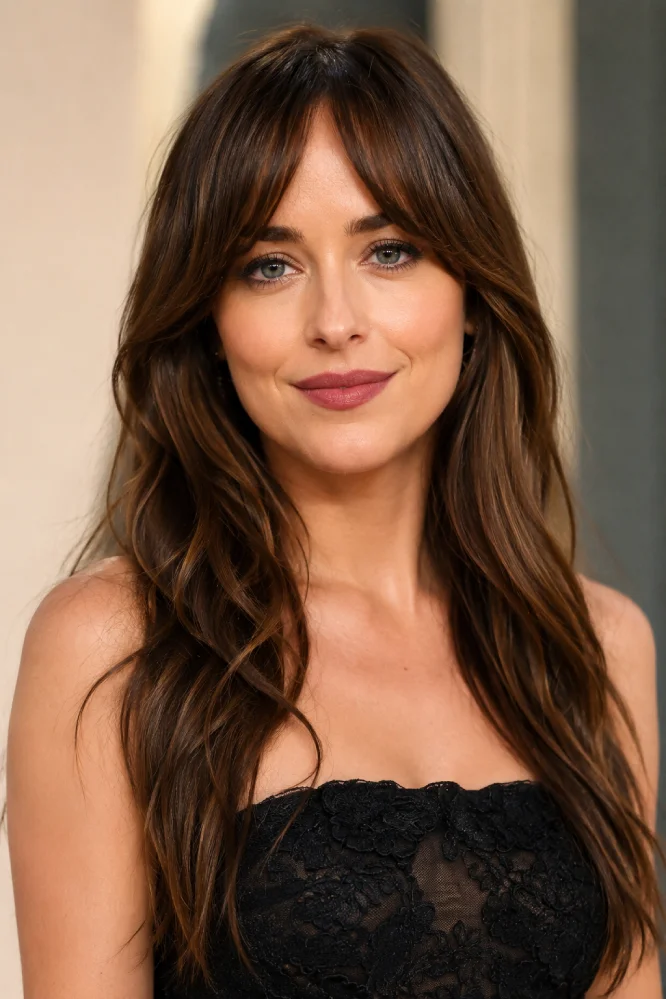
Why they work on every hair type:
- Fine/Straight Hair: Adds volume and texture, keeping flat hair from lying lifeless against the forehead. A round-brush blowout builds instant root lift.
- Thick Hair: A skilled stylist can texturize and point-cut the ends to reduce bulk while keeping the shape, blending smoothly into layered cuts.
- Wavy Hair: Natural wave enhances the curtain effect and dries with a gorgeous swooping motion, needing minimal styling.
- Curly Hair: Cut longer to compensate for shrinkage, then diffuse to define the curl pattern for a relaxed, bohemian effect.
- Coily Hair: Extra length is essential. Finger-coil the front sections while damp and let them dry naturally for a defined, face-framing shape.
Best face shapes: Round, heart, oval, square — virtually universal.
2. Side-Swept Bangs
A soft, diagonal fringe that sweeps across the forehead and rests to one side, either grazing the eyebrows or sweeping past the eyes. Emma Stone has worn this style on numerous red carpets.
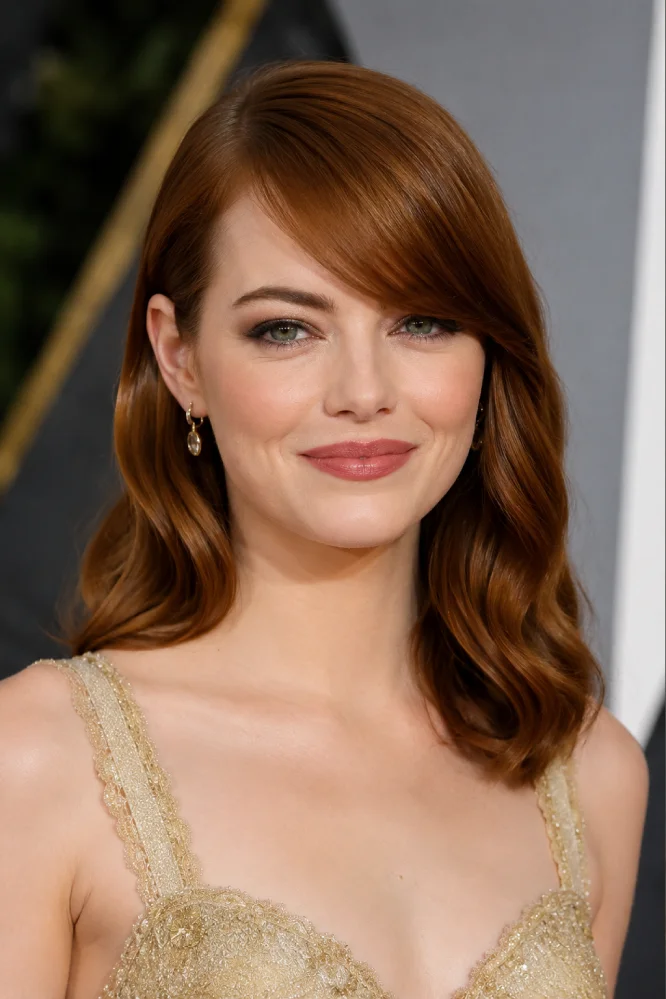
Why they work on every hair type:
- Fine/Straight Hair: The diagonal line creates the illusion of thicker hair and adds visual density at the root.
- Thick Hair: The natural weight of thick strands holds the sweep in place with minimal product or effort.
- Wavy Hair: Natural movement enhances the sweep, adding romantic softness to the diagonal line.
- Curly Hair: Rather than fighting curl direction, let natural coils flow to one side; a curl cream defines them without frizz.
Best face shapes: Round (adds angles), heart (softens forehead), oval (highlights features), square (counteracts jawline sharpness).
3. Wispy Bangs
Light, feathery strands drape softly across the forehead, with slightly jagged or feathered ends creating a delicate, almost see-through effect. Taylor Swift and Zendaya have both popularized this style.
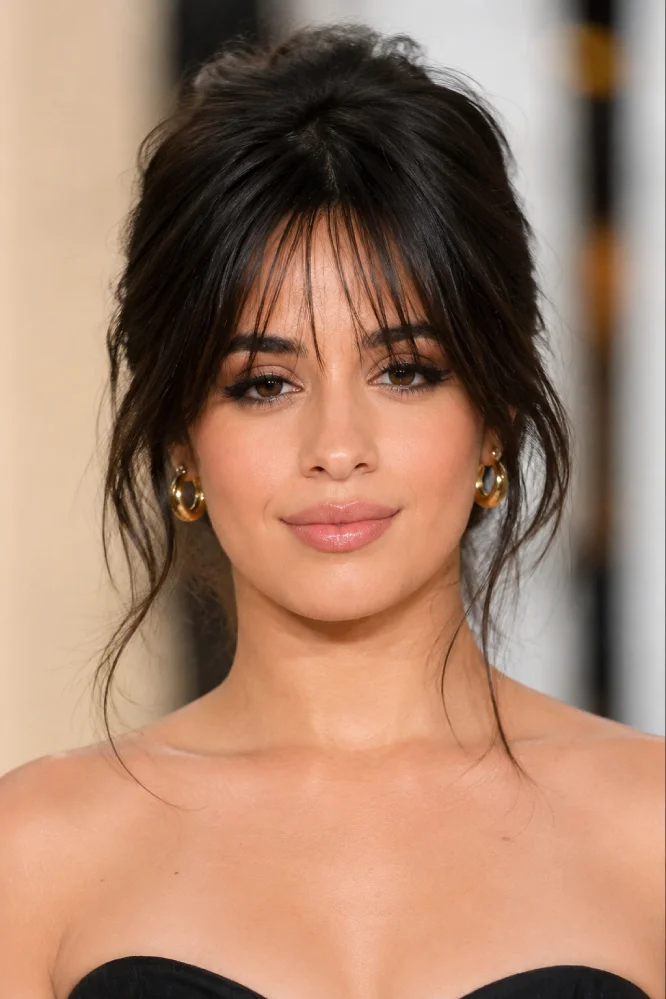
Why they work on every hair type:
- Fine/Straight Hair: Keeps a clean, defined line — the delicacy here is intentional, not sparse.
- Thick Hair: Natural texture peeks through without the bulk of a blunt cut when texturizing products are used.
- Wavy Hair: The airy quality pairs beautifully with natural wave for an effortless, romantic result.
- Curly Hair: Creates a soft, cloud-like frame — cut slightly longer to allow for spring-back.
Best face shapes: Heart (softens forehead), square (eases jawline angles), oval (enhances natural balance).
4. Blunt Bangs
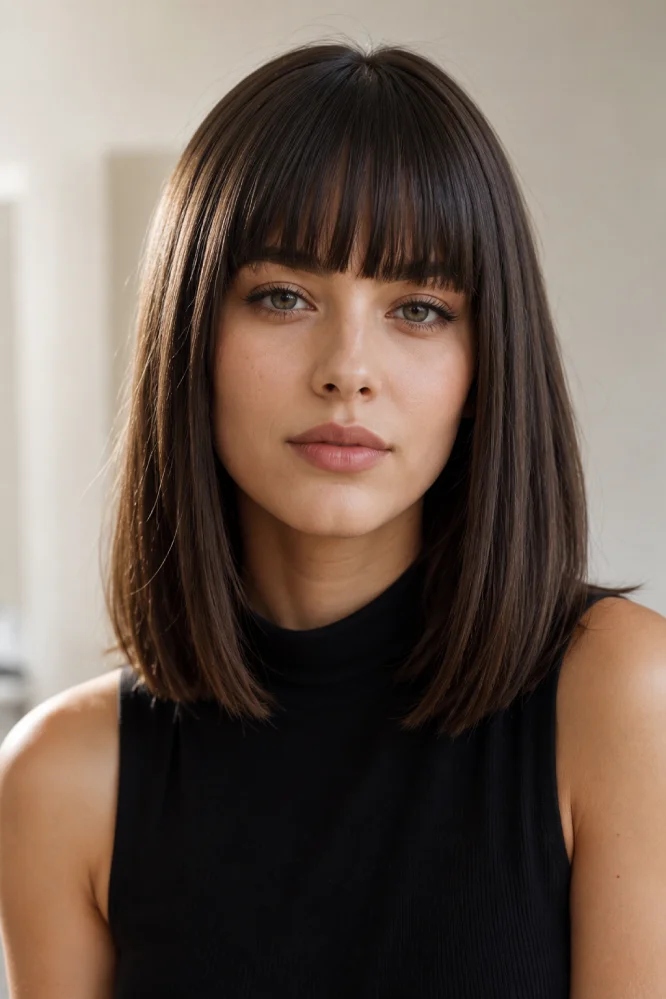
A straight-across cut hitting just above or at the eyebrow line, with a sharp, uniform edge that bolds the frame around the eyes. Cardi B pairs this style with sleek bobs for maximum impact.
Why they work on every hair type:
- Fine/Straight Hair: The clean line creates a striking, polished look — a flat iron gives a perfectly smooth finish.
- Thick Hair: Needs thinning to avoid a “helmet” effect. Ask your stylist for point-cutting along the edge.
- Wavy Hair: A flat iron or tension-styling technique keeps the line sharp, or embrace a softer, textured blunt look.
- Curly Hair: The trickiest pairing. Wet-cutting causes shrinkage surprises, so ask for a dry cut with at least two extra inches of length.
Best face shapes: Oval (accentuates eyes), heart (dramatic contrast), oblong (shortens face length). Avoid on round faces, where blunt lines shorten the face further.
5. Bottleneck Bangs
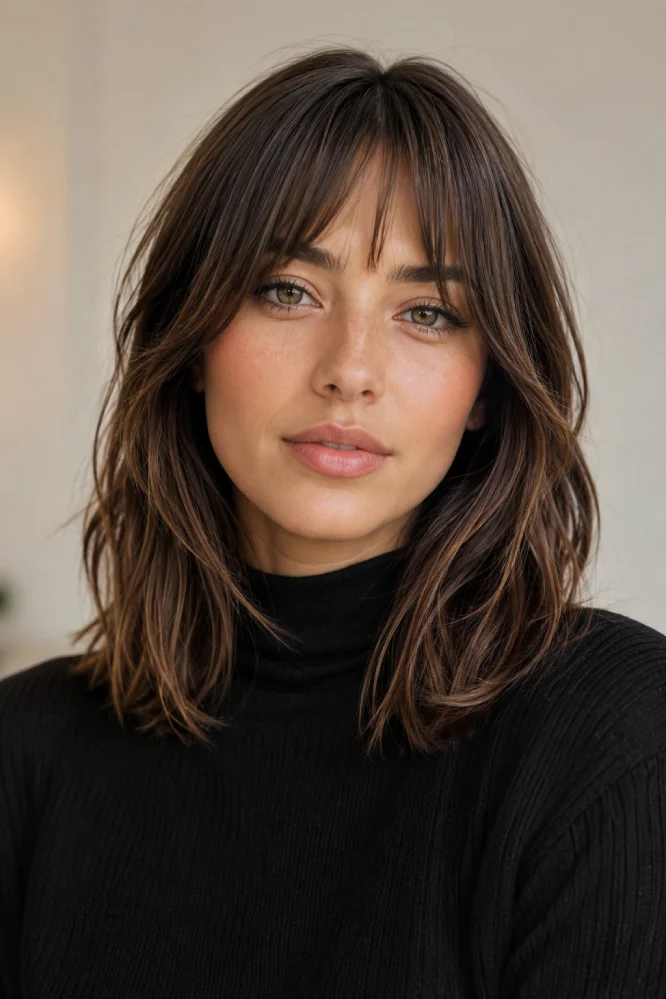
Named for their shape, these bangs are cut shorter at the top of the forehead and cascade longer toward the cheek and eye line — a wider, more organic frame than curtain bangs, and the modern evolution of the Bardot fringe.
Why they work on every hair type:
- Fine/Straight Hair: Graduated length adds dimension and prevents the flat, one-length look fine hair struggles with.
- Thick Hair: Cascading layers distribute weight naturally, so each section carries less bulk than a blunt alternative.
- Wavy Hair: Natural wave enhances the bottleneck curve for an intentionally undone, chic result.
- Curly Hair: Cut with extra length on the longest sections; the curl pattern forms a beautiful, organic bottleneck naturally.
Best face shapes: Universal. A middle part and graduated length flatter nearly every facial structure.
6. Micro Bangs (Baby Bangs)
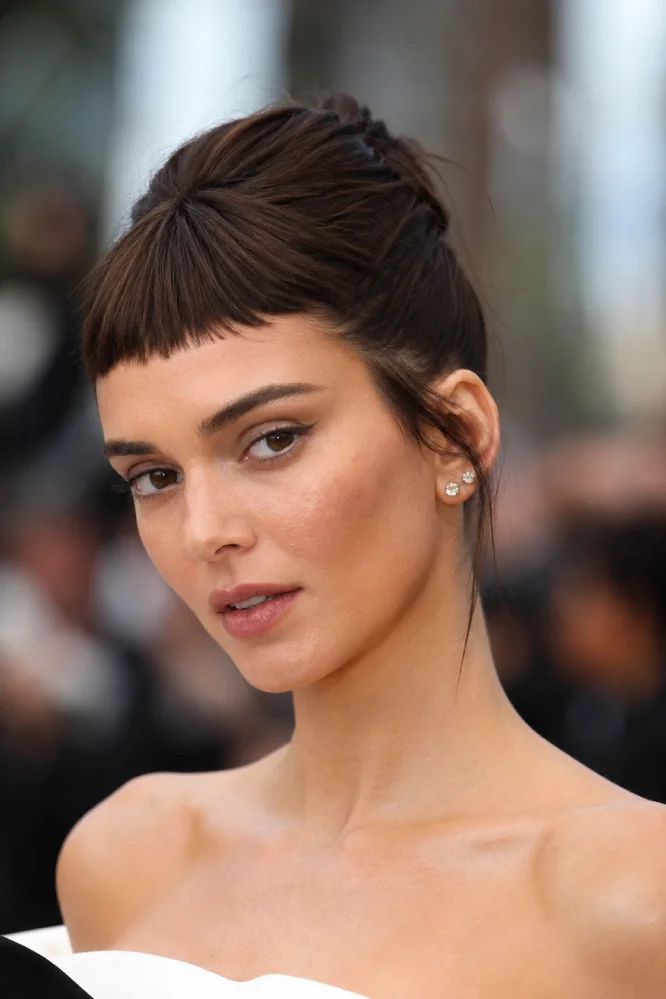
A short, blunt or slightly textured fringe sitting well above the eyebrows, often mid-forehead, drawing immediate attention to the eyes and brows. Audrey Hepburn made these iconic in the 1950s; Hailey Bieber revived the trend for a modern audience.
Why they work on every hair type:
- Fine/Straight Hair: The crisp, short line reads as intentionally bold, and fine hair holds this length without bulk issues.
- Thick Hair: Requires texturizing shears to avoid a heavy block above the brows.
- Wavy Hair: A slight wave softens the blunt edge for a less severe version of micro bangs.
- Curly Hair: The riskiest pairing due to shrinkage — cut dramatically longer than the target and consult a curl specialist before committing.
Best face shapes: Oval, heart, and square, where micro bangs highlight cheekbones and shorten longer proportions. Avoid on round faces, where the short horizontal line can widen the face.
7. Curly Bangs
These bangs celebrate natural curl and coil patterns, sitting on the forehead in their natural formation. The key: always cut longer than the target resting length to compensate for shrinkage.
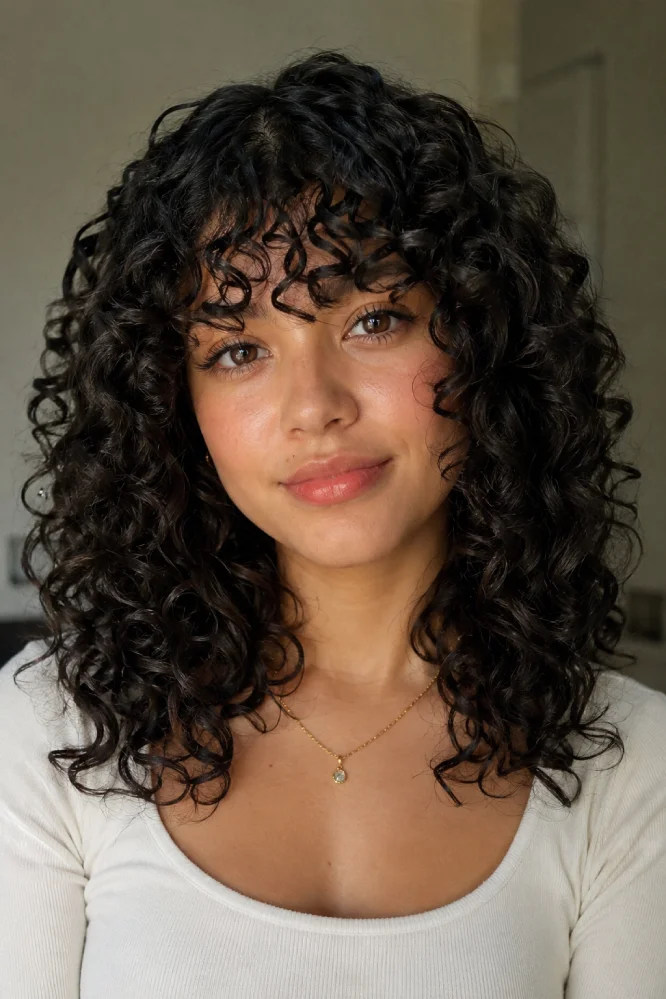
- Type 2 (Wavy): Loose S-patterns create a soft, tousled bang; light curl cream enhances definition without stiffness.
- Type 3 (Curly): Defined ringlets form a bouncy, full, face-framing fringe.
- Type 4 (Coily): Tight coils add dramatic height and texture; moisture-rich products are essential for definition and health.
Face shape compatibility: Curly bangs soften angular features on square and heart faces, add width to oblong faces, and — side-parted — create vertical lines that benefit round faces.
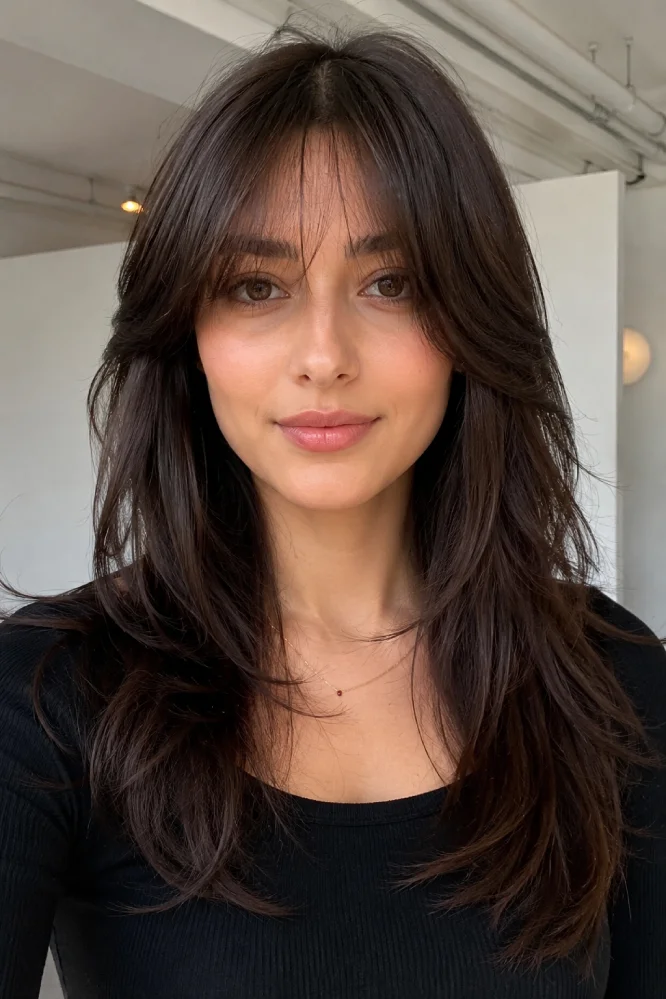
8. Layered Bangs
Multiple lengths blend into a soft, dimensional fringe that graduates from shorter to longer, giving you the option to part it down the middle, sweep it to one side, or let it fall forward.
Why they work on every hair type:
- Fine/Straight Hair: Varied lengths create an illusion of thickness, each layer adding its own dimension.
- Thick Hair: Layers distribute weight evenly, preventing the heavy, blocky look thick bangs can create.
- Wavy Hair: Natural wave moves through the layers for a textured, effortless look.
- Curly Hair: Different curl lengths create a playful, organic shape and prevent tangling at the forehead.
Best face shapes: Universally flattering — layers soften square faces, add dimension to round faces, and complement the natural balance of oval faces.
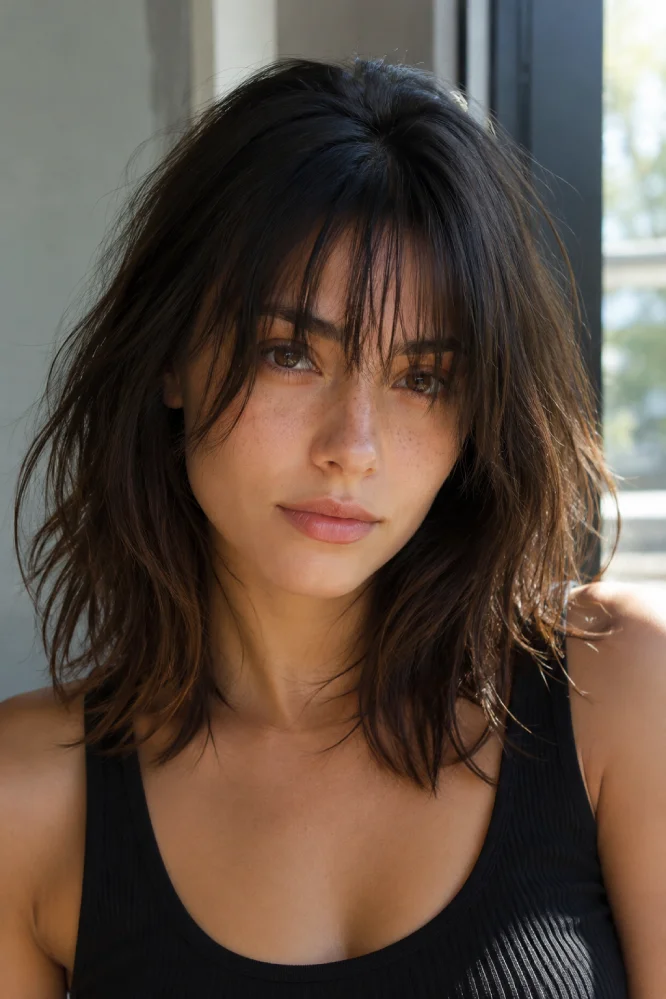
9. Choppy Bangs
Cut at varying, deliberately irregular lengths, with each strand landing at a slightly different point for an edgy, intentionally undone effect.
Why they work on every hair type:
- Fine/Straight Hair: Irregular lengths add texture and body; flat-ironing emphasizes the choppy definition.
- Thick Hair: Choppy cutting removes bulk naturally, breaking up heaviness.
- Wavy Hair: Natural wave amplifies the choppiness, doing the styling work for you.
- Curly Hair: Each curl occupies its own space within the fringe for a bold, textured statement.
Best face shapes: Oval, heart, and square, where irregular lines soften angular features and add interest to balanced proportions.
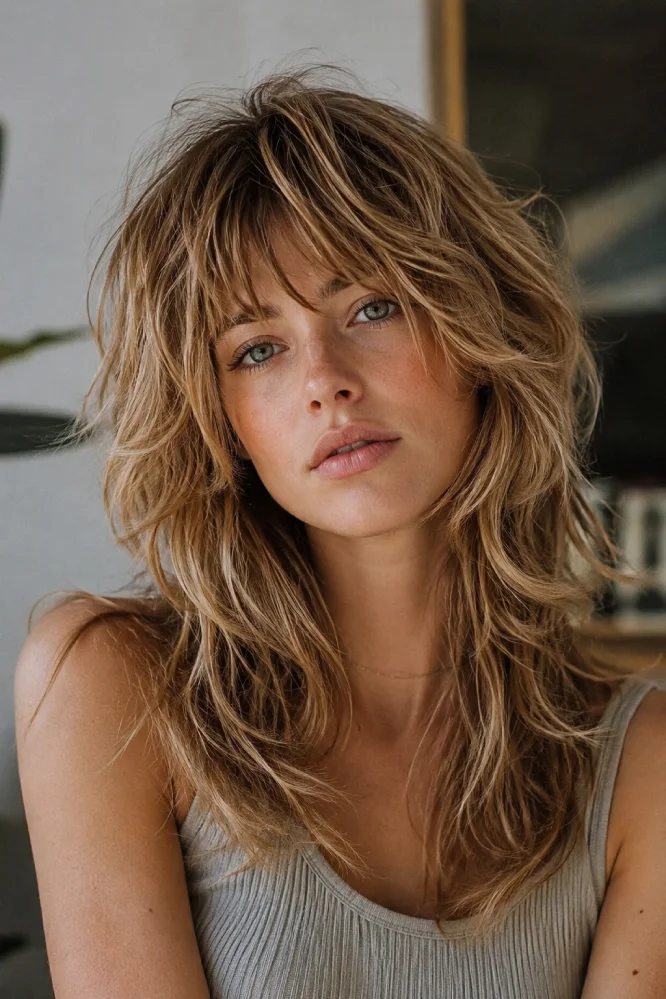
10. Shaggy Bangs
Choppy, mussed-up fringe that blends into a layered, shag-inspired cut with an intentionally messy, rock-and-roll aesthetic reminiscent of Jane Fonda in her prime.
Why they work on every hair type:
- Fine/Straight Hair: The shaggy texture adds instant body and movement to flat hair.
- Thick Hair: Messy layering reduces visual weight, letting strands fall into a natural, effortless pattern.
- Wavy Hair: Wave and shag are a natural match.
- Curly Hair: Curls amplify the shag’s carefree, voluminous, rock-inspired spirit.
Best face shapes: Oval, round, and heart, where shaggy bangs add width and volume at the forehead to balance narrower faces.
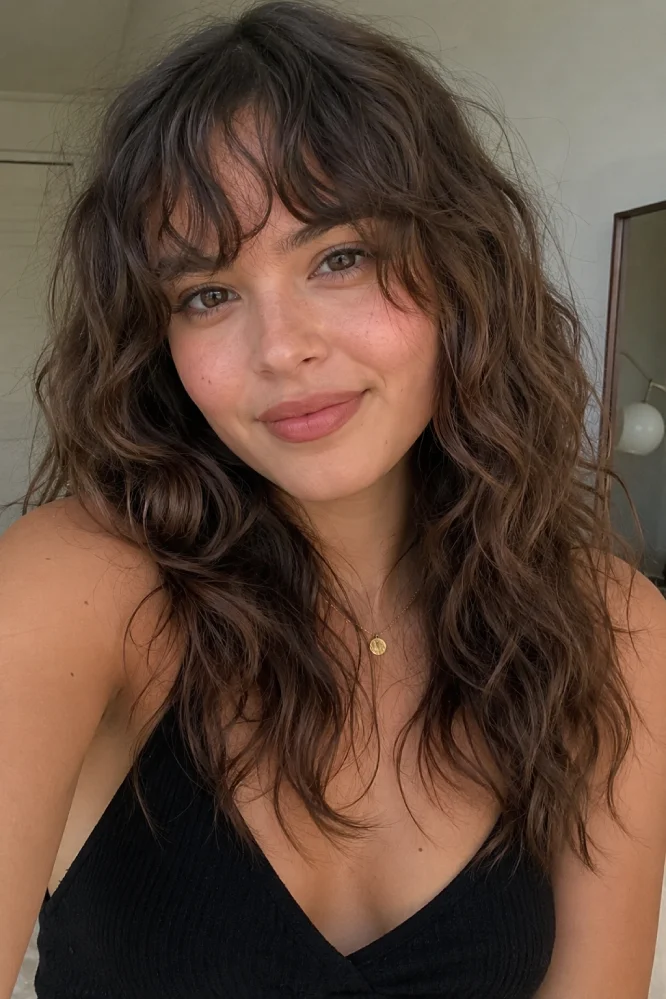
11. Wavy Bangs
These bangs embrace and showcase natural wave patterns instead of forcing straightness, creating soft, undulating movement across the forehead.
Why they work on every hair type:
- Straight Hair: Create waves with a flat-iron twist technique or overnight braids.
- Wavy Hair: Zero effort required — simply air-dry and let your natural pattern do the work.
- Curly Hair: Stretch curls slightly for a wavier effect; a lightweight leave-in conditioner smooths without flattening.
- Coily Hair: Use a blow-dryer with a concentrator nozzle to stretch coils into a loose wave pattern.
Best face shapes: Universally flattering — waves soften any face geometry.
12. Piecey Bangs
Well-defined strands with visible separation between each piece give this fringe a feathery, “done but undone” quality.
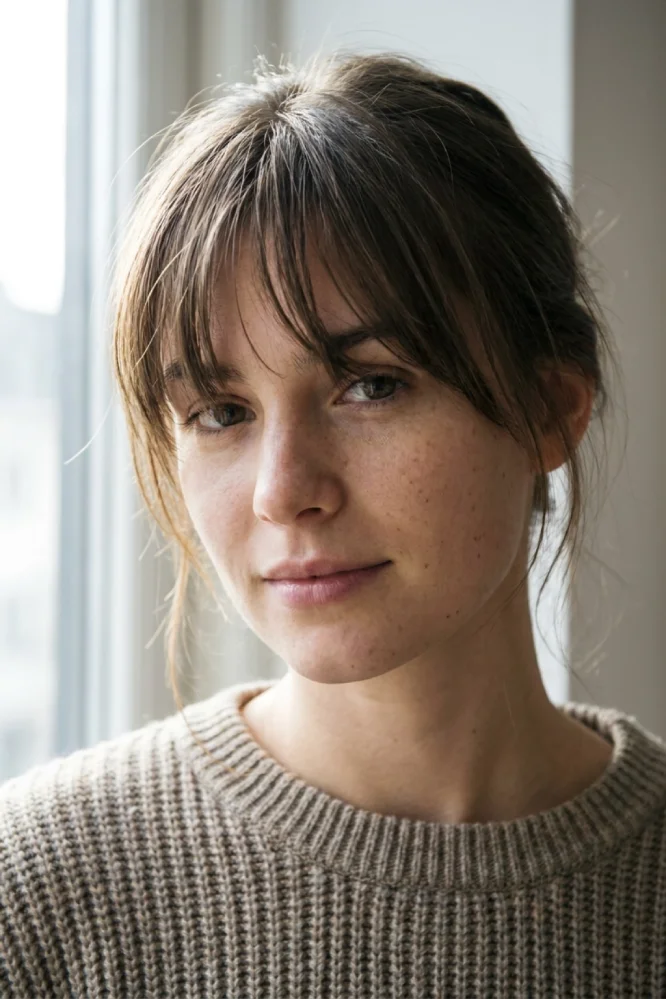
Why they work on every hair type:
- Fine/Straight Hair: Piece separation creates the illusion of more individual strands, adding visual density.
- Thick Hair: Separating thick strands prevents a dense, blocky look and gives each section breathing room.
- Wavy Hair: Natural texture enhances piece definition with organic separation.
- Curly Hair: Curl definition naturally separates pieces; a light pomade enhances individual sections.
Best face shapes: Oval and heart, where separated strands draw attention to the eyes and create a soft, approachable frame.
13. Braided Bangs
Instead of cutting, braids create the forehead-framing effect. Short braids sweep across the forehead like traditional bangs; long braids can be tucked into loops for faux fringe — a technique that pairs beautifully with protective styles and natural textures.
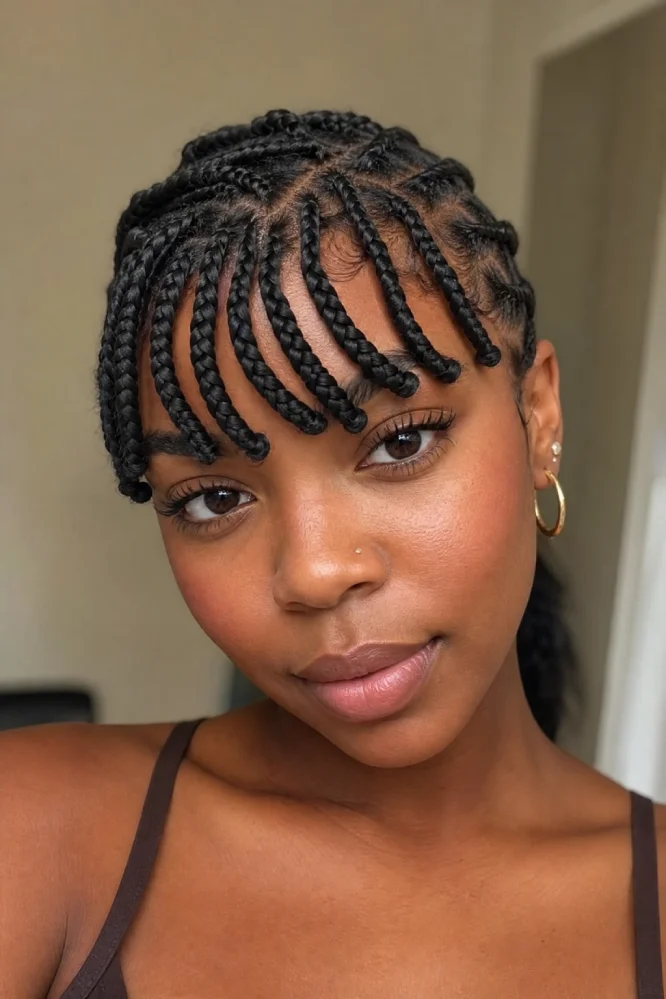
Why they work on every hair type:
- Straight/Wavy Hair: Small braids pinned across the forehead create a bohemian, festival-inspired look with no scissors required.
- Curly/Coily Hair: Integrates naturally with locs, twists, cornrows, and other protective styles as a creative, commitment-free option.
- Thick Hair: Braids hold structure well on dense hair, creating bold, visible braided fringe.
Best face shapes: Universally flattering — the braided texture adds interest without the geometric commitment of cut bangs.
14. Feathered Bangs
Ultra-light strands with tapered, wispy ends create a soft gradient effect — more suggestion than statement, and more graduated and airy than wispy bangs.
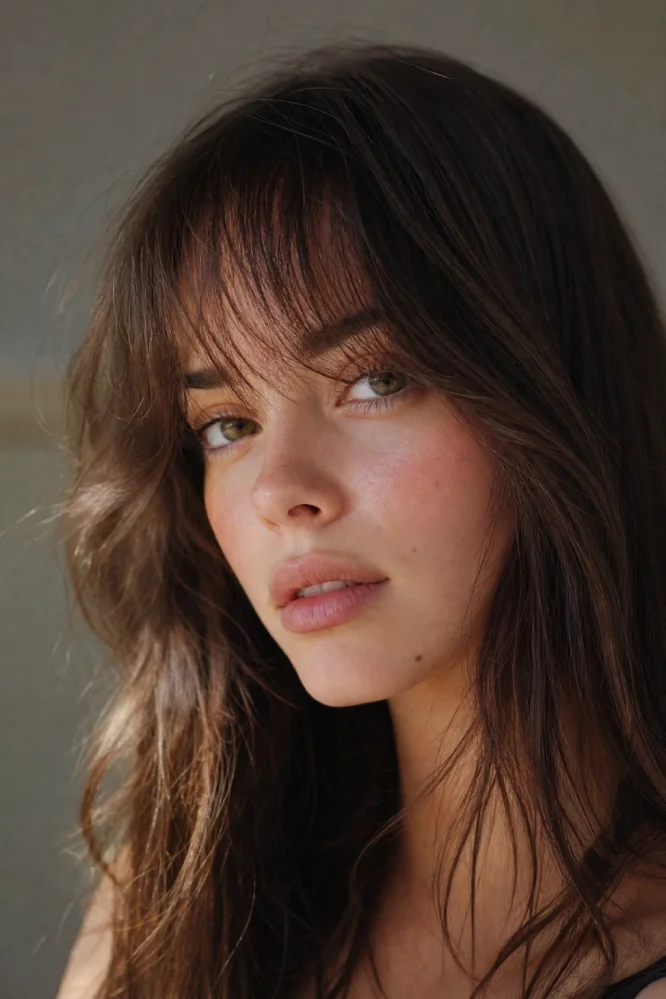
Why they work on every hair type:
- Fine/Straight Hair: Feathered ends add movement without removing density, keeping fullness while adding airiness.
- Thick Hair: Feathering removes weight from the surface for lighter, more manageable bangs.
- Wavy Hair: Natural wave through feathered strands creates a graceful waterfall effect.
- Curly Hair: Feathered tips reduce bulk at the ends, preventing the triangular shape dense curls can create.
Best face shapes: Square, heart, and round — the gentlest framing option available.
15. Clip-In Bangs
Hair extensions designed as temporary, removable bangs attach via small clips at the hairline — on in the morning, off at night. No cutting, no commitment, no risk.

Why everyone should try them first:
Clip-in bangs solve the biggest barrier to getting fringe: fear. A 2024 Allure survey found that 47% of women who considered bangs decided against them, mainly out of fear of regret. Clip-ins let you test-drive any style — length, texture, placement — before committing to scissors.
How to choose the right clip-in for your hair type:
- Fine/Straight Hair: Choose human hair clip-ins that match your density; synthetic options may look too thick.
- Thick Hair: Look for higher-density clip-ins that match your natural volume.
- Curly/Coily Hair: Seek textured clip-ins that match your curl pattern — many brands now offer 2C through 4C options.
How to Maintain and Trim Your Bangs
Trim frequency depends on bang length and style.
| Bang Style | Trim Frequency | Why |
|---|---|---|
| Micro Bangs | Every 2 weeks | Shortest length shows growth fastest |
| Blunt Bangs | Every 2 weeks | Sharp line dulls quickly with growth |
| Wispy Bangs | Every 2 to 3 weeks | Light density grows out visibly |
| Curtain Bangs | Every 3 to 4 weeks | Gradual length hides regrowth |
| Side-Swept Bangs | Every 3 weeks | Diagonal line shifts with growth |
| Layered Bangs | Every 4 weeks | Multiple lengths disguise growth |
| Shaggy Bangs | Every 5 to 6 weeks | Messy texture forgives regrowth |
Essential Tools for Bang Care
Every bang owner needs these five items:
- A quality round brush for daily blow-dry shaping
- A lightweight dryer — the Revlon One-Step is an affordable option; the Dyson Airwrap is premium
- Heat protectant spray, essential before any heat styling
- Dry shampoo for oil control between washes
- Sharp hair-cutting scissors for minor at-home dusting (never kitchen scissors)
Washing and Drying Tips
Bangs touch your forehead constantly and absorb oil faster than the rest of your hair, so they need more frequent washing. Wash every 2 to 3 days with a sulfate-free shampoo to prevent dryness. Pat gently with a microfiber towel — never wring — and air-dry or blow-dry on low heat.
Reviving Flat or Greasy Second-Day Bangs
The morning revival routine takes under three minutes:
- Mist bangs lightly with water from a spray bottle.
- Apply a small amount of dry shampoo at the roots.
- Blow-dry using a round brush for 60 seconds.
- Set with a cool shot of air.
- Finish with a pea-sized amount of finishing cream for hold.
When to Visit a Salon vs. DIY Trim
Visit the salon for shape changes, length adjustments, and first-time trims. DIY dusting is fine for removing split ends between appointments — use sharp professional scissors only, cut less than a quarter inch, and cut into the ends vertically, never horizontally.
Conclusion
Bang haircuts exist for every hair type — fine, thick, straight, wavy, curly, and coily. The barrier isn’t your hair; it’s knowledge.
Know your face geometry, respect your natural texture, and start with a low-commitment option if you’re nervous — clip-in bangs let you try before you commit to scissors.
The 15 styles above range from bold micro bangs to barely-there feathered fringe, each adapted for multiple hair types and face shapes. Save this guide for your next salon visit, discuss the options with your stylist, and remember: the two-week adjustment period is real. Give your new bangs time to settle before judging the result.

