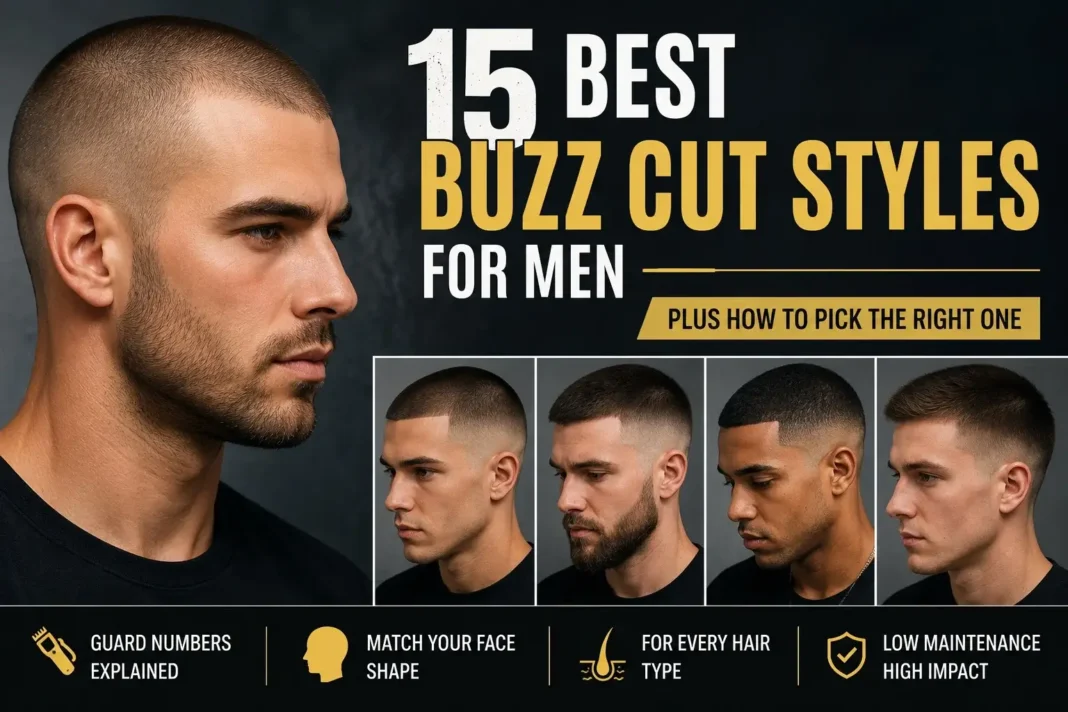
A buzz cut is a short, clipper-cut hairstyle where clippers trim the hair to one length using a guard attachment. Buzz cut styles started in the military, where speed and hygiene mattered more than fashion. Over time, this haircut turned into one of the most requested looks for men in general, worn by athletes, office workers, and anyone who wants a low-maintenance style that never has a bad hair day.
The confusing part isn’t whether to get a buzz cut. It’s figuring out which of the many buzz cut styles actually fits you. The guard number you pick changes the whole result more than the style name does.
This guide covers every major buzz cut style, the exact guard number each one uses, and how to match a style to your face shape, head shape, and hair type.
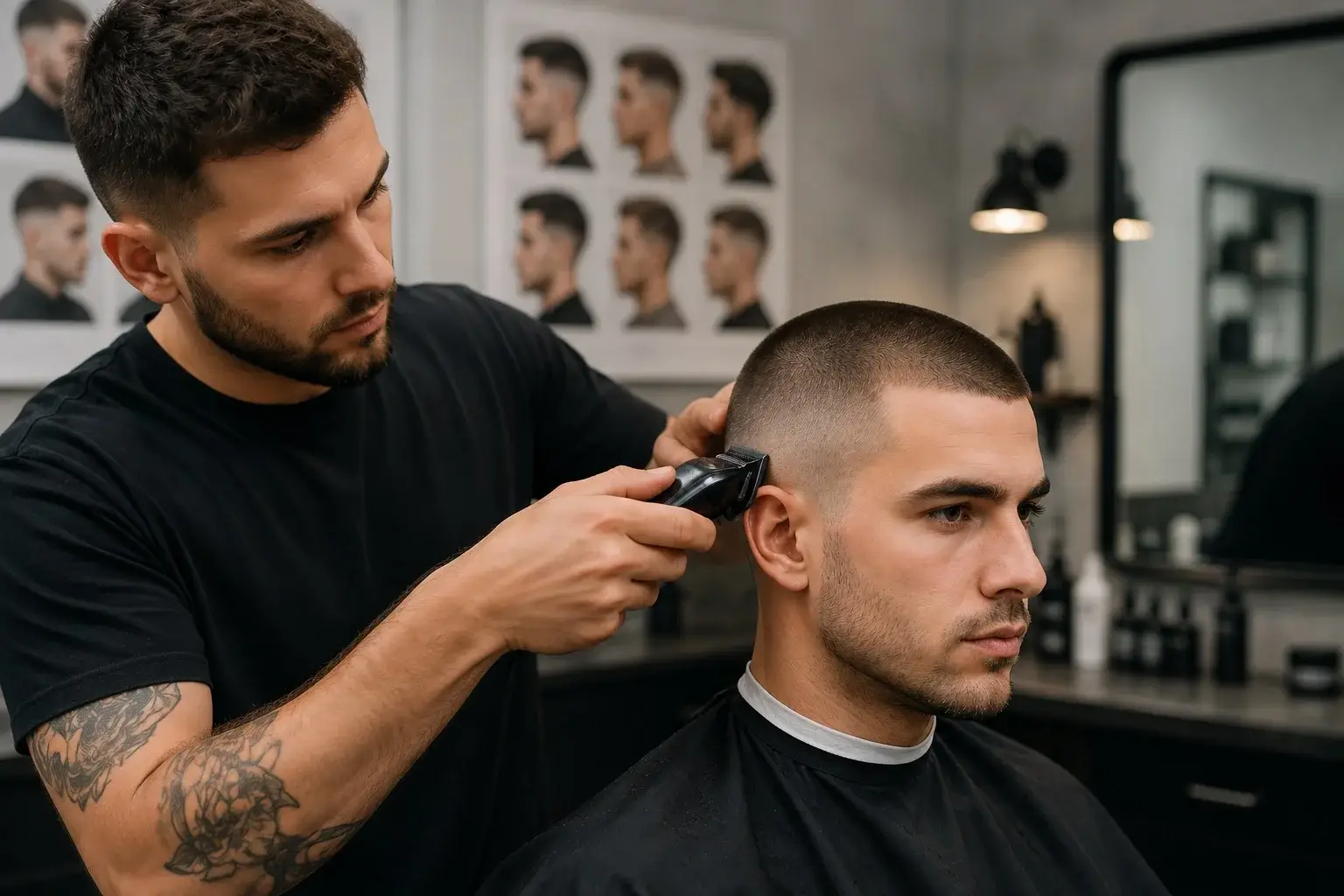
What Guard Number Should You Ask For?
A guard is the plastic attachment that clips onto clippers and controls how much hair stays behind. Here’s what each number actually looks like.
| Guard | Length | What It Looks Like |
|---|---|---|
| #0 | 1/16 inch | Skin visible, almost shaved |
| #1 | 1/8 inch | Light stubble, scalp still shows |
| #2 | 1/4 inch | Short and clean, slight scalp show |
| #3 | 3/8 inch | Reads as a haircut, not a shave |
| #4 | 1/2 inch | The most common buzz cut length |
| #5 | 5/8 inch | Visible texture, softer finish |
| #6 | 3/4 inch | Starts to look like a short crop |
If this is your first buzz cut, ask for a #3 or #4. It’s short enough to be low maintenance, and long enough that the result won’t surprise you. Going shorter next time is easy. Adding length back after cutting too short is not.
What Are the Shortest Buzz Cut Styles?
These are the closest to a full shave. Expect the most scalp exposure and the shortest gap between trims.
1. Induction Buzz Cut Uses a #0 or #1 guard all over, with no fade. This is the classic military cut, and it leaves almost no length anywhere. It suits men with strong facial features, since there’s nowhere to hide.
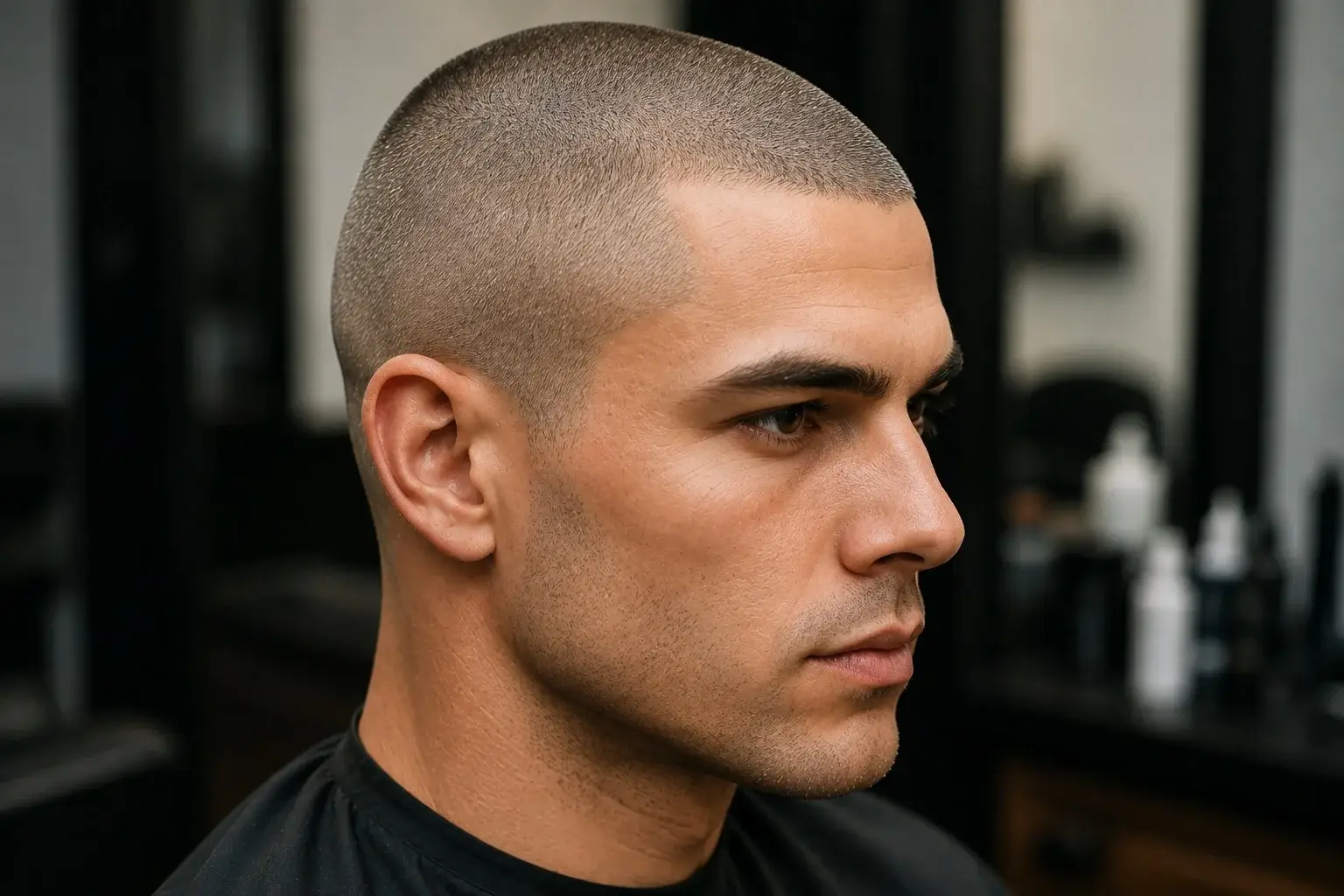
2. Burr Cut One step longer than the induction, at a #1 or #2 guard. There’s just enough length to see hair color and texture, while staying extremely low maintenance.
3. Butch Cut The most requested buzz cut length, using a #3 or #4 guard. It looks like a deliberate haircut rather than a shave and works on nearly every face shape, making it the safest starting point for first-timers.
4. Uniform Buzz Cut A single guard, usually a #2 or #3, covers the entire head with no variation anywhere, including the sides and back. It differs from the butch cut mainly in how strictly even the length stays from front to back, which suits an oval face better than most other shapes.
What Are the Best Buzz Cut Fade Styles?
Fades and high-contrast cuts add shape without adding length. These buzz cut styles pair a short or shaved section with a longer top.
5. High and Tight The sides and back go down to skin, while the top stays slightly longer at a #2 or #3. The sharp contrast works especially well for round or square faces.
6. Jarhead Buzz Cut Similar to a high and tight, but the shaved section runs all the way up to the temple instead of stopping lower down. The contrast between skin and hair is more abrupt, which gives it a blunter, harder-edged look.
7. Buzz Cut Fade This style buzzes the top at a #3 or #4, then fades the sides and back smoothly down to a shorter length or bare skin. It’s one of the most requested modern buzz cut styles.
8. Low Skin Fade The blend point starts just above the ears, giving more coverage on the sides. This suits men who want a fade without a dramatic, high-contrast look.
9. Mid Fade The blend point sits higher, roughly at the temple. Many consider it the most versatile fade since it works with almost any face shape, aside from men thinning heavily on top.
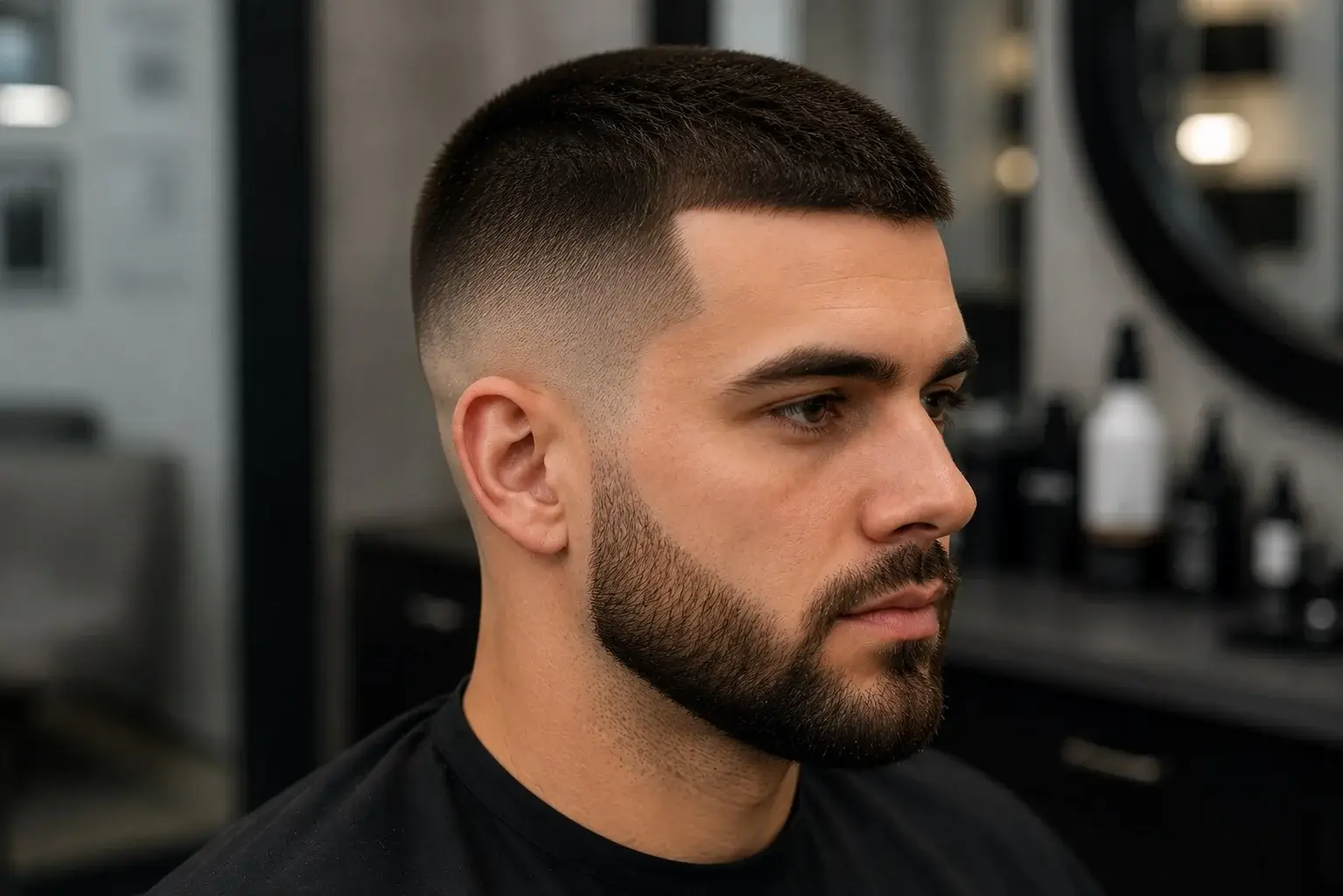
What Are the Longer and More Textured Buzz Cut Styles?
These options leave more length on top, either for softness, texture, or a bit of styling flexibility.
10. Brush Cut Uses a #4 to #6 guard, the longest end of the buzz cut range. Hair stands up slightly at this length and can take a small amount of product if you want it.
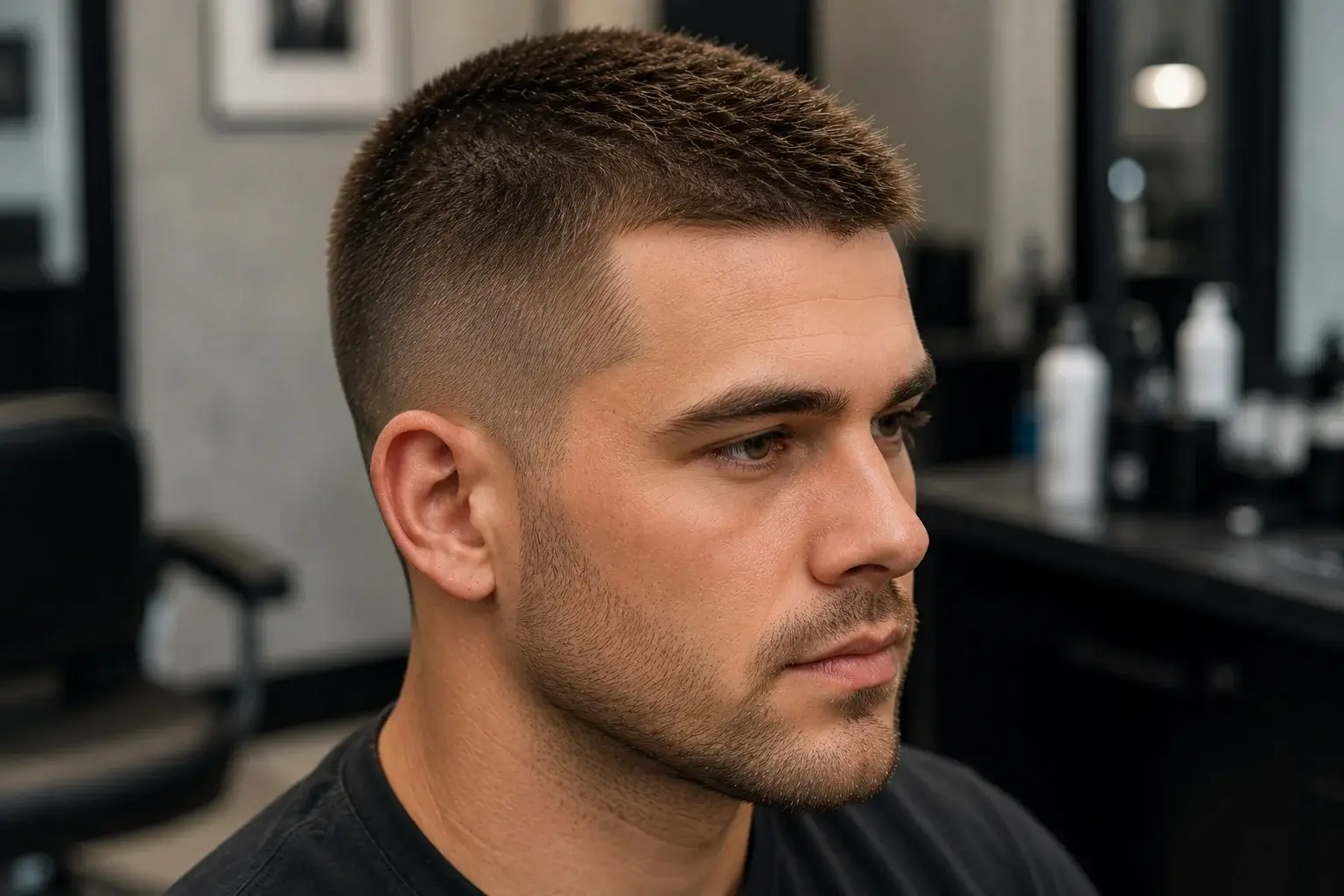
11. Tapered Buzz Cut Instead of a sharp fade, the hair gradually shortens around the neckline and ears. It’s a softer, more natural look than a full fade, and it grows out cleaner too.
12. Disconnected Buzz Cut Skips the blend entirely. There’s a clear, deliberate line between the short sides and the longer top, which creates a bold contrast that isn’t ideal for conservative workplaces.
13. Textured Buzz Cut A barber adds slight variation to the length or direction of the hair on top, usually with scissors, to create dimension. This works especially well on thicker hair, which can look flat with a plain, uniform buzz.
14. Crew Cut Not technically a true buzz cut, since the top stays longer, usually 1 to 2 inches, while the sides taper short. Worth knowing because people often ask for a “buzz cut” when this extra length on top is what they actually want.
15. Caesar Cut A #3 or #4 buzz on the sides, paired with a short, straight fringe on top. This is a strong option if you’re dealing with a receding hairline, since the fringe helps cover the front.
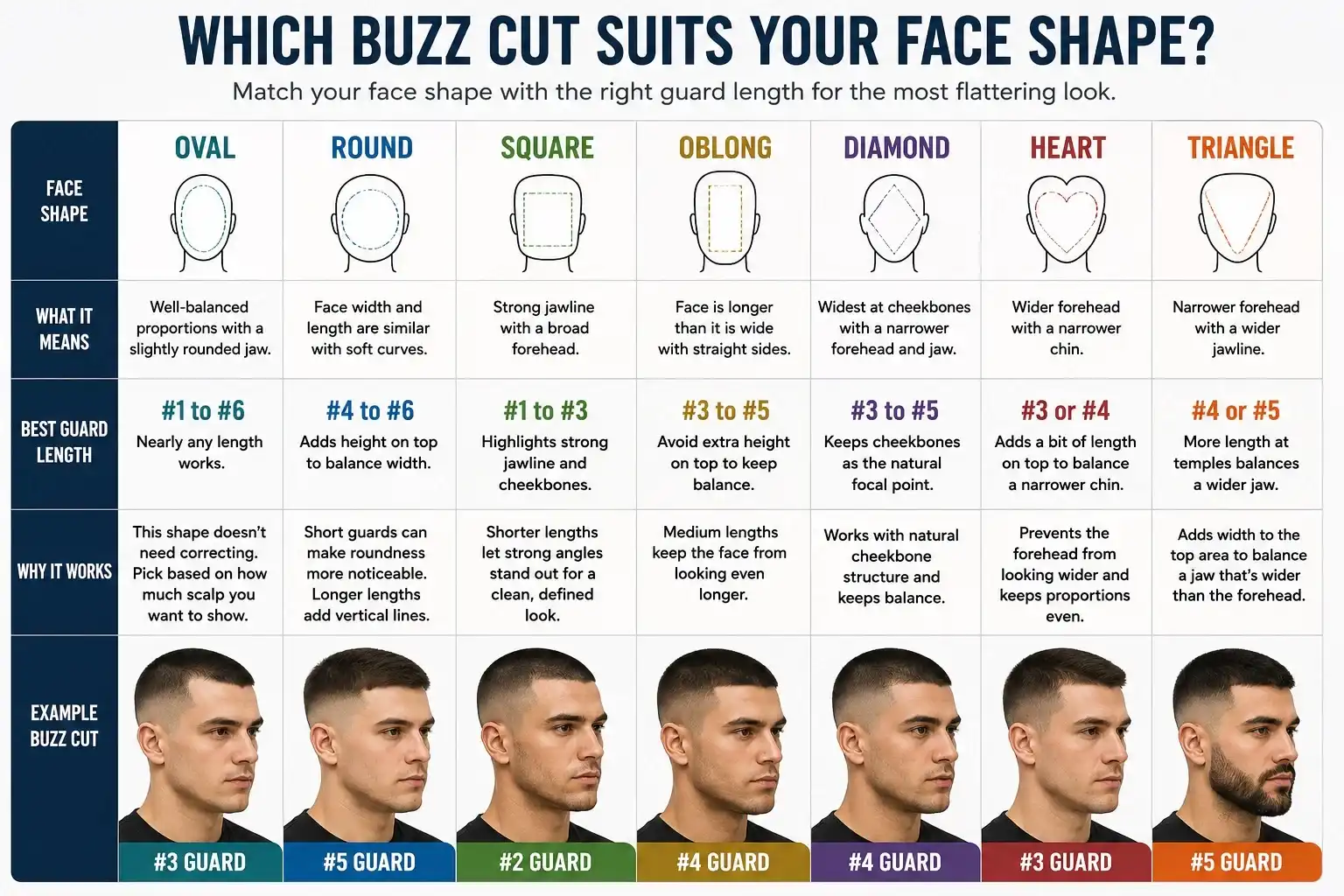
Which Buzz Cut Suits Your Face Shape?
Matching buzz cut styles to your face shape comes down to guard length more than the style name.
Oval face: Nearly any length from #1 to #6 works. This shape doesn’t need correcting, so pick based on how much scalp you want to show.
Round face: Very short guards (#0 to #2) can make roundness more noticeable, since they remove any vertical lines. A #4 to #6 brush cut adds slight height on top, which balances the width.
Square face: Short guards (#1 to #3) let a strong jawline and cheekbones stand out, making this one of the most flattering shapes for a buzz cut.
Oblong face: Stay in the #3 to #5 range and avoid adding extra height on top, since that stretches an already long face further.
Diamond face: A #3 to #5 works well, and shorter lengths are fine too, since this shape keeps the cheekbones as the natural focal point either way.
Heart-shaped face: Very short guards expose the full width of the forehead with nothing to soften it. A #3 or #4 keeps a bit of length on top to balance a narrower chin.
Triangle face: A #4 or #5, with slightly more length at the temples than the sides, helps balance a jaw that’s wider than the forehead.
Does Your Head Shape Matter Too?
Face shape gets most of the attention, but the actual contour of your skull affects how a buzz cut looks from the side and back.
Flat spots or a raised crown show up clearly at very short lengths, since there’s nothing to soften them. A #4 or longer hides these far better than a #0 or #1.
Cowlicks become more visible at short lengths too, since there’s no weight to hold the hair down. A #3 or longer lets the surrounding hair blend a cowlick instead of leaving it as an isolated tuft.
If you’re unsure about your head shape, run a hand over it and feel for flat areas or bumps. If you notice anything, start at a #4 rather than a #0, then go shorter on your next visit once you’ve seen the result.
What’s the Difference Between a Buzz Cut, a Fade, and a Taper?
This mix-up trips up a lot of people, even after several haircuts. A buzz cut is the haircut itself, one length across the whole head. A fade and a taper are techniques for the sides and back, not haircuts on their own.
A fade drops hair down to skin fairly quickly, creating a sharp, high-contrast look. A taper is a slower, more gradual decrease in length that keeps your natural hairline visible instead of shaving down to bare skin. Asking for a fade when you actually wanted a taper can leave you with a much more dramatic result than expected, so it helps to be specific with your barber.
A crew cut is separate from both. It keeps more length on top, blends that into shorter sides, and gives more shape and styling flexibility than a true buzz cut.
How Do You Pair a Buzz Cut with a Beard?
Matching lengths matters more than most people think here.
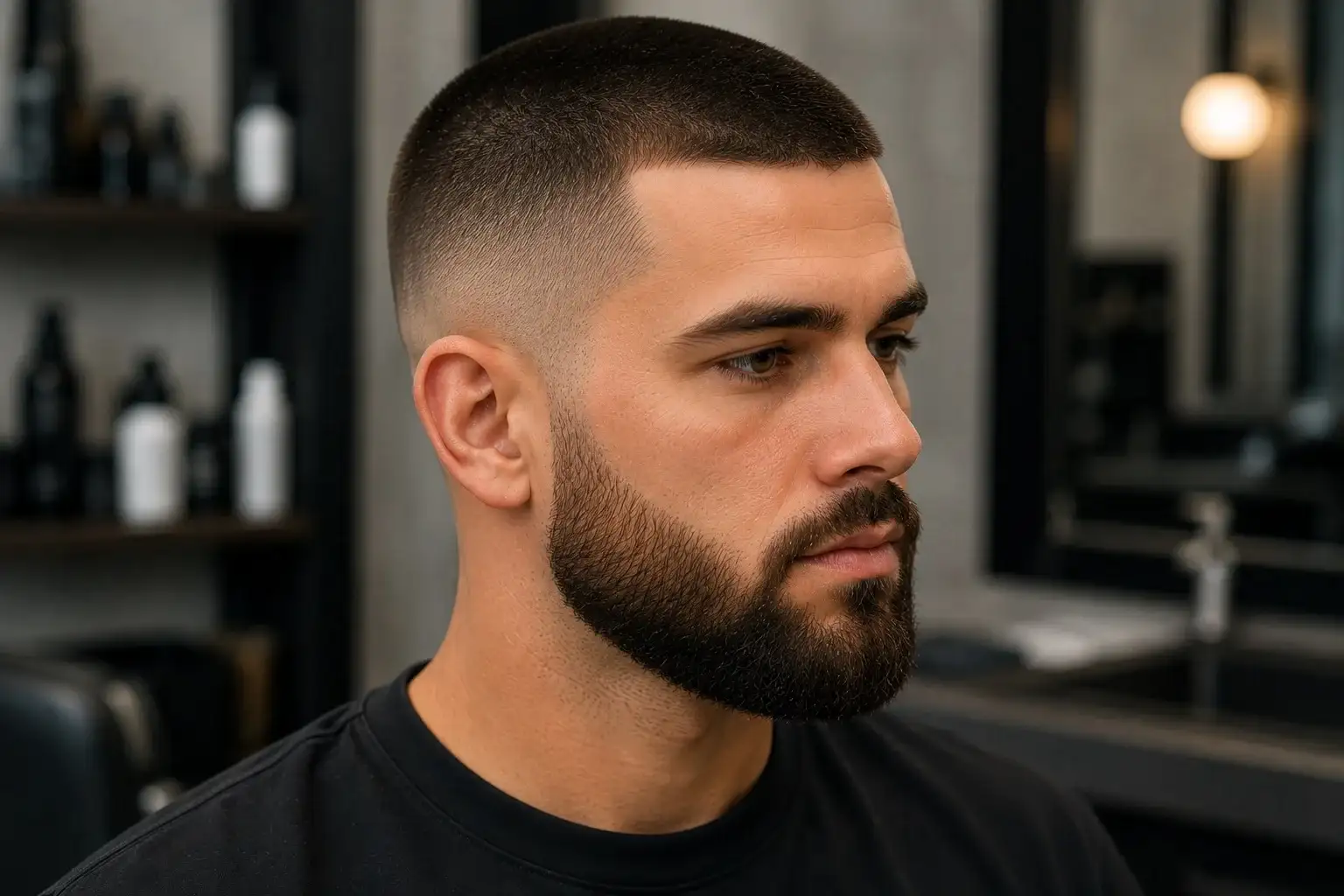
Shorter buzz cuts, in the #0 to #2 range, pair best with stubble or a short, neatly trimmed beard. This keeps your face proportional instead of top-heavy at the jaw.
Longer buzz cuts, from #4 to #6, can handle a fuller beard, since the extra length on top balances the extra volume below. A short buzz with a long, bushy beard tends to look mismatched, so aim for some balance between the two.
Basic beard upkeep still applies. Regular trims, a comb to keep hairs in place, and a beard oil to prevent dryness keep the whole look sharp, not just the haircut itself.
How Do You Take Care of a Buzz Cut?
Low maintenance doesn’t mean zero maintenance. A few habits keep it looking sharp between visits.
Trim on a schedule. Shorter guards, like a #0 or #1, need attention every 1 to 2 weeks. A #4 or longer can usually stretch to 3 to 5 weeks.
Take care of your scalp. Shorter buzz cuts expose more skin, so a light, non-greasy moisturizer helps prevent dryness and flaking. A gentle scalp scrub once a week helps prevent ingrown hairs, especially at very short lengths.
Protect it from the sun. Hair normally blocks some UV rays, and a short buzz cut removes that protection. The American Academy of Dermatology recommends a broad-spectrum SPF 30 or higher on any exposed skin, including your scalp, if you’re spending time outdoors.
Skip the heavy products. Most buzz cuts need nothing at all. If you have a longer brush cut and want texture, a small amount of matte clay or a light salt spray is enough.
Many men also keep a basic set of clippers at home for quick touch-ups between barber visits, especially for shorter guards that grow out fast.
What Happens If You Want to Grow It Out?
Growing out a buzz cut is easier than growing out most short haircuts, since there’s no awkward shape to fight along the way.
In the first four weeks, it still reads as a buzz cut, just slightly longer. Between weeks four and eight, it starts moving into short haircut territory, with enough length for a bit of natural texture. By weeks eight to twelve, there’s usually enough length to start styling it into something new.
Regular trims during this stretch help shape the emerging style instead of letting it grow out shapeless, so it’s worth booking a shaping appointment partway through rather than waiting the full three months.
FAQs
Does a buzz cut look good on a round face?
It depends on the guard length. Very short guards can make roundness more noticeable, while a #4 to #6 brush cut adds slight height that helps balance the shape.
Will a buzz cut work with a receding hairline?
Yes. A uniform length at #2 to #4 removes the contrast between thinning and full areas. A Caesar cut, which keeps a short fringe on top, is a strong option if you want extra coverage at the front.
How often does a buzz cut need to be trimmed?
Every 1 to 2 weeks for a #0 or #1, every 2 to 3 weeks for a #2 or #3, and every 3 to 5 weeks for a #4 or longer.
Final Thoughts
There’s no single “best” buzz cut. The right one among all these buzz cut styles depends on your face shape, your head shape, how your hair grows, and how much upkeep you’re willing to do. Start with a #3 or #4 if you’re unsure, watch how it grows in, and adjust the next time you’re in the chair.
Once you land on the right length and style, a buzz cut is one of the easiest haircuts to stick with. It looks the same every day, takes almost no time to manage, and it’s hard to get wrong once you know the guard number that works for you.

