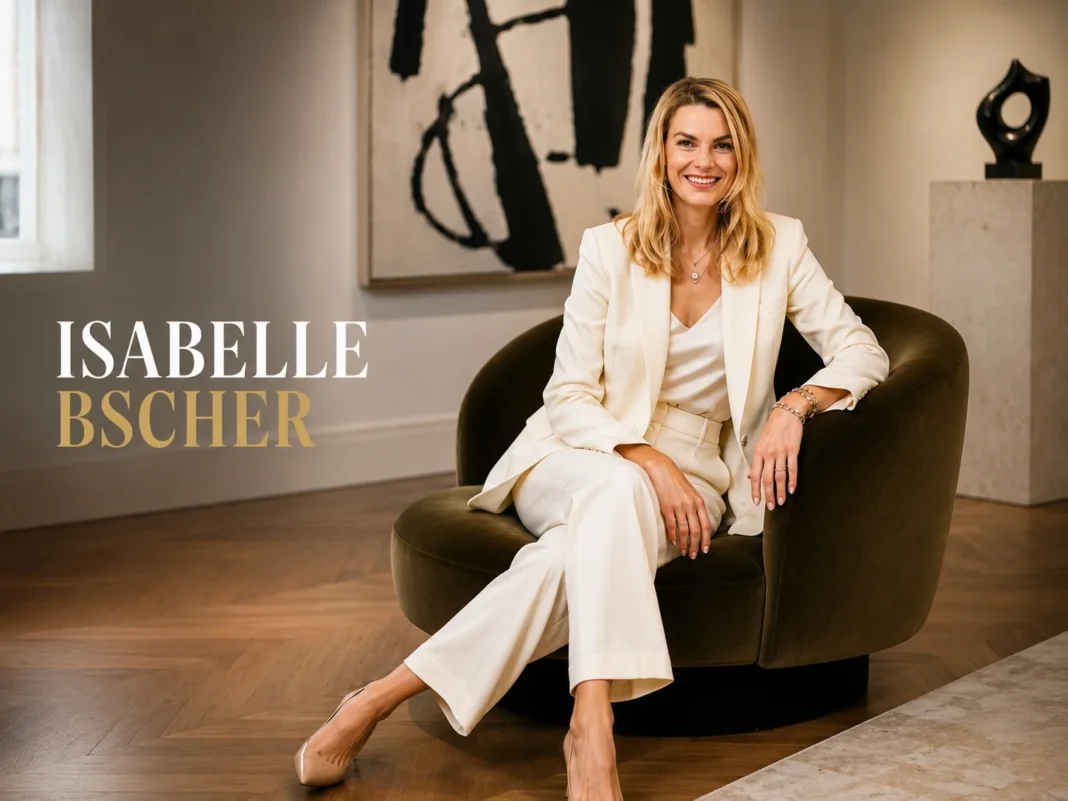
Isabelle Bscher runs the New York arm of Galerie Gmurzynska. The gallery has deep roots in early European modernism. However, over the decades it has widened its focus to postwar and contemporary art. Bscher is the third woman in her family to lead the business. As a result, her name turns up often in art-world coverage, whether for her exhibitions, her collaborators, or the family story behind the gallery itself. Here is what is documented about her background and her work.
Quick Facts About the Gallerist
| Category | Details |
|---|---|
| Role | Gallerist, Galerie Gmurzynska (leads the New York program) |
| Family position | Third generation, after her grandmother and her mother |
| Locations | Two spaces in Zurich, one in Zug, one in New York’s Fuller Building |
| Education | Studied contemporary art in London and New York; holds a master’s degree from Sotheby’s Institute of Art |
| Focus areas | Early 20th-century modernism, Russian avant-garde, postwar and contemporary art |
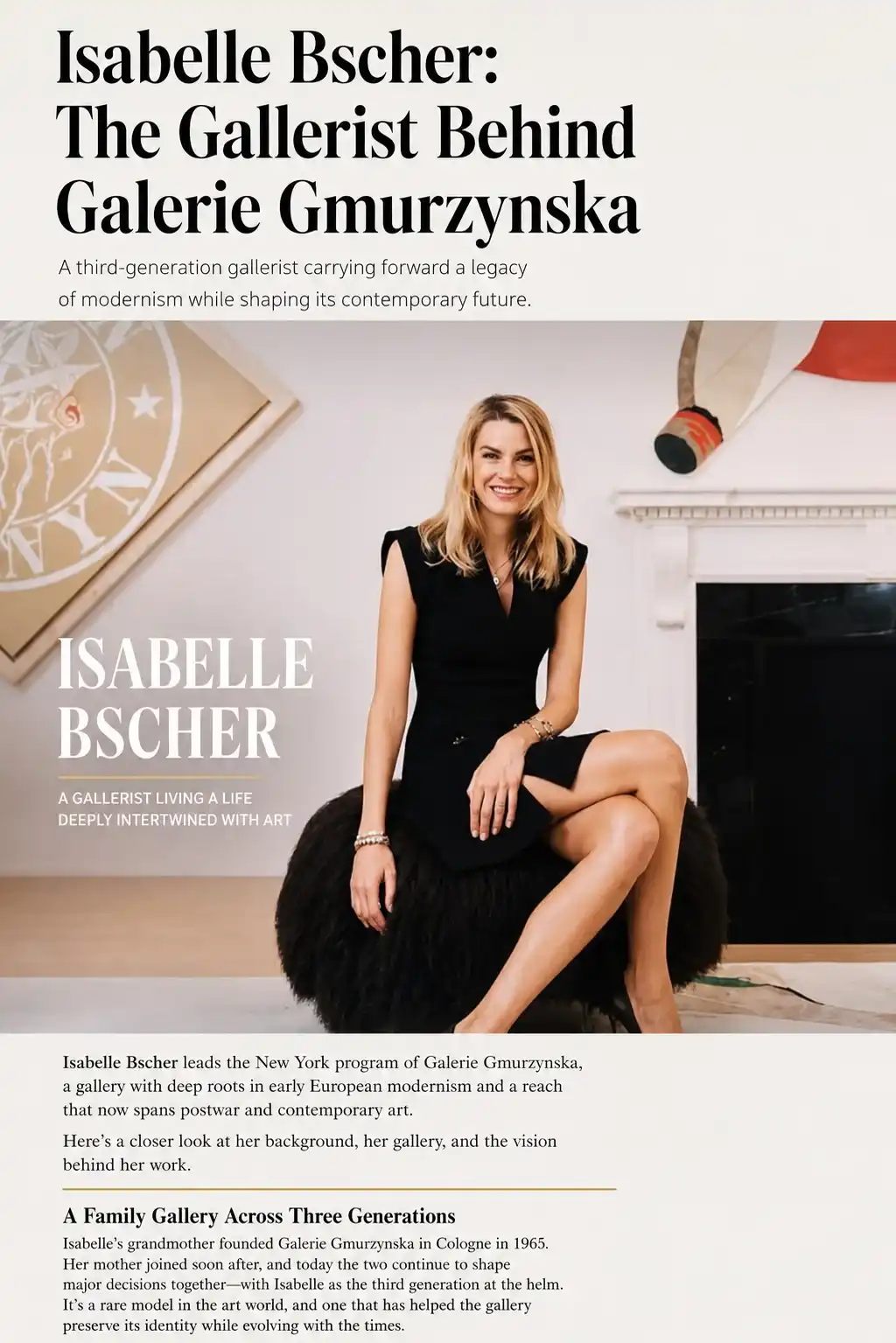
A Family Gallery Across Three Generations
Bscher’s grandmother founded Galerie Gmurzynska in Cologne in 1965. Her mother later joined the business. Today, the two women still work through major decisions together, though not always smoothly. Bscher has described the relationship as a mix of the “best of times” and the “worst of times.” In fact, she has said it may be the only gallery run by three straight generations of women.
That structure shaped the early collection, which leaned toward Surrealism and the Russian avant-garde. Meanwhile, it also remains a throughline the gallery still uses to explain its identity today.
Isabelle Bscher’s Early Life and Education
Bscher grew up in Cologne, next door to the gallery’s original space, and spent her afternoons there after school. She has joked that she took her first steps at an art fair, either Basel or FIAC. Similarly, she recalls a school trip to a Yves Klein show that her classmates found scandalous.
She later studied contemporary art in London and New York. After that, she earned a master’s degree in art history from Sotheby’s Institute of Art. At 22, she began working at the gallery full time. One of her first projects was co-organizing a show with photographer Hedi Slimane. Not long after, she helped launch the gallery’s Zurich space with an Alexander Calder exhibition.
Family Beyond the Gallery
Bscher’s father, Dr. Thomas Bscher, is a banker who also raced competitively. For instance, he won the GTR Euroseries championship with McLaren in 1998, before later becoming CEO of Bugatti.
Her godfather, Baron Hans Heinrich Thyssen, was a Swiss industrialist. His private art collection was counted among the largest in the world, said by some to rival the British royal family’s holdings.
Her great-grandfather, Robert Pferdmenges, was a German banker who became a partner at Oppenheim Bank around 1930. Under Nazi rule, Oppenheim’s Jewish owners were forced out, and the bank was renamed after him. After the war, however, Pferdmenges handed the bank back to the Oppenheim family. This made it one of only two seized Jewish-owned businesses restored to their original owners. He then became an influential figure in West German politics, helping Konrad Adenauer become the country’s first postwar chancellor and co-founding the Christian Democratic Union. Oppenheim Bank itself operated until 2010, when Deutsche Bank acquired it.
Growing Galerie Gmurzynska Into a Global Gallery
Galerie Gmurzynska now operates four locations: two in Zurich, one in Zug, and one in New York. The New York space opened on the Upper East Side in 2018. More recently, the gallery has been preparing a new Manhattan space to mark its 60th anniversary, timed to a celebration this September, with a library designed by Jil Sander.
The gallery’s current New York exhibitions run out of the Fuller Building on Madison Avenue. This building has its own art history, having once housed the Pierre Matisse Gallery in the 1940s.
Beyond its founding focus on modernists like Kandinsky, Miró, and Picasso, the roster has grown over time. It now includes Robert Indiana, Louise Nevelson, Marjorie Strider, Tom Wesselmann, James Turrell, and the estate of Yves Klein. Additionally, the gallery shows photography by Karl Lagerfeld and paintings by Sylvester Stallone, alongside work by architects Zaha Hadid and Richard Meier.
Bscher’s Notable Collaborations
Zaha Hadid. Hadid wrote her academic thesis on the Russian avant-garde, a subject the gallery had specialized in early on. She curated a show pairing her own work with pieces from Bscher’s mother’s collection, split into black and white sections. Later, she designed the architecture of one of the gallery’s own spaces, along with a Kurt Schwitters exhibition in Zurich.
Baz Luhrmann. For an Art Basel Miami presentation, Luhrmann built a classroom-style booth around the idea that “my kid could have done that.” He used works by Kandinsky and Cy Twombly to make the opposite case.
Sylvester Stallone. Bscher curated a retrospective of Stallone’s five-decade painting career, titled “Painting for 55 Years,” at the Osthaus Museum in Hagen, Germany. The gallery began representing his paintings after he bought work from the Zurich space roughly twelve years earlier.
Joan Miró at Villa Paloma. Bscher co-curated a Miró exhibition at Monaco’s New National Museum, developed with Prince Albert’s involvement. It included previously unshown works and drew the highest visitor numbers in the museum’s history, during the height of the Covid pandemic.
Karl Lagerfeld. While not a formal collaboration, Bscher has called Lagerfeld one of the wittiest people she has known. She recalls his quip that having a tattoo is “like spending your whole life in a Pucci dress.”
Current Exhibition: Picasso and Wifredo Lam
Bscher’s most recent major project, “Lam/Picasso,” runs at the Fuller Building location through June 30, 2026. It is the first exhibition to bring the two artists together since a 1939 show at New York’s Perls Gallery.
The exhibition traces a friendship that began in Paris in May 1938, when Lam arrived with a letter of introduction from Salvador Dalí. Picasso reportedly told Lam he must carry his blood, calling him a cousin. The show includes roughly 50 works spanning 1918 to 1978, including paintings, frescoes, ceramics, and collages. Highlights include rare frescoes from Picasso’s 1918 honeymoon in Biarritz and Lam’s 1943 piece “Étude pour La Jungle.”
The location carries its own resonance. Between 1940 and 1946, Picasso and Lam both showed at the Pierre Matisse Gallery, which occupied the same Fuller Building. In addition, the exhibition includes a fashion component built with designer Rachel Scott of Diotima, a winner of the 2023 LVMH Prize, whose pieces draw on Lam’s jungle-inspired imagery. A 350-page scholarly book on the Picasso-Lam relationship, with new research by art historian Jérôme Neutres, accompanies the show.
Public Profile
Lifestyle coverage has dubbed Bscher “the world’s most glamorous gallerist.” Still, that label sits alongside, rather than in place of, the gallery’s academic approach to its exhibitions, which she has framed as a point of pride.
Frequently Asked Questions
Where is Galerie Gmurzynska located? The gallery has two spaces in Zurich, one in Zug, Switzerland, and a New York location in the Fuller Building on Madison Avenue.
What kind of art does Isabelle Bscher focus on? Her program centers on early 20th-century modernism and the Russian avant-garde. Over time, it has expanded to include postwar and contemporary artists, architects, and photographers.
How did Galerie Gmurzynska start? Bscher’s grandmother founded the gallery in Cologne in 1965. It has stayed in the family since, now led by three consecutive generations of women.
What is Isabelle Bscher’s educational background? She studied contemporary art in London and New York and holds a master’s degree in art history from Sotheby’s Institute of Art.
What is Isabelle Bscher currently working on? Her current major project is “Lam/Picasso,” an exhibition at the gallery’s Fuller Building space running through June 30, 2026.
Conclusion
Isabelle Bscher’s career is closely tied to the gallery she grew up inside of. She took over a program built by her grandmother and mother, and kept its original grounding in modernism and the Russian avant-garde. From there, she pushed it toward postwar and contemporary work, unexpected collaborators, and a stronger New York foothold. Whether she is placing Zaha Hadid’s architecture inside the gallery walls or reuniting Picasso and Wifredo Lam for the first time since 1939, her projects tend to follow one pattern: serious art history, presented in a way that still draws a wider audience. Given that track record, her next move is worth watching.

