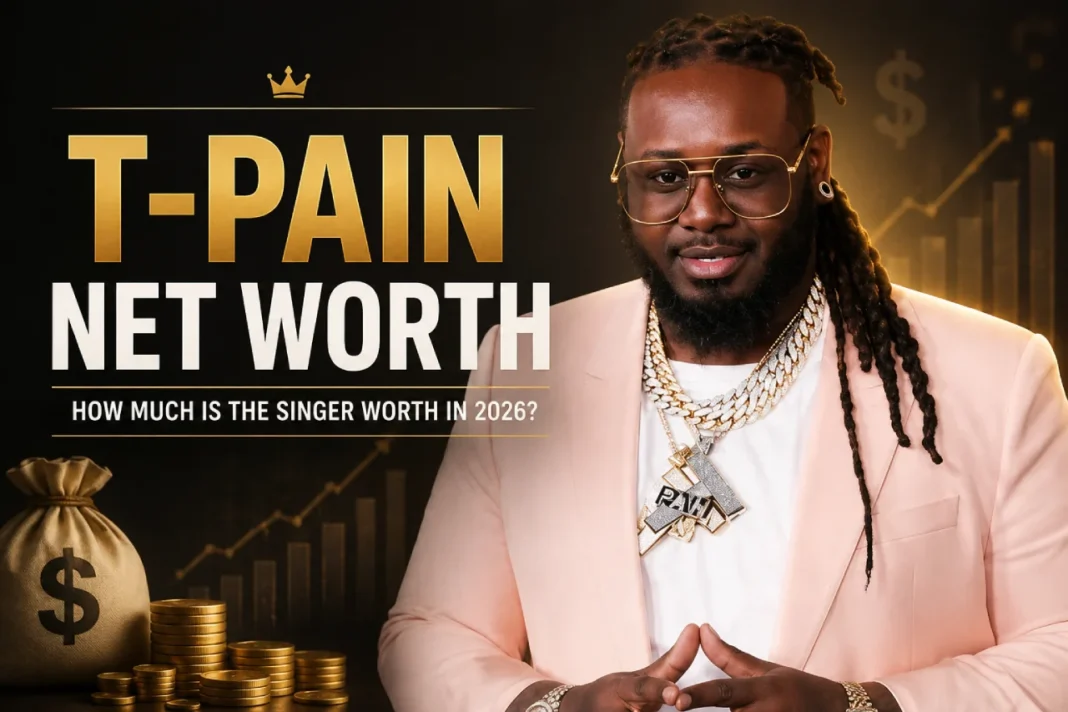
T-Pain, born Faheem Rashad Najm, is one of the most influential figures in modern hip-hop and R&B. His signature Auto-Tune sound defined an era of music. However, in 2026, people are asking a different question: how much is T-Pain actually worth?
The answer is complicated. As of 2026, Celebrity Net Worth estimates T-Pain’s baseline net worth at $10 million. Still, that figure doesn’t tell the whole story. In February 2025, T-Pain sold his music catalog to HarbourView Equity Partners for a reported $100 million, according to Music Business Worldwide. As a result, that one-time deal dramatically changed his financial picture.
His financial journey is one of the most compelling in music. T-Pain went from a $40 million peak to nearly zero, then rebuilt his wealth through Twitch streaming, sponsorships, and business ventures. Today, according to interviews with Yahoo Entertainment and HipHopDX, he makes more money playing video games than he does from music.
Here’s a complete breakdown of T-Pain’s net worth, income sources, and financial journey in 2026.
T-Pain Net Worth Overview (2026 Estimate)
Current Estimated Net Worth
As of 2026, Celebrity Net Worth places T-Pain’s baseline net worth at $10 million. This figure reflects his assets before the major catalog sale, so it’s now outdated.
In February 2025, T-Pain sold his publishing catalog and select master recordings to HarbourView Equity Partners for a reported $100 million, per Music Business Worldwide and According2HipHop. Because of this deal, his financial position changed fundamentally. Taxes on the sale, investment decisions, and ongoing business spending all affect how much of that $100 million remains, so nobody has publicly confirmed his precise current net worth. Even so, one thing is clear: the catalog sale gave him a liquidity event most working musicians never see.
Why Estimates Vary
You’ll find very different net worth figures for T-Pain across the internet. Here’s why:
Pre-sale vs. post-sale figures. Many sites haven’t updated their content since before the February 2025 catalog sale. Consequently, they still cite the older $10 million baseline without accounting for the deal.
Private financial information. T-Pain is a private individual who hasn’t publicly disclosed his exact bank balances or investment portfolio. Therefore, every published figure — including this one — draws on known income sources and reported deals rather than confirmed data.
Different methodologies. Some sites calculate net worth from liquid assets only; others factor in business valuations and royalty streams, which produces very different totals.
Overall, because T-Pain hasn’t confirmed a post-sale figure, the honest answer is that his current net worth is meaningfully higher than the $10 million baseline. That said, any single precise number circulating online is an estimate, not a confirmed fact.
T-Pain’s Net Worth Timeline
| Year | Milestone | Financial Status |
|---|---|---|
| 2005 | Debut album Rappa Ternt Sanga released | Career begins |
| 2007–2010 | Peak commercial success; two Grammy wins | ~$40 million (per People) |
| Early 2020s | Financial low point disclosed in interviews | Bank balance near zero (per People) |
| 2022–2024 | Twitch streaming career grows | Twitch income begins exceeding music income (per Yahoo Entertainment) |
| February 2025 | Catalog sold to HarbourView Equity Partners | $100 million lump sum (per Music Business Worldwide) |
| 2026 | Current baseline estimate | $10 million pre-sale figure (per Celebrity Net Worth) |
Income Sources Breakdown
T-Pain’s income comes from five main sources:
| Source | Type | Estimated Value | Recurring? |
|---|---|---|---|
| Music Royalties | Streaming/Sync | $1–2M/year (pre-sale) | Yes |
| Twitch Streaming | Platform + Sponsorships | $1.5M+/year | Yes |
| Sponsorships | Brand Deals | Variable (e.g., $250K/2hrs) | Per Deal |
| Nappy Boy Businesses | Multi-Vertical | Undisclosed | Yes |
| Catalog Sale | One-Time Asset Sale | $100M (2025) | No |
Music Royalties & Streaming
Before the catalog sale, T-Pain earned an estimated $1 million to $2 million annually from music royalties. This income came from streaming platforms, radio play, and sync licensing for TV, film, and video games.
He has sold over 50 million singles and generated billions of streams, according to figures Apple Music’s artist page reports. Songs like “Buy U a Drank,” “Bartender,” and “Low” still generate royalties decades later. Even so, streaming pays artists very little per play — a point T-Pain has raised publicly, per ArtistDirect’s reporting on his reasons for selling.
After the HarbourView sale, those royalty streams now belong to the buyer. Because of this, T-Pain no longer earns ongoing royalties from the songs in the deal — instead, he received the $100 million lump sum.
Twitch Streaming Earnings
In an interview with Yahoo Entertainment and HipHopDX, T-Pain revealed he earns between $50,000 and $60,000 per hour streaming on Twitch — a figure that stunned the music industry when it first circulated.
The earnings come primarily from sponsorships rather than direct fan payments. Companies pay T-Pain to play games or simply appear on stream while their brand is featured. For example, a single 7-Eleven sponsorship paid him $250,000 for two hours of streaming, according to widely cited reporting.
In fact, T-Pain has said that over a four-year period, his Twitch earnings exceeded his music income — a striking shift for an artist who defined a musical era.
Sponsorships & Brand Deals
Beyond Twitch, T-Pain has partnered with brands including Red Bull, Corsair, and Temu, according to reporting from Spilled.gg. The 7-Eleven deal remains the most concrete example: $250,000 for two hours works out to roughly $125,000 per hour.
His sponsorship style is organic — he mentions products naturally during streams rather than doing scripted reads. This authenticity is part of why brands pay premium rates for his audience.
Nappy Boy Business Empire
T-Pain’s company, Nappy Boy, has expanded well beyond music. The brand now includes four divisions:
- Nappy Boy Entertainment — his music label
- Nappy Boy Automotive — custom car modification and design
- Nappy Boy Gaming — interactive entertainment and streaming
- Nappy Boy Dranks — beverage development and distribution
The company operates out of a 50,000-square-foot warehouse in Tallahassee, Florida, according to According2HipHop. T-Pain hasn’t publicly disclosed revenue from these ventures, but the physical expansion signals real investment.
Music Catalog Sale (One-Time)
The $100 million HarbourView deal is T-Pain’s largest single financial transaction. Unlike his other income sources, it was a one-time asset sale — he gave up future royalty payments in exchange for an upfront sum, which he has described as a generational wealth strategy for his children.
T-Pain’s Music Catalog Sale to HarbourView
Deal Details
In February 2025, T-Pain sold his publishing catalog and select master recordings to HarbourView Equity Partners, according to Music Business Worldwide. Music Business Worldwide reported the deal at approximately $100 million, though the parties didn’t publicly disclose exact terms.
HarbourView is a major player in music IP investment. Per industry reporting on LinkedIn, the firm has acquired more than 60 catalogs totaling roughly 29,000 songs, with assets under management around $1.45 billion. Notably, the T-Pain catalog includes rights to hits like “Buy U a Drank,” “I’m Sprung,” and “Bartender.”
Why He Sold
T-Pain discussed his reasoning in interviews that According2HipHop cited, including on the Storytime with Legendary Jerry podcast. As ArtistDirect reported, his primary motivation was dissatisfaction with streaming economics — what he’s called “streaming devaluation.” A song can generate hundreds of millions of streams but earn the artist only a fraction of what physical sales once produced. Therefore, selling converted that uncertain future income into a guaranteed lump sum.
His second stated reason was family security: securing his children’s financial futures rather than depending on unpredictable royalty income.
Industry Context
T-Pain’s sale is part of a broader trend. Artists including Jay-Z, Bruce Springsteen, and Justin Bieber have all sold portions of their catalogs in recent years, as music IP has become a sought-after investment asset class. In addition, T-Pain isn’t the first 2000s-era hip-hop and R&B artist to build wealth outside traditional royalties — peers like Akon expanded into business ventures for similar reasons.
For artists, the trade-off is straightforward: give up long-term royalty upside for immediate, guaranteed cash, plus the tax and estate-planning benefits of converting future income into a present-day asset. Meanwhile, for investors like HarbourView, it’s a bet on a catalog’s long-term streaming and licensing revenue. For T-Pain specifically, the deal removed a major source of financial uncertainty from his life.
How Much T-Pain Makes on Twitch
Earnings Breakdown
T-Pain’s reported $50,000–$60,000-per-hour Twitch earnings, per Yahoo Entertainment, come mostly from sponsorships rather than fan subscriptions or donations. For instance, if he streams 20 hours in a month at even the low end of that rate, that’s roughly $1 million — before accounting for platform fees and taxes.
Twitch vs. Music Earnings at a Glance
| Music (Pre-Sale) | Twitch Streaming | |
|---|---|---|
| Estimated earnings | $1M–$2M per year | $1.5M+ per year |
| Who controls the revenue split | Record label (T-Pain’s early deal: 15%) | T-Pain directly |
| Notable single example | Decades-old catalog royalties | $250,000 for one 7-Eleven stream (2 hours) |
| Reported by | Apple Music, ArtistDirect | Yahoo Entertainment, HipHopDX |
Why Twitch Pays More Than Music
T-Pain has explained this gap in interviews: his first record deal gave him a $40 million advance, but under a 15/85 split, he kept only 15% of earnings. This was a common structure for 2000s-era label deals, where the artist had to earn back the advance before seeing additional income.
On Twitch, however, he owns the channel outright. The platform takes a cut, but the rest goes to him directly. That’s why a single two-hour sponsorship can outearn months of music royalties.
Notable Sponsorships
Beyond 7-Eleven, T-Pain’s sponsors include Red Bull and Corsair — both natural fits for his gaming persona — and Temu, according to Spilled.gg. These deals typically involve product placement, co-branded streams, or social promotion rather than one-off ads.
Nappy Boy Entertainment & Business Ventures
Nappy Boy Entertainment (Music Label)
T-Pain founded Nappy Boy Entertainment in 2005. The label has signed artists including Travie McCoy and Field Mob and served as the release vehicle for T-Pain’s own music. However, it hasn’t been without conflict: T-Pain sued Cash Money Records for $500,000 in unpaid royalties linked to a distribution deal, according to Stereogum.
Nappy Boy Automotive
A passionate car enthusiast with an interest in drift driving, T-Pain built Nappy Boy Automotive around custom car modification and design — turning a personal interest into a revenue stream.
Nappy Boy Gaming
Nappy Boy Gaming ties into his Twitch presence and broader gaming interests. Notably, T-Pain has confirmed involvement in GTA VI, though he hasn’t detailed his exact role publicly.
Nappy Boy Dranks
The beverage division builds on T-Pain’s earlier energy drink venture, focusing on drink development and distribution. Revenue figures aren’t public.
Recent Expansion
The clearest signs of his financial recovery are recent, tangible acquisitions: the 50,000-square-foot Tallahassee warehouse and a private plane for business use, both of which According2HipHop reported.
T-Pain’s Financial Journey: From $40 Million to Broke to Recovery
Peak Wealth ($40 Million)
T-Pain’s debut album, Rappa Ternt Sanga, dropped in 2005. Hits like “I’m Sprung” and “Buy U a Drank” made him a star, and his Auto-Tune sound influenced a generation of artists. At his peak, his net worth reached roughly $40 million, largely thanks to his first record deal’s advance. During this time, he collaborated widely with artists including Kanye West, Jamie Foxx, Lil Wayne, and Flo Rida.
Financial Challenges
Despite the massive income, T-Pain’s finances unraveled through poor money management — something he’s discussed candidly in interviews People has reported. He revealed his bank balance hit zero at one point and that he once had to ask for money to buy his children burgers. On top of that, the 15/85 label split compounded the problem: he had to earn back the $40 million advance before seeing meaningful additional income, and spending outpaced what came in.
Rebuilding Wealth
T-Pain’s recovery followed a clear pattern:
- Acknowledged the problem. He discussed his financial mistakes publicly rather than hiding them.
- Diversified beyond music. He built a Twitch career that didn’t depend on label deals.
- Built sponsorships. His authentic streaming style attracted premium brand rates.
- Expanded Nappy Boy. The label grew into a multi-vertical business.
- Sold his catalog. The $100 million HarbourView deal converted his music legacy into immediate capital.
Career Highlights & Achievements
Grammy Awards
T-Pain has won 2 Grammy Awards from more than 12 nominations, per Grammy.com and Apple Music: Best Rap Song (2008) for “Good Life” with Kanye West, and Best R&B Performance by a Duo or Group (2010) for “Blame It” with Jamie Foxx. In addition, he’s won 28 BMI Awards, and BMI named him Songwriter of the Year three times, according to its press records.
Hit Songs & Albums
His best-known songs include “I’m Sprung” (2005), “Buy U a Drank” (2007), “Bartender” (2007), “Low” with Flo Rida (2007), “Good Life” with Kanye West (2007), and “Blame It” with Jamie Foxx (2009). Meanwhile, his studio albums span Rappa Ternt Sanga (2005) through The Bluez Brothaz (2024).
Industry Impact
T-Pain didn’t invent Auto-Tune — Antares Audio Technologies developed the software. However, he popularized its creative use in mainstream hip-hop and R&B so thoroughly that fans and critics came to call the style the “T-Pain effect.” Altogether, he’s sold over 50 million singles, generated billions of streams, and logged 10 Billboard Hot 100 number-one hits, per Apple Music’s artist data.
Personal Life & Family
Real Name & Background
T-Pain’s real name is Faheem Rashad Najm. He was born September 30, 1985, in Tallahassee, Florida, and turns 41 in 2026. He still bases his business operations in his hometown rather than Los Angeles or New York.
Family
T-Pain is married to Amber Najm, and the couple has three children. In discussing the catalog sale, he emphasized that securing his children’s futures was a primary motivation, per According2HipHop’s reporting on the deal.
Lifestyle
T-Pain was previously outspoken about avoiding private jets for cost reasons. Since then, however, recent reports indicate he’s acquired a private plane as part of his business expansion — a shift reflecting his improved financial position after the catalog sale.
Future Outlook & Projects
T-Pain’s Nappy Boy empire continues expanding from its Tallahassee base, with the warehouse providing infrastructure across gaming, automotive, and entertainment divisions. He’s also confirmed involvement in GTA VI, though he hasn’t detailed his specific role publicly.
Beyond business, he’s become a public voice for artist ownership and fair streaming compensation — using his own journey from $40 million to near-zero to recovery as a cautionary tale and a blueprint for other artists navigating the modern music business.
FAQs
What is T-Pain’s net worth in 2026?
Celebrity Net Worth estimates T-Pain’s baseline net worth at $10 million. That figure predates his reported $100 million catalog sale to HarbourView Equity Partners in February 2025, so his current total wealth is meaningfully higher, though nobody has officially confirmed a post-sale figure.
How much does T-Pain make on Twitch?
T-Pain earns between $50,000 and $60,000 per hour streaming on Twitch, according to interviews Yahoo Entertainment has reported. Most of this comes from sponsorships, and he’s said his Twitch earnings exceeded his music income over a four-year period.
Did T-Pain sell his music catalog?
Yes. In February 2025, he sold his publishing catalog and select master recordings to HarbourView Equity Partners for a reported $100 million, citing streaming devaluation and family security as his main reasons.
How did T-Pain lose his $40 million?
Through poor money management and an unfavorable 15/85 label split that gave him just 15% of earnings. He’s said his bank balance hit zero at one point.
What businesses does T-Pain own?
Nappy Boy, which includes Entertainment (his music label), Automotive, Gaming, and Dranks (beverages) — operating out of a 50,000-square-foot facility in Tallahassee.
How many Grammys did T-Pain win?
Two, from more than 12 nominations: Best Rap Song for “Good Life” (2008) and Best R&B Performance by a Duo or Group for “Blame It” (2010).
What is T-Pain’s real name?
Faheem Rashad Najm, born September 30, 1985, in Tallahassee, Florida.
Is T-Pain broke in 2026?
No. Despite past financial struggles, he’s rebuilt his wealth through Twitch streaming, sponsorships, business ventures, and the $100 million catalog sale.
What are T-Pain’s biggest hit songs?
“I’m Sprung,” “Buy U a Drank,” “Bartender,” “Low” with Flo Rida, “Good Life” with Kanye West, and “Blame It” with Jamie Foxx.
How old is T-Pain?
Born September 30, 1985, he turns 41 in 2026.
Does T-Pain own a private plane?
Yes — he acquired one as part of his recent business expansion, a change from his earlier, more cost-conscious approach to travel.
What is Nappy Boy Entertainment?
T-Pain’s music label, founded in 2005, now serves as the umbrella for a broader business empire spanning automotive, gaming, and beverage divisions.
Conclusion
T-Pain’s 2026 net worth reflects a remarkable financial journey — from a $40 million peak, to near-zero, to a $100 million catalog sale and a genuinely diversified income base. Ultimately, what makes the story compelling isn’t just the numbers; it’s that he acknowledged his mistakes publicly, diversified beyond music when music failed him, and converted an uncertain royalty future into immediate, generational wealth.
For anyone curious about how modern artists navigate the changing economics of entertainment, T-Pain’s financial journey is a case study worth studying.

