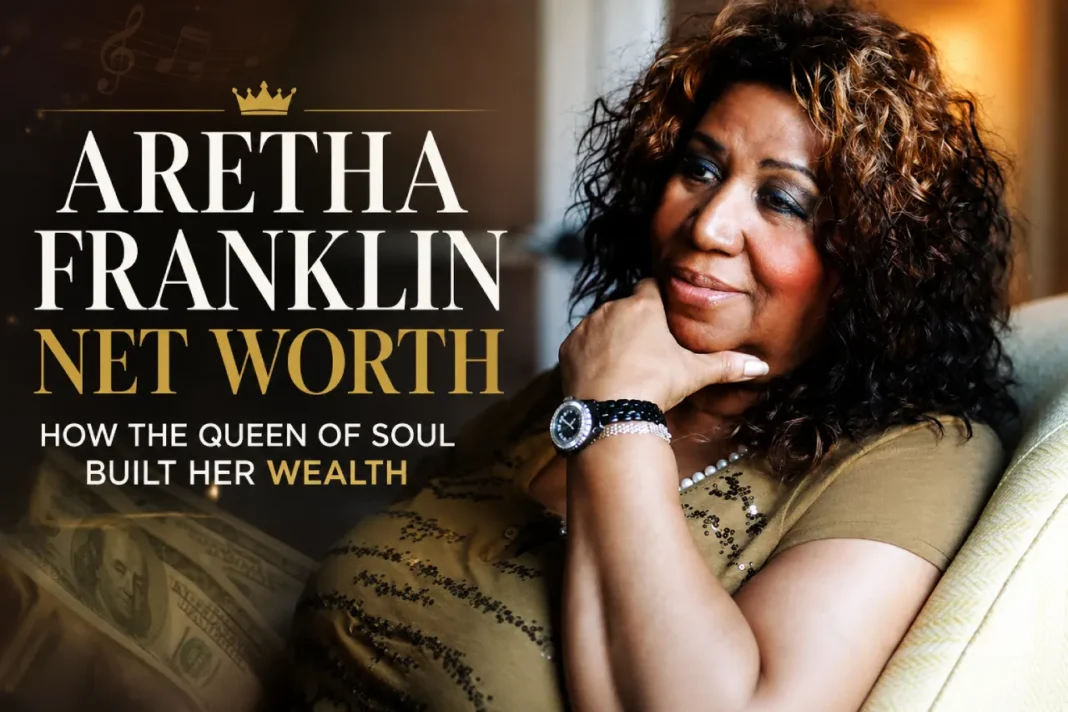
Aretha Franklin’s net worth at the time of her death in August 2018 was estimated at $80 million. This figure is widely cited by Forbes and Celebrity Net Worth. However, that headline number included approximately $4.1 million in liquid assets — cash, real estate, and documented property. It included an estimated $50 million to $80 million in music catalog value and future royalties. As of 2026, her estate’s current value is estimated at roughly $18 million to $100 million. This range depends on how her catalog is valued.
The Queen of Soul built her wealth over six decades. She earned it through record sales, touring, royalties, real estate, and licensing. But her financial story is also a cautionary tale. Three handwritten wills, a public probate battle, and an IRS tax debt of $7.8 million complicated what should have been a straightforward transfer of generational wealth.
This article breaks down the numbers behind Aretha Franklin’s fortune. It also covers how she earned it, what happened to her estate after her death, and the estate planning lessons her case still teaches.
Aretha Franklin Net Worth at Death (2018)
The $80 Million Figure: What It Included
Aretha Franklin’s estimated $80 million net worth was not cash sitting in a bank account. Instead, it was a combined valuation of several asset categories: music recordings, publishing interests, real estate, personal property, and future royalty streams.
Forbes and Celebrity Net Worth have both cited the $80 million total estate value for years. This figure reflects the earning power of a catalog that includes “Respect,” “Think,” “(You Make Me Feel Like) A Natural Woman,” and “I Say a Little Prayer.” Overall, she sold 75 million records worldwide.
Liquid Assets vs. Music Catalog Value
The gap between liquid assets and catalog value is the most misunderstood part of Aretha Franklin’s finances.
Her estate’s documented liquid assets — cash and real estate — totaled approximately $4.1 million, according to court filings in Oakland County Probate Court. Meanwhile, the much larger $80 million figure came from the estimated value of her music catalog and intellectual property. This catalog was projected to generate income for decades.
In short, Aretha Franklin was asset-rich but cash-poor. Her real wealth was in copyrights, master recordings, and royalty streams, not easily accessible bank balances.
Why Sources Report Different Numbers
Search for Aretha Franklin’s net worth, and you’ll see figures ranging from $10 million to $100 million. These differences come from different valuation methods and time periods. For example:
- $4.1 million — The documented liquid portion of the estate filed in probate court.
- $18 million to $25 million — Conservative post-debt estimates. These reflect legal costs and a cautious catalog valuation.
- $80 million — The most commonly cited total estate value at death, including catalog value.
- $100 million — Optimistic current valuations if the catalog were sold in today’s music-rights market.
The $7.8 million IRS tax debt and years of legal fees from the will dispute reduced the amount ultimately available to her heirs.
| Asset Category | Value at Death (2018) | Notes |
|---|---|---|
| Liquid assets and real estate | ~$4.1 million | Documented in probate filings |
| Music catalog and intellectual property | ~$50–80 million | Estimated future royalty value |
| Total estimated estate value | ~$80 million | Combined valuation |
| IRS tax debt | $7.8 million | Paid in full by July 2022 |
| Annual estate income (2026) | $3–10 million | Ongoing royalties and licensing |
How Aretha Franklin Built Her Wealth
Music Record Sales
Record sales were the foundation of Aretha Franklin’s fortune. She sold more than 75 million records worldwide, making her one of the best-selling music artists in history.
Her breakthrough album, I Never Loved a Man the Way I Love You, sold more than 5 million copies. Similarly, the gospel album Amazing Grace sold more than 2 million copies. It remains one of the best-selling gospel records ever made. Across her career, she placed 112 singles on the Billboard charts. She also scored 20 number-one R&B hits.
Touring and the Cash-Before-Show Policy
Touring was another major income source. During her peak years, her income from touring and performances reached an estimated $20 million to $30 million per year.
She was also known for requiring cash payment before performing. This gave her immediate liquidity and control. However, it also created an incomplete tax record. Combined with off-books payments to staff, this practice contributed to the $7.8 million IRS debt her estate later had to resolve.
Music Royalties and Publishing Rights
Royalties were Aretha Franklin’s most valuable long-term asset. They came from record sales, streaming, radio play, film and television licensing, and sync deals.
Her signature song, “Respect,” is estimated to generate $1 million or more per year in royalties and licensing income. However, there’s a critical nuance: Aretha Franklin didn’t write “Respect.” Otis Redding wrote and originally recorded it. Because she never held the songwriting copyright, she never received publishing royalties from the song.
Even more surprising, U.S. terrestrial radio stations don’t pay performance royalties to recording artists at all. As a result, millions of radio plays of “Respect” never directly generated income for Aretha Franklin or her estate. Instead, its value to her came almost entirely from licensing and streaming.
Real Estate
Real estate made up a smaller share of Aretha Franklin’s wealth, with total holdings estimated at around $6 million. Her primary residence in Detroit, Michigan, anchored her real estate portfolio. It also remained deeply tied to her identity as a Detroit icon.
Acting, Endorsements, and Licensing
Aretha Franklin also earned outside of music, appearing in films like The Blues Brothers and on television. Licensing deals for commercials, films, and shows added revenue. These deals also extended the commercial life of her catalog, though they were smaller than touring and record sales.
Wealth sources at a glance:
- Record sales (75+ million worldwide)
- Touring and live performances
- Music royalties and licensing
- Publishing rights (for self-written songs)
- Real estate holdings
- Acting, television, and endorsement deals
Aretha Franklin’s Estate After Her Death
The Handwritten Wills Discovered
When Aretha Franklin died on August 16, 2018, it was initially reported that she had no will. That turned out to be incomplete. In the months that followed, handwritten documents were discovered in her Detroit home, including one found under couch cushions. None were prepared by an estate planning attorney, and they weren’t consistent with each other. As a result, a years-long legal battle followed over which document should control her estate.
The 2023 Court Verdict
The case went to Oakland County Probate Court in Michigan. There, Aretha Franklin’s four sons disagreed about which document reflected their mother’s final wishes. In October 2023, a Michigan jury ruled that a 2014 handwritten will, found under a couch cushion, was valid. This will became the controlling document for the estate. The verdict mattered because it gave larger shares to sons Kecalf Cunningham and Edward Franklin, rather than splitting the estate equally among all four.
The IRS Tax Debt: Resolved in 2022
Before the estate could be distributed, it had to resolve its debt to the IRS. The agency claimed $7.8 million in unpaid income taxes, interest, and penalties dating back to Franklin’s final years. In 2021, the estate and the IRS agreed to a structured payment plan directing 45% of the estate’s quarterly income toward the balance. This plan accelerated repayment. By July 2022, the estate confirmed the full $7.8 million debt had been paid off, clearing the way for distributions to her sons.
Current Estate Value in 2026
As of 2026, the estate has stabilized. Still, its exact value depends on how the music catalog is valued. Conservative estimates place it at $18 million to $25 million, reflecting debts and legal costs already paid. More aggressive music-industry valuations push the figure toward $100 million, especially if the catalog were sold outright in today’s active market. Overall, the estate’s real value sits somewhere in that range, driven by royalty income and catalog demand rather than one fixed number.
Annual Estate Income
Aretha Franklin’s estate continues to earn an estimated $3 million to $10 million per year. This comes from streaming, record sales, licensing, and sync deals. This kind of posthumous income has become increasingly valuable across the music industry. In fact, investment funds and music companies now compete to acquire iconic song catalogs, a trend that keeps estates like hers earning long after death.
Who Inherited Aretha Franklin’s Money?
Aretha Franklin had four sons: Clarence Franklin, Edward Franklin, Ted White II, and Kecalf Cunningham. Under the 2014 handwritten will validated in 2023, the estate was not divided equally. Kecalf Cunningham and Edward Franklin received larger shares, and Kecalf also gained control over certain assets and real estate. The exact dollar breakdown by heir hasn’t been made fully public. Still, the outcome is clear: two sons received a greater share of Aretha Franklin’s remaining wealth than the other two.
Beyond financial assets, the estate included personal property — furs, jewelry, gold records, and other valuables — along with real estate including the Detroit home. These items carried sentimental as well as monetary value. Ultimately, they were distributed according to the terms of the validated will.
Aretha Franklin’s Career Highlights That Generated Wealth
Aretha Franklin won 18 Grammy Awards from 44 nominations. She also received the Grammy Legend Award and the Grammy Lifetime Achievement Award. She placed 112 singles on the Billboard charts and scored 20 number-one R&B hits. This level of chart dominance translated directly into decades of royalty income.
Her most commercially successful period began in 1967, when she signed with Atlantic Records. The Atlantic era produced the run of hits — “Respect,” “Think,” “(You Make Me Feel Like) A Natural Woman,” “Amazing Grace” — that turned her into a global superstar. This period also built the core of the catalog still generating millions of dollars annually.
In 1987, she became the first woman inducted into the Rock and Roll Hall of Fame. Later, she received the Presidential Medal of Freedom. Meanwhile, Rolling Stone has named her the greatest singer of all time and ranked “Respect” among the greatest songs ever recorded — distinctions that keep her catalog commercially relevant today.
| Career Metric | Total |
|---|---|
| Records sold worldwide | 75+ million |
| Grammy Awards | 18 |
| Grammy nominations | 44 |
| Charted Billboard singles | 112 |
| Number-one R&B hits | 20 |
| Rock and Roll Hall of Fame induction | 1987 |
Common Myths About Aretha Franklin’s Estate
“She died without a will.” In fact, she had three handwritten wills, not zero. One was ultimately validated by a jury in 2023.
“Her estate was $80 million in cash.” Only about $4.1 million was liquid. The rest was an estimate of future catalog and royalty value.
“Her sons split the estate equally.” Actually, the validated 2014 will gave Kecalf Cunningham and Edward Franklin larger shares than their brothers.
“She earned royalties every time ‘Respect’ played on the radio.” In reality, U.S. radio doesn’t pay recording artists performance royalties. So those airplays generated no direct income for her.
“Her estate is still worth $80 million today.” After legal costs and the settled IRS debt, current 2026 estimates range from $18 million to $100 million, not a fixed repeat of the 2018 figure.
How Her Estate Compares to Other Music Legends
Aretha Franklin’s case isn’t unique. Several major artists left behind estates complicated by inadequate planning, while others avoided it entirely.
Prince died in 2016 with no will at all. As a result, his estate spent six years in dispute between Comerica Bank & Trust and the IRS over valuation. Comerica’s $82.3 million appraisal clashed with the IRS’s $163.2 million claim before both sides settled at $156.4 million in 2022.
Whitney Houston died in 2012 with an estate commonly estimated around $20 million, though reports vary widely. Some accounts even put her net worth as low as negative $20 million once debts were factored in. Since then, her estate has grown substantially through posthumous licensing and catalog deals.
Tina Turner, by contrast, completed a formal estate plan in 2021, two years before her death, specifically to avoid a family dispute. She died in 2023 with an estimated net worth of $250 million. Her fortune passed to her husband, Erwin Bach, largely without public conflict.
The pattern is consistent. Artists without a clear, professionally drafted estate plan — Prince, and to a lesser extent Aretha Franklin — saw years of costly legal battles. Meanwhile, artists who planned, like Tina Turner, avoided them almost entirely.
Estate Planning Lessons from Aretha Franklin’s Case
Handwritten wills invite disputes. Aretha Franklin’s wills were found in her home, not drafted and stored by an attorney. Handwritten wills can be legally valid in Michigan, but they’re far harder to authenticate. As a result, her family spent years in court.
A will isn’t the same as an estate plan. Aretha Franklin didn’t die with zero wills. However, she died without a clear, professionally managed plan. That gap cost her estate years of delay, legal fees, and public scrutiny.
Cash-only business practices create tax risk. Requiring cash before performances gave her control. But it also created an incomplete tax record, a major contributor to the $7.8 million IRS debt her estate had to pay off.
Five takeaways for high-net-worth individuals:
- Formalize your will. Handwritten notes leave too much room for dispute.
- Plan for taxes in advance. Unresolved tax debt can delay distribution for years.
- Communicate with heirs. Surprises after death often lead directly to court battles.
- Value intellectual property separately. Music catalogs and copyrights need expert appraisal, not guesswork.
- Keep business finances clean. Cash-heavy practices feel simple at the time. However, they create serious problems later.
FAQs
What was Aretha Franklin’s net worth when she died?
Aretha Franklin’s net worth at her death in August 2018 was estimated at $80 million. This included roughly $4.1 million in liquid assets and $50–80 million in projected music catalog value.
How much is Aretha Franklin’s estate worth in 2026?
Estimates for 2026 range from $18 million to $100 million, depending on how her music catalog is valued. Conservative post-debt estimates fall closer to $18–25 million.
Did Aretha Franklin have a will?
She didn’t have a formal, attorney-drafted will. However, three handwritten wills were found after her death. In October 2023, a Michigan jury validated a 2014 handwritten will found under a couch cushion.
Who inherited Aretha Franklin’s estate?
Her four sons — Clarence Franklin, Edward Franklin, Ted White II, and Kecalf Cunningham — were the heirs. Under the validated 2014 will, Kecalf Cunningham and Edward Franklin received larger shares than their brothers.
How did Aretha Franklin make her money?
Primarily through record sales, touring, music royalties, publishing rights, real estate, and licensing. She sold more than 75 million records, and her peak touring years earned an estimated $20–30 million annually.
How much does Aretha Franklin’s estate earn per year?
An estimated $3 million to $10 million annually from royalties, streaming, and licensing. This income has continued for years after her death.
What was Aretha Franklin’s most valuable asset?
Her music catalog and intellectual property, estimated at $50–80 million at death. That’s far more than her roughly $4.1 million in documented liquid assets.
Why was there a dispute over Aretha Franklin’s will?
Because three inconsistent handwritten wills were found after her death, and her sons disagreed about which one reflected her true wishes. A jury resolved the dispute in October 2023 by validating the 2014 will.
How many Grammy Awards did Aretha Franklin win?
18 Grammy Awards from 44 nominations, plus the Grammy Legend Award and the Grammy Lifetime Achievement Award.
Was Aretha Franklin’s IRS tax debt ever paid off?
Yes. Her estate and the IRS agreed to a structured payment plan in 2021, and the full $7.8 million debt was paid off by July 2022.

