
In This Article
Avant garde fashion is clothing made to test an idea before it flatters the body. A dress may carry padding where the body has none, and a boot may split at the toe. Each piece starts with a design question, and the finished garment shows the answer.
Below you’ll find what the term means, the signs that mark an avant-garde garment, where the movement came from, and the six designers who shaped it. A comparison with haute couture and ready-to-wear follows, plus a simple way to wear one bold piece yourself.
What Avant Garde Fashion Means
From Advance Guard to Design Idea
The phrase comes from French military language, where the avant-garde was the advance guard that moved ahead of the main force. Artists later used it for work ahead of accepted taste. A design counts as avant-garde when it breaks a normal expectation of shape, material, or finish on purpose.
Concept Before Comfort or Convention
Most clothes start with a wearer and a use. Avant-garde clothes start with a question, such as whether a coat can hold its shape on its own. The answer becomes the garment. Comfort may follow, but it doesn’t lead.
How to Recognize Avant Garde Fashion
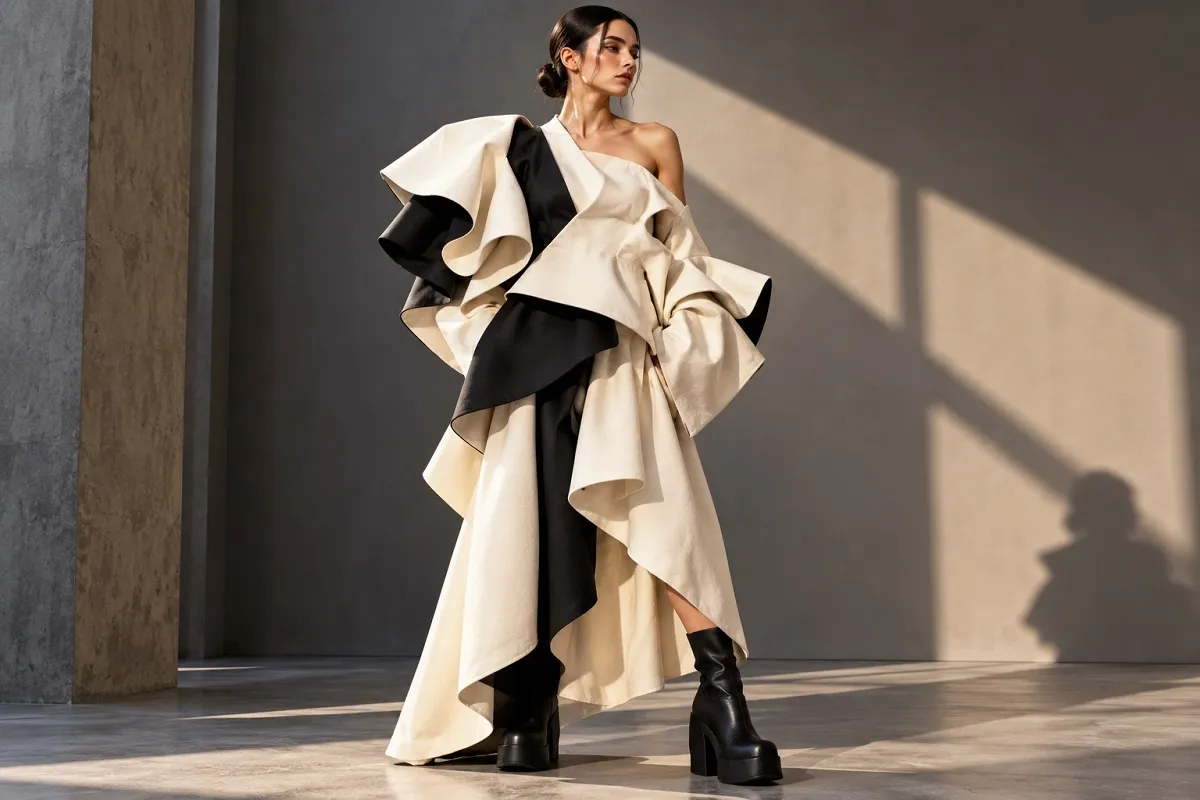
One odd detail doesn’t make a garment avant-garde. The style shows when several traits work together under one clear idea.
Shape That Changes the Body Line
Shape is the first sign. Silhouettes grow large, drop on one side, or stand away from the body. Shoulders sit square, sleeves hang unevenly, and hems fall at two levels. That unevenness is deliberate.
Materials and Visible Construction
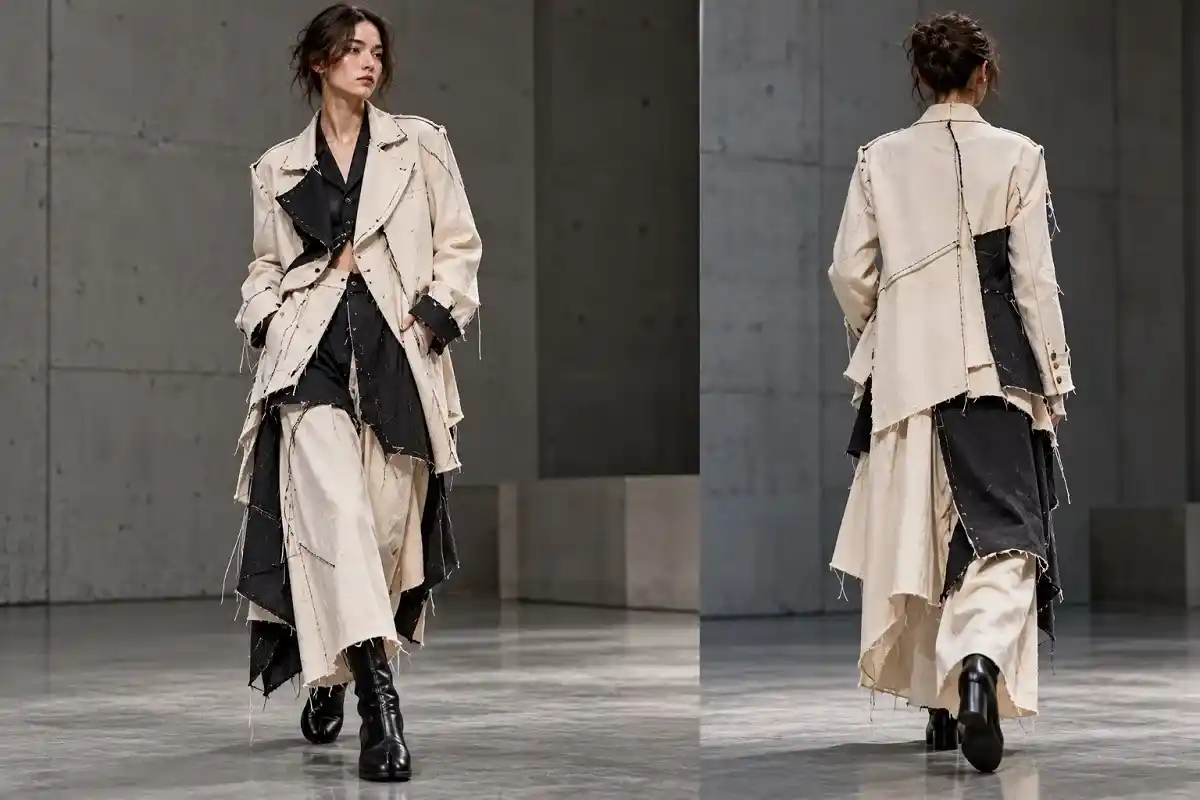
Material is the second sign. A designer may use plastic, metal, stiff cloth, or fabric that holds a form after the wearer moves. Construction often stays in view on purpose, with seams outside, edges raw, and linings worn as outer layers.
Color That Serves Form
Color tends to support shape rather than lead it. Black, white, and gray keep attention on form, which is why so much early avant-garde work looks monochrome. Bold color still appears, as Schiaparelli’s red lobster shows.
Four Signs to Check
- Shape changes the body’s outline.
- Material or method is part of the idea.
- Construction shows, or a garment is rebuilt from others.
- You can state the idea in one sentence.
Where Avant Garde Fashion Comes From

Surrealism Enters Fashion in the 1930s
In the 1930s Elsa Schiaparelli worked with surrealist artists and treated garments as places for strange images. Her Lobster dress, designed with Salvador Dalí for her summer 1937 collection, placed a large red lobster across white silk organza and turned a dinner dress into a joke and a work of art at once. Wallis Simpson bought the design for her trousseau before marrying the Duke of Windsor, according to the Philadelphia Museum of Art, and Cecil Beaton’s photographs of her wearing it made the dress famous.
The 1981 Paris Moment
In 1981 Rei Kawakubo and Yohji Yamamoto showed in Paris for the first time. Their clothes were loose, mostly black, and finished with holes, raw edges, and uneven hems, the opposite of the fitted glamour of the period. Parts of the French press mocked the look as “Hiroshima chic,” yet the shows changed what a fashion collection could be: clothes that refused to flatter the body in the expected way.
Deconstruction in the Late 1980s and 1990s
Deconstruction became a shared method in the late 1980s and 1990s. Garments were taken apart, turned inside out, or rebuilt from other clothes, with inner structure left visible. Martin Margiela, who founded his house in 1988, made visible construction his central subject, while Antwerp designers such as Ann Demeulemeester explored a darker, more poetic side of the same approach.
Six Designers Who Shaped the Movement
Rei Kawakubo and Comme des Garçons
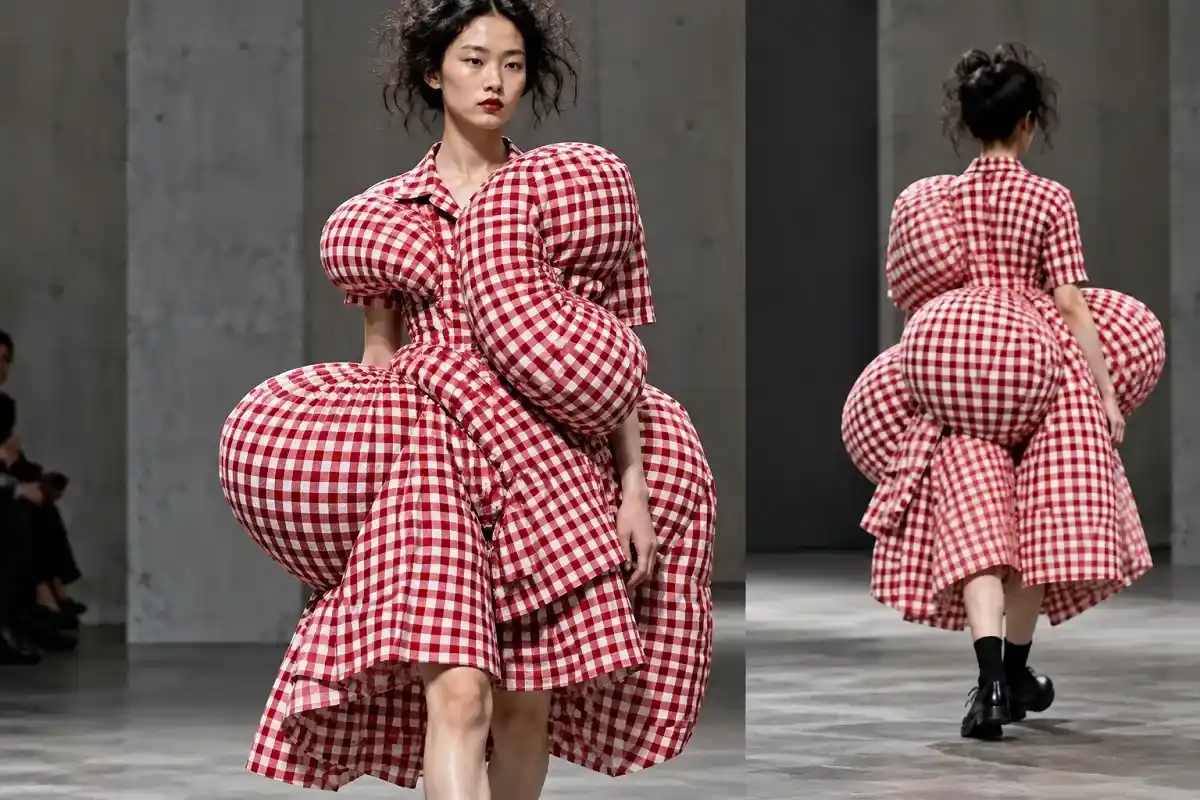
Rei Kawakubo changed the silhouette itself. Her early Paris work used loose, dark clothes that hid the body’s outline. Her spring/summer 1997 Comme des Garçons collection, Body Meets Dress, Dress Meets Body, went further, with padding sewn into stretch gingham dresses and skirts. The pads sat exactly where fashion usually smooths the body away, and the gingham, a cloth tied to domestic life, made the distortion harder to dismiss as fantasy. Pieces from it returned in the Metropolitan Museum of Art’s 2017 exhibition Rei Kawakubo/Comme des Garçons: Art of the In-Between.

Yohji Yamamoto and the Power of Drape
Yohji Yamamoto built his work on drape, layering, and the space between cloth and body. The Victoria and Albert Museum sums up his style as oversized, layered, and draped silhouettes, mostly in black, that avoid symmetry. Long pieces fall away from the figure, and the asymmetry keeps the outline from settling into a familiar shape. Black lets seam, shadow, and volume carry the design.
Issey Miyake and Garment Pleating
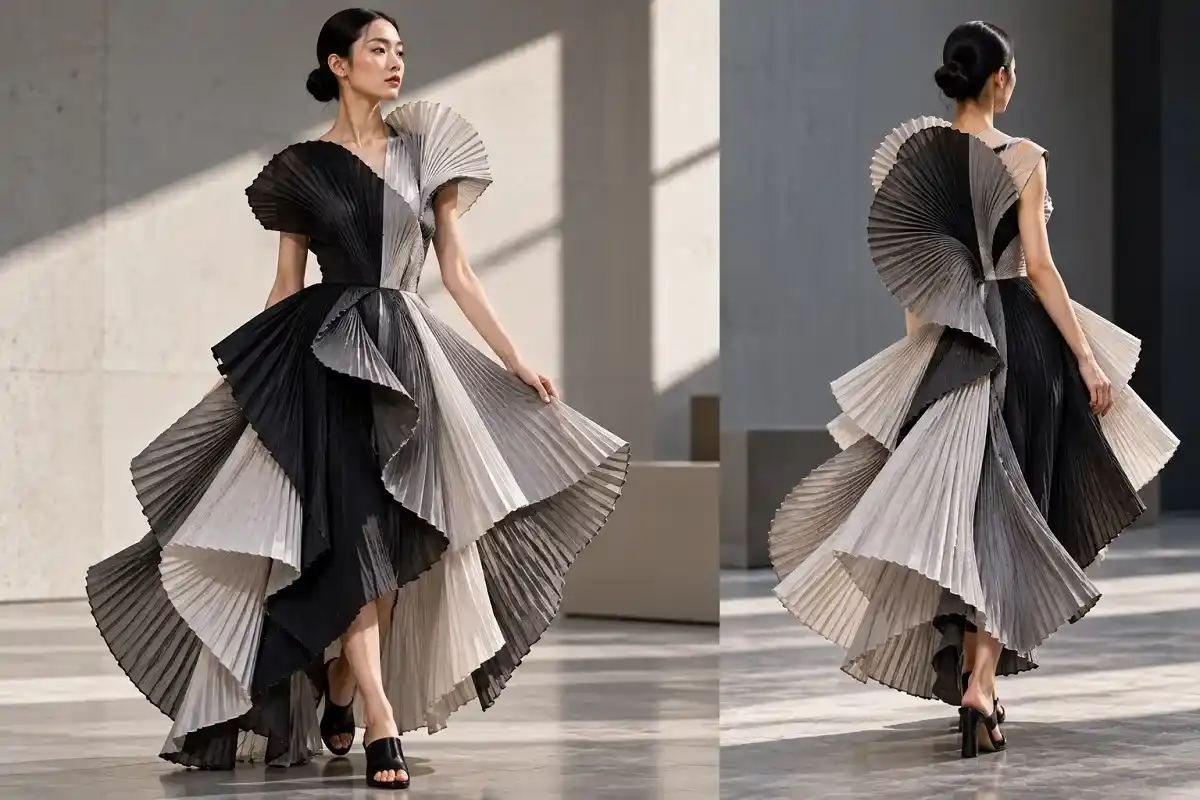
Issey Miyake changed what fabric itself could do. His Pleats Please line, launched in 1993, reversed the usual order of work: garments were cut and sewn two to three times larger than their final size, then heat-pressed so the pleats held for good. The cloth keeps its shape through washing and packs flat for travel. In 1998 he began A-POC, short for A Piece of Cloth, with textile engineer Dai Fujiwara, a system that knits a whole garment from one continuous tube of cloth, as his official chronology records.
Martin Margiela and Visible Making
Martin Margiela made the making of clothes the subject. His house showed seams outside, linings as outer layers, and vintage pieces rebuilt into new ones. His split-toe Tabi boot, modeled on Japanese tabi socks, turned a practical shape into a fashion signature. It first appeared at his debut show in Paris in October 1988, for spring/summer 1989, with the soles dipped in red paint so each step left a split-toe print on the white runway. The split changes how the foot reads and gives a plain outfit a point of tension.
Alexander McQueen and Theatrical Tailoring
Alexander McQueen joined sharp tailoring to dark, theatrical presentation. Plato’s Atlantis, his spring/summer 2010 collection and the last he fully completed, used digital prints and marine shapes to imagine a world reclaimed by the sea. Its Armadillo boot stands 30 centimeters (about 12 inches) high, was carved from wood, and ignores the natural shape of the foot. Most pairs were made only for the show, which makes the boot a small sculpture more than footwear.
Iris van Herpen and Technology as Material
Iris van Herpen treats technology as a material, not a trick. Her Crystallization collection of July 2010, inspired by water and limestone deposits, included the first 3D-printed garment ever sent down a runway, made with architect Daniel Widrig. Since then she has combined 3D printing, laser cutting, and hand techniques in her Paris couture shows, so a single dress can be partly engineered and partly hand-built.
Avant Garde, Haute Couture, and Ready-to-Wear
Haute couture and avant-garde fashion are often confused because both can look extreme. Couture is a regulated way of making clothes, while avant-garde is an approach to design, and the two can overlap.
| Point | Avant garde fashion | Haute couture | Ready-to-wear |
|---|---|---|---|
| Purpose | Test an idea | Serve one client, made to measure | Sell in standard sizes |
| Made for whom | An idea first, then buyers | One private client at a time | Many buyers in set sizes |
| How it is made | Often visible, rebuilt, or experimental | By hand, to measure, in a Paris atelier | Finished for factory production |
| Rules | No official label or approval | Legally protected title in France | No protected label |
| Finish | Visible work is part of the look | Hidden, highly finished handwork | Finished for repeated wear |
In France, “haute couture” is a protected title. A house can use it only with approval from the Fédération de la Haute Couture et de la Mode, and its pieces must be made to measure in Paris workshops. A garment can be both couture and avant-garde when a couture house tests an idea with full handwork; Schiaparelli’s Lobster dress is one such case. A ready-to-wear piece can borrow one trait, such as an asymmetric hem, without carrying the full idea.
Runway ideas reach everyday clothes in softened form. Oversized silhouettes, dropped shoulders, raw hems, and exposed seams have all moved into ready-to-wear, usually one trait at a time.
How to Wear One Bold Piece

Full avant-garde looks belong on a runway, in a gallery, or in a photograph more than in a working day. In real life, borrow one idea and keep the rest plain.
Start With One Statement Piece
Pick one piece to carry the idea: an oversized coat, a sculptural top, a skirt with unusual volume, or split-toe boots. Build the rest of the outfit from simple basics in one or two colors, such as wide-leg black trousers under a red sculptural top.
Balance Shape, Color, and Texture
When the shape is large, keep color restrained and texture smooth. When texture is rough or construction is visible, keep the shape simple. If you want a warmer neutral base than black, earthy shades work well too; see our guide to colors that go with brown clothes. For an office, a small asymmetric hem or one exposed-seam jacket is easier to wear than a full sculptural silhouette.
Choose One Bold Piece, Keep the Rest Plain
Avant garde fashion puts a concept ahead of a familiar shape, and each designer here changed a different part of the craft: silhouette, drape, fabric, construction, presentation, or technology. If you want to try it, choose the one idea you like most, find a single piece that carries it, and dress everything else simply. The piece then reads as a choice rather than a costume.