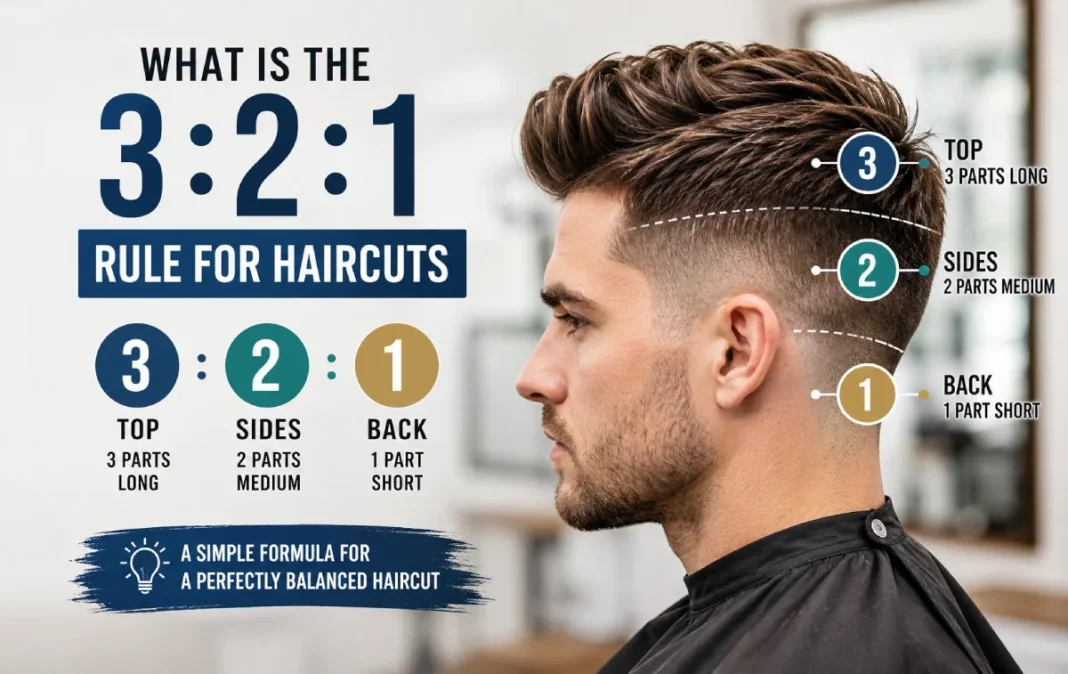
You’ve probably nodded along when a barber said, “Three on top, two on the sides,” and hoped your head would explain itself. The 3:2:1 rule for haircuts is easier to understand than most guys assume, and more versatile than most explanations give it credit for. This single framework covers everything from a military buzz cut to a textured modern fade, and once you know it, you won’t sit in the chair confused again.
This guide covers both interpretations of the rule, exact measurements, face-shape adjustments, and a week-by-week maintenance schedule. You’ll also get the exact phrases to use at the barbershop, so you can skip the vague requests and disappointing mirrors.
What Exactly Is the 3:2:1 Rule for Haircuts?
The 3:2:1 rule has two distinct interpretations, and most barbers lean on one or the other. Knowing both gives you an edge in the chair.
The Clipper Guard Interpretation
This is the most common version. It refers to specific clipper guard numbers used during the cut:
- #3 guard on top — approximately ⅜ inch (10mm)
- #2 guard on the sides — approximately ¼ inch (6mm)
- #1 guard around the edges and neckline — approximately ⅛ inch (3mm)
Each numbered attachment snaps onto a clipper and controls exactly how much hair remains, creating a graduated taper: longer at the crown, tighter at the temples, shortest at the nape.
A skilled barber traces the #1 guard along the occipital bone — the slightly curved area at the back of the skull — then blends the #2 upward through the sides. The #3 sits across the crown, leaving enough length to show hair texture.
Between guard numbers, barbers use the clipper’s taper lever for fine-tuning. Half-open on a #3 gives roughly a #3.5 effect, which removes hard lines between zones.
Quick conversion for international readers:
| Guard | Inches | Millimeters | Approximate Feel |
|---|---|---|---|
| #1 | ⅛” | 3mm | Stubble-length, near-skin |
| #2 | ¼” | 6mm | Close but visible |
| #3 | ⅜” | 10mm | Textured, finger-width |
| #4 | ½” | 13mm | Noticeably longer |
The 3:2:1 uses guards #1 through #3, the shorter end of the full #1–#8 range. That’s why the result always looks tight and structured.
The Proportional Ratio Interpretation
Some stylists use 3:2:1 as a balance principle rather than a fixed measurement — a ratio for visual harmony:
- 3 = longest zone (top)
- 2 = medium zone (sides)
- 1 = shortest zone (neckline and edges)
The actual inches shift depending on the style. A textured quiff might mean 3 inches on top, 2 inches on the sides, and 1 inch at the neckline. A classic taper might use 1.5, 1, and 0.5 inches instead. Either way, the principle holds: top stays dominant, sides stay moderate, neckline stays tight. This framework is what prevents the most common imbalance in men’s cuts — bulky sides paired with a flat top.
Which Interpretation Should You Use?
Use the guard version for short styles — buzz cuts, tight tapers, clean fades — since guards give barbers exact, repeatable measurements. Use the ratio version for longer styles — textured crops, side parts, slick backs — where exact clipper numbers don’t apply, and proportional thinking matters more.
Most experienced barbers blend both: guard-based structure first, then proportional adjustments by eye. Knowing both systems means you can communicate clearly no matter which one your barber prefers.
Why the 3:2:1 Rule Actually Works
This framework isn’t arbitrary — it solves problems that show up in a lot of haircuts.
It creates a built-in taper
The gradual drop from #3 to #2 to #1 produces a natural, blended shadow without any advanced fading technique. The gradient happens automatically through guard progression.
It delivers visual balance
A 2024 Professional Barbers Association survey found that 43% of men aged 25 to 40 prefer structured, tapered cuts, likely because proportional cuts flatter most face shapes and skull structures — the crown stays fuller, and the sides avoid looking bulky.
It simplifies barber communication
Instead of gesturing vaguely at your head, you give three numbers. Your barber translates those into a cut, and guesswork disappears from both sides of the chair.
It grows out cleanly
Because the gradient is measured, each zone ages at a similar visual rate. You won’t end up with one awkward patch while the rest still looks sharp — a real advantage over disconnected styles.
It adapts across occasions
The same 3:2:1 foundation works for boardrooms, beach days, and casual weekends, reading as intentional regardless of context.
3:2:1 Haircut Styles You Can Actually Ask For
The 3:2:1 isn’t one haircut — it’s a system that supports multiple styles. Here are five proven variations.
The Classic 3:2:1 Buzz Cut
This is the purest expression of the guard interpretation. A #3 on top delivers about ⅜ inch of textured length. The #2 tightens the sides to ¼ inch. The #1 defines crisp borders around the ears and neckline.
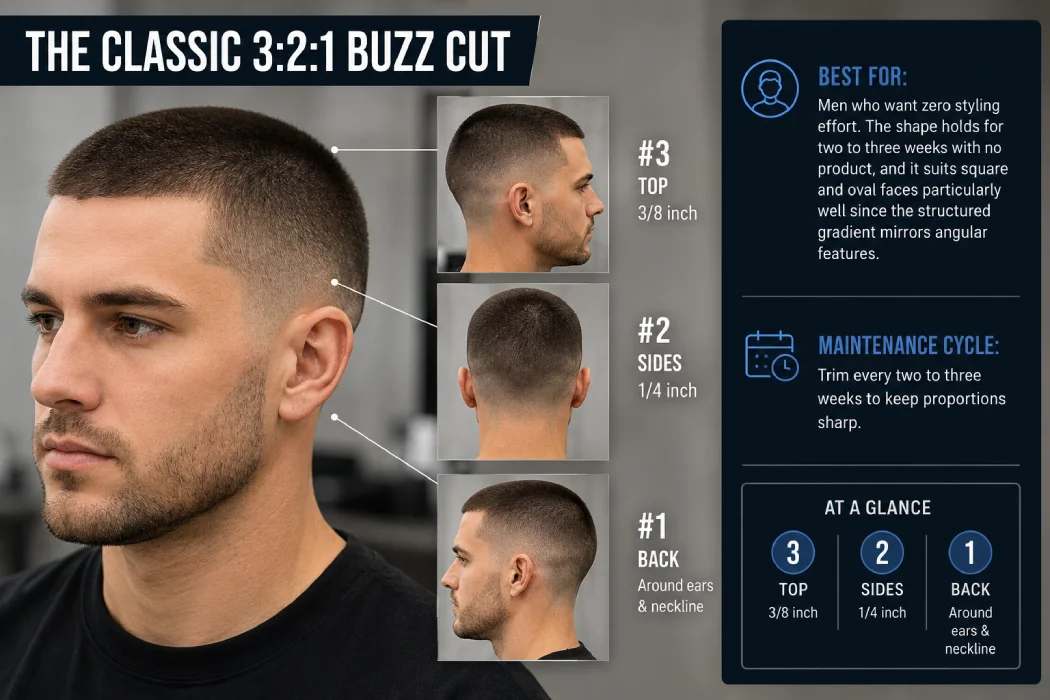
- Best for: men who want zero styling effort. The shape holds for two to three weeks with no product, and it suits square and oval faces particularly well since the structured gradient mirrors angular features.
- Maintenance cycle: trim every two to three weeks to keep proportions sharp.
The 3:2:1 Taper Fade
Here the ratio interpretation takes over. The top stays longer, styled with a pomade or matte clay. The sides use a #2 guard that blends progressively. The neckline gets a #1, or even a skin-tight finish for sharper contrast.
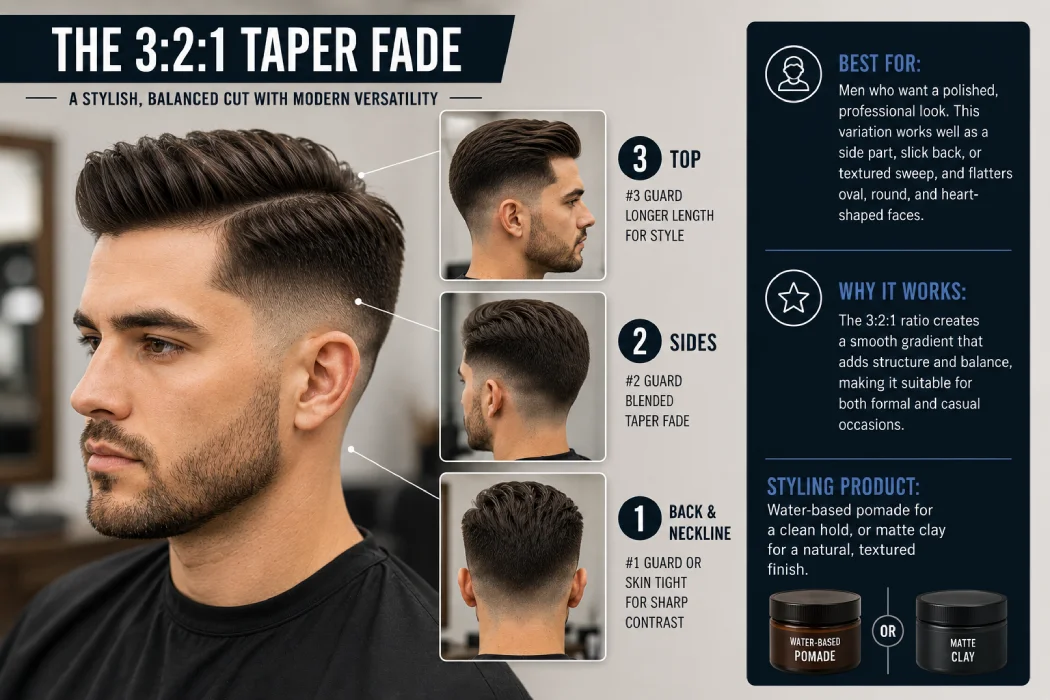
- Best for: men who want a polished, professional look. This variation works well as a side part, slick back, or textured sweep, and flatters oval, round, and heart-shaped faces.
- Styling product: water-based pomade for a clean hold, or matte clay for a natural, textured finish.
The 3:2:1 Textured Crop
Keep the top at a #3 or slightly longer, then add deliberate texture with a styling product. The #2 sides frame the face tightly, while the #1 neckline keeps everything grounded.
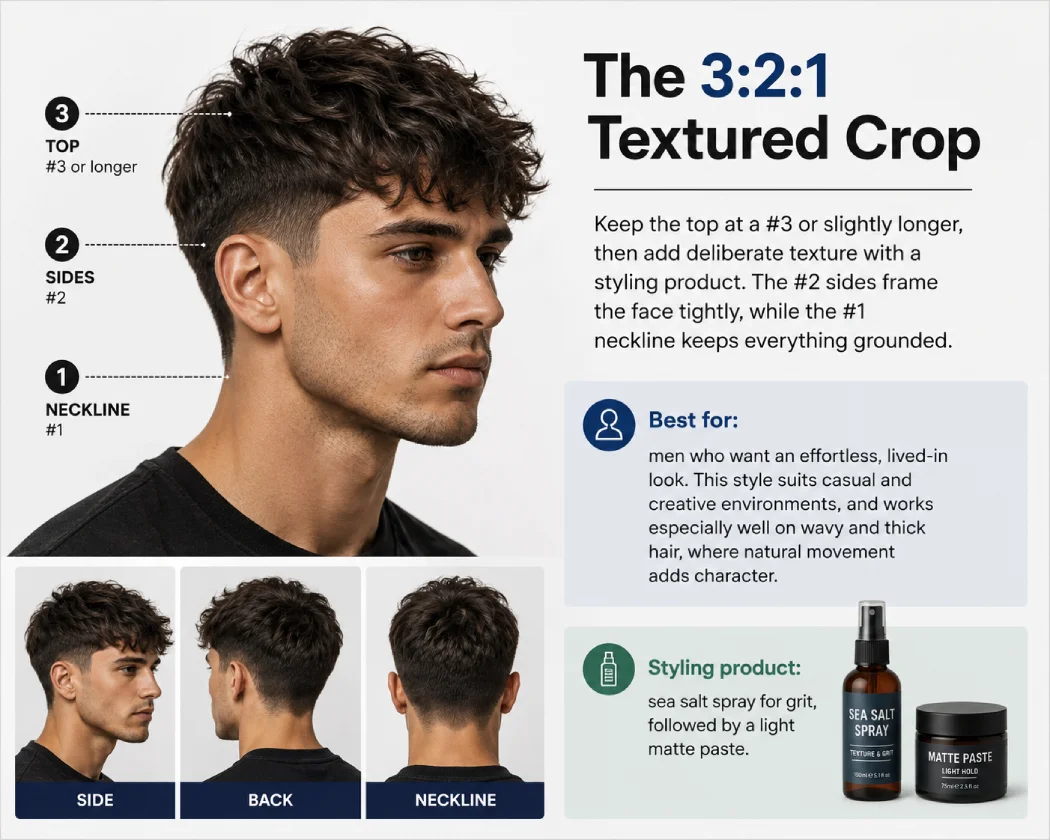
- Best for: men who want an effortless, lived-in look. This style suits casual and creative environments, and works especially well on wavy and thick hair, where natural movement adds character.
- Styling product: sea salt spray for grit, followed by a light matte paste.
The 3:2:1 Undercut
This variation pushes the contrast harder. The top stays at a #3 or longer for dramatic volume, while the sides drop sharply to a #1 or shorter. The disconnect between zones creates a bold, contemporary silhouette.
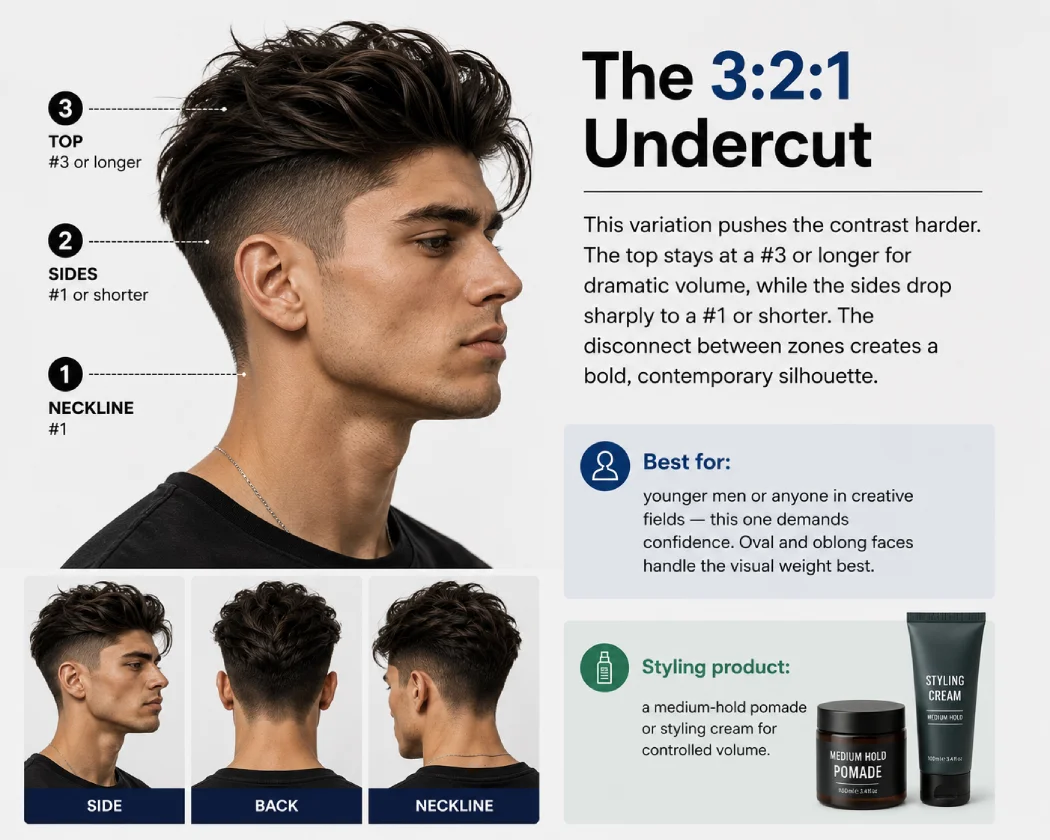
- Best for: younger men or anyone in creative fields — this one demands confidence. Oval and oblong faces handle the visual weight best.
- Styling product: a medium-hold pomade or styling cream for controlled volume.
The 3:2:1 Side Part (Professional/Office-Friendly)
This applies the ratio interpretation with longer measurements: three units on top, combed into a defined part; two units on the sides, kept clean but not severe; one unit at the neckline, tapered softly.
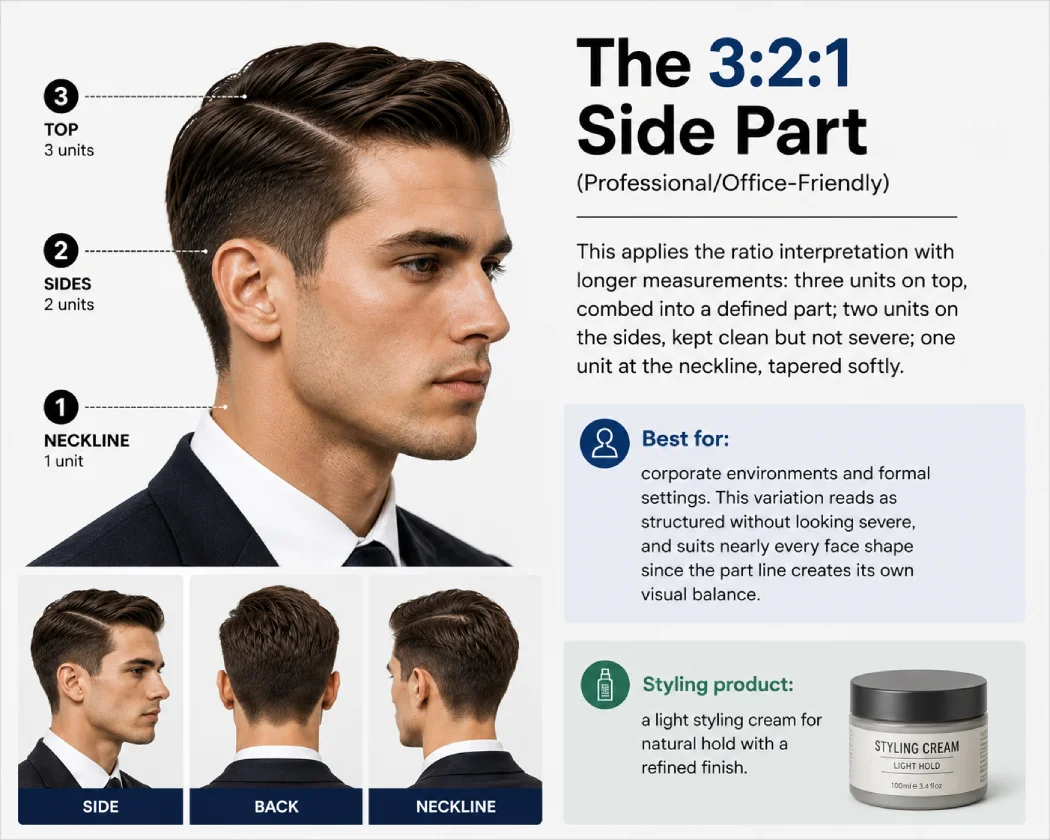
- Best for: corporate environments and formal settings. This variation reads as structured without looking severe, and suits nearly every face shape since the part line creates its own visual balance.
- Styling product: a light styling cream for natural hold with a refined finish.
Does the 3:2:1 Rule Work for Your Face Shape?
Face shape determines how the gradient reads on your specific structure. Here’s how to adjust it.
Round Face
Round faces have fuller cheeks and a softer jawline, so the 3:2:1 can add vertical length that counteracts the width. Keep the top at a full #3 or slightly higher, and ask your barber to taper the sides tighter — blending from #2 down to #1. This draws the eye upward and elongates the appearance.
Square Face
A square face features a strong, defined jawline with angular geometry, and the 3:2:1 mirrors this precision well. The classic guard interpretation works here without adjustment — the graduated taper echoes the face’s natural structure.
Oval Face
Oval faces are the most versatile shape, since the proportions are already balanced. Nearly every 3:2:1 variation flatters this structure, so pick whichever style suits your lifestyle and personality.
Heart-Shaped Face
Heart-shaped faces are wider at the forehead and narrower at the chin. The 3:2:1 helps by keeping moderate volume on the sides — rather than tapering to an extreme #1, keep the sides at a longer #2. This balances the forehead’s width against the chin’s narrowness.
Oblong/Rectangular Face
Oblong faces have more vertical length than average. The 3:2:1 still works, but avoid excessive top height — keep the ratio closer to 3:2:1.5 instead of a dramatic 3:2:1, so you don’t add more vertical emphasis. A textured crop variation works particularly well here.
Does the 3:2:1 Rule Work for All Hair Types?
Yes, but each texture needs its own adjustment.
Straight Hair
Standard 3:2:1 works as-is. Straight strands lie flat, so the gradient reads clearly from every angle. One caveat: fine, straight hair can look flat without texture, so a light matte clay or texture powder adds dimension to the crown.
Wavy Hair
Waves create natural volume that clipper guards can suppress. Consider bumping the top to a #3.5 or #4 — this lets the wave pattern show while keeping the proportional framework intact, resulting in a textured, natural-looking top that still tapers cleanly.
Curly and Coily Hair
Curly strands shrink when cut short. A #3 guard that looks like ⅜ inch on straight hair might appear closer to ¼ inch on tight curls. The fix: increase each guard by one number — #4 on top, #3 on the sides, #2 at the edges. The 4:3:2 ratio preserves the same visual proportion.
Coily hair has even higher shrinkage, sometimes 50% or more. Work with a barber experienced in textured hair who can account for curl recoil.
Thick Hair
Dense hair shows the 3:2:1 gradient beautifully, and the contrast between zones is immediately visible. Some barbers use thinning shears on the crown to reduce bulk and keep the top from looking heavy.
Thin or Fine Hair
Here’s where caution matters: too much contrast between zones can expose thin areas. If the #3 top is noticeably thinner than the #2 sides, the scalp shows through the transition. Keep the ratios closer — 3:2:2 instead of 3:2:1 — to reduce visual contrast.
Receding Hairline
The 3:2:1 actually helps minimize a receding hairline. Uniform shortness draws attention to the cut’s structure rather than the hairline’s position, and the graduated taper creates a deliberate, groomed look that reads as intentional. It’s a strong choice over longer styles that emphasize thinning areas.
Hair thinning is often driven by DHT, a hormone that gradually shrinks follicles. The 3:2:1 won’t stop that biological process, but it manages the visual impact effectively.
How to Ask Your Barber for a 3:2:1 Haircut
Communication is where most haircuts succeed or fail.
The Exact Phrase to Use
Walk in and say this:
“I’d like a 3:2:1 — number 3 guard on top, number 2 on the sides, and number 1 around the edges and neckline.”
That single sentence gives your barber everything needed: guard numbers eliminate ambiguity, and zone descriptions confirm placement.
Bring a Reference Photo
A picture prevents miscommunication more effectively than any verbal description. Save two or three images showing the style from multiple angles, and show them before the clippers start.
What NOT to Say
Avoid these common traps:
- “Just a little shorter on the sides.” — How short is “a little”?
- “Make it look good.” — Good for what context?
- “The usual.” — Your barber serves dozens of clients.
- “Just clean it up.” — This means something different to every barber.
Vague requests produce vague results. Specificity is what separates a decent cut from a great one.
If Your Barber Doesn’t Know the Term
Not every barber uses the “3:2:1” label, and that’s fine. Show the reference photo, then describe the guard numbers and zones — the concept translates regardless of terminology.
3:2:1 Haircut Maintenance: How to Keep It Fresh
A great cut needs a plan. Here’s the week-by-week breakdown.
Week 1–2: Peak Shape
The gradient is crisp, and the lines are defined — no action needed. If you’re using a styling product, a light matte clay or texturizing cream is all it takes. Your scalp is more exposed at this stage, so a light moisturizer helps prevent dryness.
Week 3–4: Softening Begins
The structure starts losing definition. The #3 top now reads closer to a #4, and the taper zones blur slightly. This is the ideal window for a maintenance trim to restore the original proportions.
Week 5–6: Losing Definition
The gradient fades noticeably, and the once-crisp outline around the ears and neckline grows shaggy. At this point, you have two options: book a full refresh, or embrace the longer length and transition into a different style.
Week 7–8: Decision Point
By now the 3:2:1 structure is mostly gone. Either reset with a fresh cut or let it grow into a textured, longer style — some men intentionally grow through this phase for a casual, tousled look.
Hair growth science: Hair grows roughly half an inch per month, so your #3 top (10mm) will reach approximately 20mm by week six. Knowing this rate helps you plan trims accurately.
Best Products by Stage
| Stage | Product | Purpose |
|---|---|---|
| Week 1–2 | Matte clay or styling cream | Light hold, natural finish |
| Week 1–2 | Scalp moisturizer | Prevents dryness on exposed skin |
| Week 3–4 | Pomade (water-based) | Restores shape as length increases |
| Week 5–6 | Sea salt spray or texture powder | Manages the grow-out phase |
3:2:1 vs. Other Haircut Systems
Understanding how the 3:2:1 compares helps you pick the right approach.
3:2:1 vs. Standard Fade
A standard fade starts at skin-close (#0) and blends upward into longer hair. The 3:2:1 starts at #1 minimum and never touches bare skin, which makes it more structured and moderate. Fades read as bolder; the 3:2:1 reads as more everyday.
3:2:1 vs. Skin Fade
A skin fade takes the shortest zone completely to zero, producing a dramatic, high-contrast result. The 3:2:1 keeps a consistent #1 floor instead. If you want edge without going to bare skin, the 3:2:1 is the balanced middle ground.
3:2:1 vs. Two-Block Cut
The two-block cut, popular in Korean styling, creates a dramatic disconnect between the top and sides — no gradual transition, just a sharp separation. The 3:2:1 takes the opposite approach: connected, gradual, and blended.
3:2:1 vs. Scissor-Over-Comb Taper
The scissor-over-comb technique uses freehand scissors instead of clipper guards, producing a softer, more natural result — though it’s less precise than the 3:2:1’s measured approach. Experienced barbers often combine both: clippers for structure, scissors for finishing.
FAQs
What is the 3:2:1 rule for haircuts?
The 3:2:1 rule refers to clipper guard sizes used for a structured, tapered cut: a #3 guard (⅜ inch) on top, a #2 guard (¼ inch) on the sides, and a #1 guard (⅛ inch) on the neckline and temples. Some stylists also use it as a proportional ratio — longest on top, medium on the sides, shortest at the edges.
What does a #3 guard look like?
A #3 guard leaves approximately ⅜ of an inch, or about 10mm — roughly the width of a pencil eraser. You can see hair texture and direction. It’s short enough to stay neat but long enough to avoid looking bare.
Is the 3:2:1 haircut good for all face shapes?
Yes. The proportional framework adapts to round, square, oval, heart-shaped, and oblong faces. Adjustments vary — round faces benefit from more top height, while oblong faces work better with less vertical emphasis. A skilled barber tailors the guard sizes to your structure.
What is the difference between a 3:2:1 cut and a fade?
A fade starts at skin level and blends upward, creating a vanishing effect. The 3:2:1 starts at #1 and uses measured guard numbers, creating a structured, layered gradient. The 3:2:1 is more defined; fades are more dramatic.
How often should I get a 3:2:1 haircut trimmed?
Every two to three weeks keeps proportions sharp. By week three, the taper zones begin blurring, and a maintenance trim at that point restores the original structure. Every four weeks still looks acceptable, just less defined.
Can I do a 3:2:1 haircut at home?
Yes, with caution. Start with a #3 guard on top, working front to back. Switch to #2 on the sides, working bottom to top. Finish with #1 around the ears and neckline, and use a hand mirror to check the back. It takes patience but no advanced skill.
Does the 3:2:1 rule work for curly hair?
Yes. Increase each guard by one number to compensate for curl shrinkage — #4 on top, #3 on the sides, #2 around the edges — which preserves the same proportional ratio. Work with a barber experienced in textured hair for the best blend.
What products do I need for a 3:2:1 buzz cut?
A light scalp moisturizer is the main essential. Short, buzzed cuts don’t need hold products, though a leave-in conditioner helps prevent flaking in colder or drier months. That’s the appeal of the buzz cut — simplicity.
How do I explain a 3:2:1 haircut to my barber?
Use this exact phrase: “I’d like a 3:2:1 — number 3 on top, number 2 on the sides, number 1 around the edges.” Show a reference photo for clarity. If your barber prefers the ratio interpretation, say: “Keep the top the longest, sides moderate, and neckline tight.”
What if the 3:2:1 ratio doesn’t suit my face?
Modify the numbers. Round faces can try 4:2:1 for more height; oblong faces can try 3:2:2 for less vertical contrast. The framework is a starting point, not a rigid formula — your barber can adjust it based on your specific proportions.
Conclusion
The 3:2:1 rule works because it solves the one problem most men never address: proportion.
It’s a framework, not a restriction. Apply it as precise clipper numbers or as a flexible visual ratio — it suits buzz cuts and textured crops alike, flatters round faces and angular jawlines, and requires minimal upkeep to grow out cleanly.
The system traces back to military grooming standards, where uniform, low-maintenance cuts were mandatory. Today’s version just adds personal style to that same discipline.
Next time you’re in the chair, skip the vague gestures. Walk in with three numbers and a reference photo, and walk out with a structured, balanced cut that holds its shape for weeks.
That’s the 3:2:1 difference: simple numbers, serious results.

