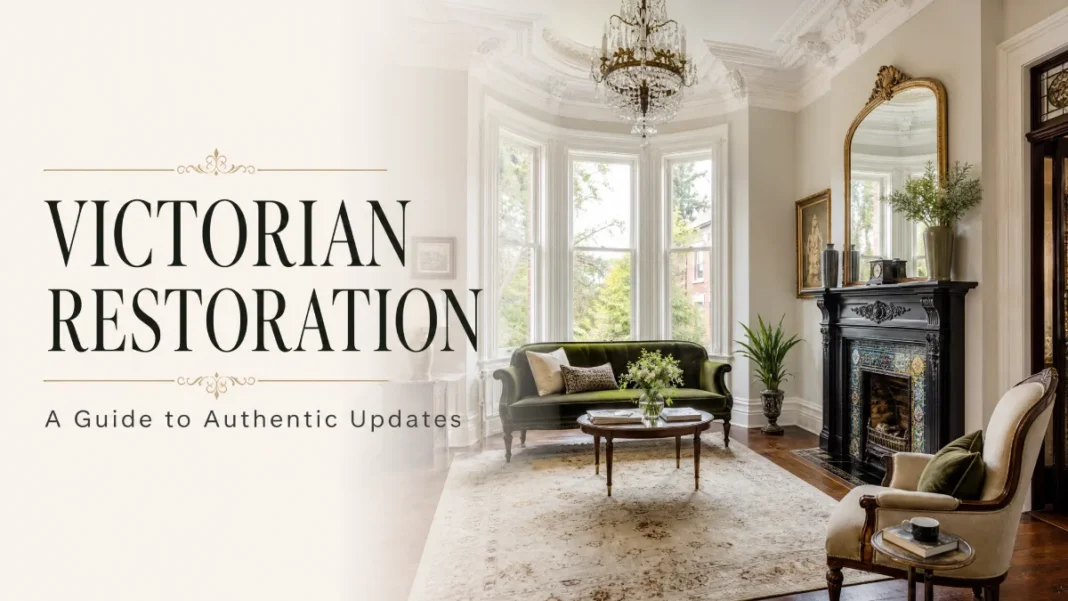
You didn’t buy a Victorian house to make it look like a new build. You fell for the high ceilings, the intricate trim, the stained glass that throws color across the hallway at 4 p.m. But now you’re standing in a kitchen that hasn’t been touched since the Eisenhower administration, wondering how to honor the past without living in a museum — or going broke.
You’re not alone. Heritage home renovations feel heavy because they are heavy. One wrong move and you erase the very character you paid a premium for. The good news: you can absolutely update for the way you live now while keeping every ounce of 1890s magic. You just need a framework that tells you what to save, what to tweak, and what to let go.
Here are seven concrete, designer‑tested ways to restore a Victorian house so it feels layered with history, utterly charming, and completely functional for modern life.
1. Learn Your Home’s Architectural Dialect First
Before you pick up a paintbrush, figure out exactly which Victorian you’re dealing with. The umbrella term “Victorian” covers a sprawling 60‑year stretch of wildly different styles. A Gothic Revival cottage wants pointed arches and steep rooflines. An Italianate demands tall, rounded windows and deep bracketed eaves. A Queen Anne begs for fish‑scale shingles, turned porch spindles, and asymmetrical massing. If you accidentally borrow details from the wrong sub‑style, the house starts to feel costume‑y instead of coherent.
Walk your neighborhood with fresh eyes. Snap photos of intact homes built in the same decade as yours. Note their window hood shapes, porch details, and siding patterns. That local catalog is your most honest design brief.
Once you know the dialect, every decision — from the profile of replacement baseboards to the style of a new storm door — gets filtered through one question: “Does this belong here?” When the answer is yes, the whole house breathes easier.
2. Restore Original Features Before You Replace Anything
It’s tempting to rip out drafty windows or tired floors on day one. Wait. Many elements you assume are beyond saving can be revived for less money than quality replacements — and they’ll look infinitely better.
- Wood windows: Original double‑hung windows with wavy glass are the eyes of a Victorian house. Have a skilled carpenter remove the sashes, repair any rot with epoxy consolidant, replace worn parting beads, and add interlocking weatherstripping. Pair them with a good storm window, and they’ll perform nearly as well as mid‑range new units while preserving irreplaceable character.
- Pine floors: Wide‑plank heart pine often hides under decades of carpet and glue. Refinishing will reveal a rich patina that no new engineered floor can replicate. Even dark stains and pet stains can be sanded past by a crew that knows antique wood.
- Plaster walls: Cracks and slight undulation aren’t defects; they’re proof of hand‑troweled craftsmanship. Unless the plaster has pulled away from the lath entirely, a skilled plasterer can fill cracks, patch missing sections, and skim‑coat for a fraction of a full drywall gut.
If you do have to replace a feature that’s completely lost, source a salvage original. Architectural salvage yards are packed with period‑correct doors, mantels, hardware, and even porch columns — often at prices competitive with new big‑box reproductions. You get the real weight, the real patina, and the right proportions.
3. Choose a Palette That Honors the Era, Then Bend It
Victorian color schemes were rich and confident — think deep burgundies, olive greens, ochres, and slate blues — but they weren’t always livable by today’s light‑seeking standards. You can capture that soulfulness without committing to a parlor that swallows all the daylight.
Layer two approaches. Use historically grounded hues in rooms meant to feel intimate and grounded: a dining room in Farrow & Ball’s “Studio Green” or a library in Benjamin Moore’s “Tucker Chocolate”. Then pivot to a lighter, modern‑Victorian palette in living spaces. Replace heavy burgundy with a dusty mauve like Sherwin‑Williams’ “Malted Milk,” and swap deep olive for a soft sage such as Farrow & Ball’s “French Gray.” The colors still feel authentic to the period’s muddied, complex undertones, but they give the home air and calm.
Don’t forget the trim. One of the greatest Victorian‑revival mistakes is painting everything stark white. Original trim was rarely pure white — it was cream, buff, or even a tone matching the wall in a lighter value. Try Benjamin Moore’s “White Dove OC‑17” or “Ivory White 925” for a soft, lived‑in contrast that won’t scream 2020s renovation.
4. Let the Hardware Do the Heavy Lifting
Original hardware is the jewelry of a Victorian house, and it’s often still lying in a drawer in the basement. Dig out the old rim locks, cast‑iron hinges, and brass mortise knobs. Even if they’re painted over, a slow‑crock‑pot soak in water and a little dish soap will lift decades of paint gently. (Yes, the crockpot trick works.)
If you’re missing pieces, skip the home center’s “Victorian” aisle. Instead, search House of Antique Hardware or Rejuvenation for exact reproductions with unlacquered brass, oil‑rubbed bronze, or period‑correct nickel finishes. Replace a handful of highly visible pieces — the front door set, the pantry latch, the stair‑newel rosette — and the whole house instantly feels more intentional.
One pro move: Mix metals the way the Victorians actually did. Brass sconces next to a nickel lock set? Totally appropriate. They used what was beautiful and available, not a matched set.
5. Modernize the Kitchen Without Betraying the House
No one wants a coal stove and an icebox. But a sleek, handle‑less European kitchen can feel like a spaceship landed in your Victorian home. The trick is to design a new kitchen that reads as furniture, not a laboratory.
Cabinetry
Choose an inset‑door construction with a simple Shaker or beaded frame. Paint them a soft heritage color — Farrow & Ball’s “Light Blue” or Benjamin Moore’s “Covington Blue” work beautifully — and avoid glossy finishes. A dead‑flat or matte lacquer lets the cabinetry recede.
Countertops
Soapstone or honed Carrara marble offer a soft, quiet luxury that feels authentic to the period. They’ll develop a patina that only gets better with age. If you need more durability, a leathered quartzite gives you similar depth without the etching anxiety.
Islands
Make the island look like a freestanding piece of furniture, not a built‑in block. Apply beadboard or tongue‑and‑groove panels to the back, add corbels or turned legs, and paint it a slightly deeper tone than the perimeter cabinetry — say, a warm charcoal against light blue.
The one modern flourish to keep: An unobtrusive induction cooktop. It gives you lightning‑fast control, looks clean, and keeps the kitchen from feeling like a period‑replica set.
6. Layer Lighting to Create That Hauntingly Beautiful Glow
Victorian homes feel magical when the light has layers. Relying on a single overhead fixture — especially a recessed can — flattens the whole room. Instead, build a lighting plan with four tiers: ambient, task, accent, and decorative.
- Ambient: Start with a central semi‑flush mount or chandelier that fits the era. Think etched glass shades, aged brass, and warm filament bulbs (2200K–2400K color temperature).
- Task: Add picture lights over art, articulated wall lamps by reading chairs, and under‑cabinet tape in the kitchen — all on separate dimmers.
- Accent: Use small, hidden uplights to wash tall ceilings, or tuck a narrow beam behind a carved newel post to highlight its silhouette.
- Decorative: This is your chance for whimsy. A beaded‑fringe sconce in a powder room, a slag glass table lamp on a hall console. One unexpected, purely pretty light source changes the mood of the entire floor.
If you need more ceiling light in a modern‑use space, install 2‑inch, trimless recessed lights strategically — only where you need task illumination — and keep them off the primary dimmer switch. That way you default to the period‑sensitive fixtures and use the recessed lights only when you’re actually chopping vegetables or sewing.
7. Know Where to Splurge and Where to Save
Heritage home renovations burn through cash when everything feels precious. Assign every line item to one of two buckets.
Splurge on:
- Restoration of original windows and doors
- Plaster repair and insulation retrofits (blown‑in cellulose behind existing plaster, not spray foam that risks trapping moisture)
- Period‑appropriate lighting in high‑visibility rooms
- Reproduction hardware on the main floor
- A high‑quality period‑sensitive kitchen design
Save on:
- Bathroom fixtures — a classic pedestal sink and a wall‑mount faucet from a mainstream brand still read as period when you surround them with wainscoting and a vintage‑style medicine cabinet
- Closet systems — nobody sees them; spend your money on visible built‑ins instead
- Paint — you can get a gloriously complex color from standard lines if you know what undertones to chase
- Reproduction woodwork in secondary spaces — simple flat‑stock profiles in bedrooms and upper hallways were common even in original Victorian homes
One final splurge you won’t regret: an hour with a local preservation consultant or a historian at your historical society. For a modest fee, they’ll walk through your house and tell you what’s original, what’s a 1920s add‑on, and what’s worth protecting. That clarity alone can save you from a five‑figure mistake.
Your House Is the Story — You’re Just the Next Chapter
Victorian homes have outlasted wars, recessions, and decades of questionable linoleum. Your renovation doesn’t need to freeze it in 1885; it just needs to keep the conversation going. When you restore the right things, update the right things, and let the house’s personality lead, you end up with something far richer than “updated” — you get a home that feels inevitable, like it was always meant to be this lovely.
Start by walking through your front door and asking which one element you’d miss most if it disappeared tomorrow. Protect that thing first. Everything else flows from there.
What’s the one original feature in your Victorian that you’re determined to save? I read every comment and would love to hear your story.

