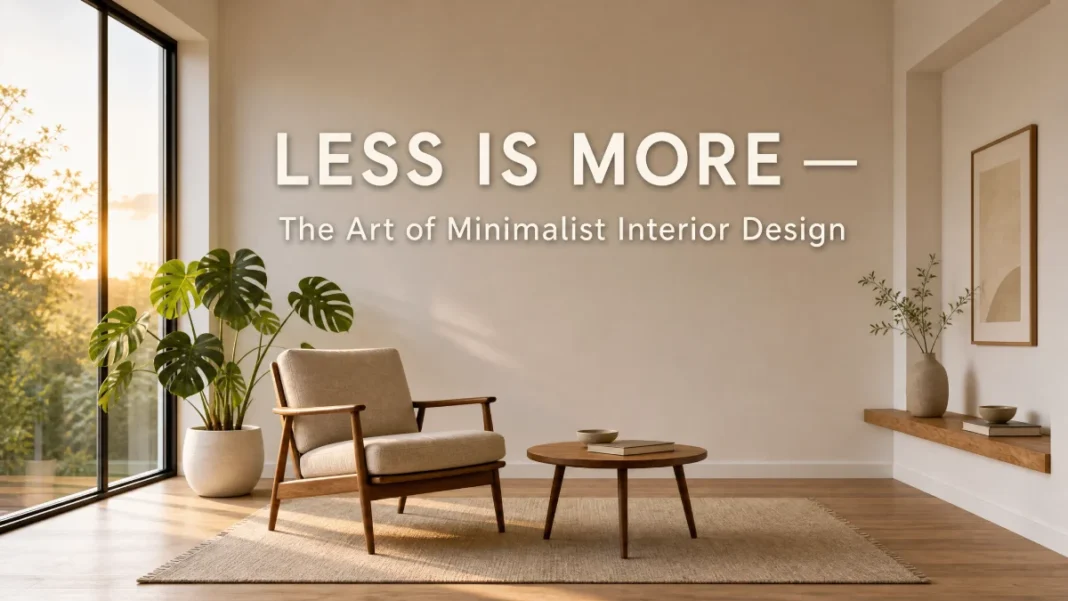
You’ve probably stood in your living room and felt the weight of your own things. The shelves are full. The surfaces collect piles. You crave calm, but everywhere you look, something is asking for your attention.
Maybe you’ve pinned serene, uncluttered interiors and thought, “That looks beautiful, but it could never work in my real life.” Here’s the secret: it can. Minimalism in interior design isn’t about living with nothing. It’s about making room for what genuinely matters.
In this guide, I’ll walk you through the philosophy behind minimalism in interior design, from Japanese aesthetics to Bauhaus principles, and then hand you a practical, room-by-room map to create a home that feels both luxurious and restful.
You’ll learn how to declutter with purpose, warm up a minimalist space so it never feels cold, and infuse it with your personality — all on a realistic budget.
The Roots of Minimalism: Where Less Became More
Minimalism didn’t start on a Pinterest board. Its roots run deep in centuries-old philosophy and early 20th-century design movements that responded to industrial clutter.
The Japanese Influence: Ma, Wabi-Sabi, and Zen
In traditional Japanese aesthetics, emptiness is never a void. The concept of Ma (間) refers to the meaningful pause — the negative space between objects that gives each element room to breathe. In your home, Ma is the clear stretch of wall that lets a single piece of art hold your gaze. It’s the empty counter that turns a simple ceramic bowl into a statement.
Then there’s wabi-sabi, the beauty of imperfection and transience. It celebrates materials that show their age with grace: a hand-thrown mug with an uneven rim, a linen sofa that softens over time, unfinished wood that bears the marks of the maker. Wabi-sabi reminds you that your home doesn’t have to be flawless to be beautiful — it just has to be real.
Zen Buddhism contributed the deeper layer: clarity through reduction. Monastic rooms contained only what was necessary for daily life, teaching that physical simplicity clears the mind. Your home can work the same way.
The Bauhaus School: Form Follows Function
Fast-forward to 1919 Germany, and the Bauhaus movement was reshaping the Western world’s relationship with objects. The school’s mantra, “form follows function,” meant that every piece should exist because it serves a purpose, not just because it decorates. Ornamentation wasn’t added for its own sake — beauty emerged from clean lines, honest materials, and thoughtful proportion.
Ludwig Mies van der Rohe, a Bauhaus director, distilled this into the now-famous phrase “less is more.” He wasn’t advocating deprivation. He was insisting that quality, light, and proportion speak louder than clutter. When you choose a well-made dining chair with no unnecessary flourishes, you’re living that principle. Decades later, the German industrial designer Dieter Rams carried this thinking forward with his ten principles of good design, the most distilled of which — “less, but better” (Weniger, aber besser) — continues to shape how we think about the objects we bring into our homes.
These two streams — Japanese reverence for space and European functional purity — converge in the modern minimalist home. Together, they give you permission to keep only what works and only what resonates.
Marie Kondo and the Modern Decluttering Movement
You can’t discuss minimalism’s surge in homes without acknowledging Marie Kondo. Her KonMari method flipped the script on decluttering. Instead of asking “What should I discard?” she asked, “What sparks joy?”
That emotional check-in transformed millions of cluttered drawers and bursting closets. For the first time, many people handled every single possession and made a conscious choice about whether to keep it. The side effect? Suddenly, they were left with emptier spaces that begged for intentional design.
But here’s where the conversation often stops short. Tidying is not the same as designing. You can clear out everything that doesn’t spark joy and still end up with a room that feels disjointed, flat, or impersonal. The KonMari method gives you the raw material — space — and then it’s up to you to shape that space into a home.
That’s what this guide is about. Decluttering is the first brushstroke on a fresh canvas. The philosophy of minimalism in interior design is the composition that follows.
The Core Principles of Minimalist Interior Design
Before you move a single piece of furniture, let’s get clear on the principles that make a space feel intentionally minimal — not just empty.
1. Intentionality Over Absence
Minimalism lives and dies on purpose. Every object in a room should serve a function, hold deep meaning, or both. The Victorian designer William Morris put it plainly decades before minimalism had a name: “Have nothing in your houses that you do not know to be useful or believe to be beautiful.” That doesn’t mean you can’t own beautiful things.
It means the ceramic vase on your console is there because you love its shape, not because you needed to fill the spot. This principle, which I call intentional selection, turns your home into a curated collection rather than a storage unit.
2. Negative Space as an Active Element
Negative space isn’t wasted space — it’s the silence that makes the notes audible. In design terms, negative space gives your eyes a place to rest. It allows the few items you do display to command attention. Think of a gallery wall with only three framed pieces, spaced generously apart. Each piece feels important. Cram 10 frames together, and nothing stands out.
3. Quality Over Quantity
Minimalism invites you to own fewer, better things. One solid wood coffee table that will age beautifully for 20 years beats three particleboard alternatives that need replacing. This doesn’t demand a luxury budget. It demands that you be patient, buy secondhand when you can, and save for the piece that elevates the room. The goal is curated longevity, not instant gratification.
4. Honest Materials and Clean Lines
Bauhaus’s legacy lives on in the celebration of raw, unadorned materials. Wood shows its grain. Stone feels cool and textured under your fingertips. Linen wrinkles elegantly. In a minimalist home, surfaces aren’t hidden under heavy ornamentation — they’re part of the beauty. Clean lines keep silhouettes simple, which makes a room feel orderly and calm.
5. Light as a Design Element
You can’t have minimalism without light. Natural light amplifies space and warms up honest materials. When you reduce visual clutter, daylight becomes the main event. Make it a priority: remove heavy drapes, keep windowsills clear, and position mirrors to bounce light into darker corners. At night, use layered, warm-toned lighting — floor lamps, wall sconces, and dimmable overheads — to create pools of intimacy.
Why Minimalism Isn’t Cold or Empty
This is the worry I hear most often: “I don’t want my house to feel like a sterile gallery.” I get it. But true minimalism in interior design is anything but cold — when you know how to build in warmth.
Texture Is Your Greatest Tool
Coldness comes from uniformity, not from emptiness. A room painted entirely in flat white with hard, glossy surfaces will feel clinical. But swap in a nubby wool rug, a chunky knit throw, linen curtains, and a matte ceramic lamp, and the same white-walled room becomes a cozy cocoon. Use at least three different textures in every room to engage the senses.
Organic Materials Soften Edges
Wood, rattan, clay, wool, and stone all carry visual warmth. A live-edge wooden bench at the foot of the bed, a woven seagrass basket holding blankets, or a simple stoneware mug on your desk — these elements ground the space in nature, making it feel alive.
Warm Neutrals Over Stark Whites
You don’t have to live with icebox walls. Paint your main living areas a soft warm white like Benjamin Moore’s White Dove OC-17. It has subtle creamy undertones that wrap a room in a gentle glow. For trim and ceilings, consider a slightly cooler white to create quiet depth without contrast that shouts.
Lighting Temperature Matters
Always choose bulbs between 2700K and 3000K — warm white, not daylight blue. Cool lighting in a minimalist room will flatten the atmosphere instantly. Warm light flatters skin tones, highlights wood grain, and makes any space feel welcoming.
The Emotional Benefits of Living with Less
You didn’t arrive here just for a pretty house. You’re seeking relief. Clutter isn’t merely physical; it occupies mental bandwidth. A 2010 UCLA study by researchers Darby Saxbe and Rena Repetti found that people who described their homes using cluttered or stressful language had consistently higher cortisol levels throughout the day. A minimalist home, by contrast, becomes a restorative environment.
When your surfaces are clear, your morning coffee ritual feels more like a meditation and less like a race. You can find your keys without digging. You walk into your bedroom, and your shoulders actually drop. That’s the quiet power of visual rest.
Minimalism also rewires your relationship with consumption. You start to ask, “Will this add lasting value, or will it become tomorrow’s clutter?” That shift alone reduces impulse buys, saves money, and cultivates a deeper appreciation for the things you already own.
A simplified home also gives you back time — less cleaning, less organizing, less managing of stuff. And that time, you can spend on what actually makes life feel full.
The Practical Decluttering Method: A Step-by-Step Guide
Now, let’s turn philosophy into action. This method is inspired by the KonMari approach but adapted specifically to guide your interior design choices.
Step 1: Define Your Vision
Before touching a single item, write down three words that describe how you want your home to feel. Calm, light-filled, and gathered? Serene, warm, and uncluttered? These words become your filter.
Step 2: Tackle by Category, Not Room
Clothes first, then books, papers, miscellaneous items (komono), and finally sentimental objects. Piling all your books from every room onto the floor reveals how much you actually own and makes it easier to let go.
Step 3: The Joy-and-Use Check
Hold each item. Ask yourself two questions: “Does this serve a clear purpose in my current life?” and “Does it make me feel something positive?” If the answer to both is no, thank it and let it go. This dual check prevents you from discarding practical items you need and from keeping objects that only carry guilt.
Step 4: Create a “Pause Box”
For items you’re unsure about, place them in a box, seal it, and mark a date six months from now. If you haven’t opened the box by that date, donate it without reopening. This protects you from rash decisions and proves how little you miss those things.
Step 5: Assess the Space That Remains
Once you’ve decluttered, live in the cleared space for a few days. Notice where the light falls, where you gravitate naturally. This observation will inform your room-by-room design decisions. You’re not just removing — you’re preparing a canvas.
A Room-by-Room Guide to Minimalist Living
Now you’ll apply the principles to every zone of your home. Each room has a distinct purpose, and minimalism should amplify that purpose.
The Living Room
Your living room is for connection and unwinding. Start by removing any furniture that doesn’t support conversation or comfort. A low-profile sofa in a performance linen blend, a pair of armchairs, and a simple coffee table are often enough.
Clear all surfaces except for two to three intentional objects. A stack of art books on the coffee table, a sculptural bowl on the console, a single ceramic vase with a branch. Keep technology and cords hidden — use a media console with closed storage. Anchor the room with a large, textured area rug in jute or wool. Paint the walls White Dove, and add warmth through throw pillows in varied neutral textures like bouclé, linen, and chunky wool.
Budget-friendly luxury: Buy a quality sofa secondhand and reupholster it. Splurge on one piece of art that you love and let it breathe on a large empty wall.
The Kitchen
A minimalist kitchen isn’t about hiding that you cook; it’s about celebrating the ritual. The single most transformative act? Clear your countertops. Store small appliances you don’t use daily in lower cabinets. Keep only a wooden cutting board, a vessel with a wooden utensil or two, and a simple soap dispenser out.
Use uniform glass jars for pantry staples like flour, oats, and coffee. They create visual harmony and make ingredients feel abundant. Opt for cabinet fronts with minimal detailing — flat-panel or Shaker-style — and choose hardware-free push latches if you’re renovating. Even simple updates, like swapping out busy knobs for slim brass pulls, shift the energy.
Actionable step: Dedicate one weekend to decanting and organizing the pantry. The calm that hits when you open that door will reinforce every other step you take.
The Bedroom
The bedroom should contain only what promotes rest and intimacy. Remove the treadmill, the work papers, the pile of random decor. Select a bed frame with a simple silhouette — an upholstered wingless headboard or a solid wood platform frame. Dress the bed in white or flax linen bedding; the texture reads as luxurious without a single pattern.
Nightstands hold just a lamp, a book, and perhaps a small ceramic dish for jewelry. Closets get the same decluttering treatment — when your clothing is pared down to what you truly wear and love, getting dressed becomes a pleasure, not a negotiation. Consider building a capsule wardrobe: a tight rotation of versatile, high-quality pieces in a cohesive color palette that eliminates decision fatigue before you’ve had your coffee.
Warmth check: Add a shearling throw at the foot of the bed and a wool rug on either side. Softness underfoot in the morning makes a measurable difference in how you start your day.
The Bathroom
Transform your bathroom into a miniature retreat. Decant soaps, shampoos, and lotions into matching amber or frosted glass pump bottles. It costs little and immediately reduces visual label noise. Keep countertops nearly bare — maybe a small tray with a candle and a vase of eucalyptus.
Use natural materials wherever possible: a teak shower stool, stone soap dishes, a cotton waffle robe hanging on a simple hook. White towels, folded neatly on an open shelf, feel hotel-luxurious. You’re not hiding function; you’re elevating it.
The Home Office
A minimalist workspace trains your brain to focus. The desk holds only your computer, a task light, and perhaps a single plant or object you love. Cords vanish with under-desk cable trays. Use floating shelves sparingly — display only a few reference books and one personal item.
Choose a chair that’s both ergonomic and visually quiet, like a molded wood shell or an upholstered design in a solid neutral. The wall color should be calm but slightly grounding; consider Benjamin Moore’s Pale Oak OC-20, a warm greige that cocoons without darkening.
Entryways and Hallways
This is the threshold between the outside world and your sanctuary. A minimalist entryway makes coming home feel like a release. Install a few sturdy hooks for coats and bags — fewer hooks mean fewer abandoned jackets. A slim console or wall-mounted shelf holds a single tray for keys and a small lamp or vase. A natural fiber runner grounds the space. Add a small bench where you can sit to remove shoes, and you’ve turned a pass-through into a ritual.
How to Personalize a Minimalist Space
A home that feels like nobody lives there fails the ultimate test. Personalization is what makes minimalism in interior design sing.
- Use what you already love. That hand-thrown pottery mug from a trip, your grandmother’s worn wooden stool — these are the pieces that tell your story. In a clutter-free room, they shine. Instead of 20 small trinkets, display one or two meaningful objects per surface.
- Art with heart. Hang artwork that speaks to you, not just what “matches.” A single large-scale photograph, a child’s framed drawing in a simple white mat, or a textured fiber wall hanging all inject personality without noise.
- Books as decor, but with intention. Stack three beautiful books on a side table, top with a small object, and you’ve created a vignette. Choose books you’ll actually pick up and revisit.
- Plants bring life. A single fiddle-leaf fig in a woven basket or a trailing pothos on a shelf adds organic movement and softness. They’re living sculptures that grow with you.
- Sentimental placement. The quilt your mother made belongs on the back of your reading chair, not hidden in a closet. When you see and use it daily, it fulfills its purpose. Minimalism isn’t about erasing memory; it’s about elevating the items that hold it.
Bringing It All Together
Minimalism in interior design isn’t a style you copy — it’s a relationship you build with your space. It’s the Japanese pause between objects and the Bauhaus conviction that function is beautiful. It’s the clarity Marie Kondo brought to our drawers and the emotional peace that follows when your surroundings truly support you.
You don’t have to achieve it all in a weekend. Clear one counter. Remove one piece of furniture that’s just taking up space. Paint one wall in White Dove and see how the light changes. The process is gentle, but the transformation is profound.
Your home is ready to breathe. All you have to do is let it.

