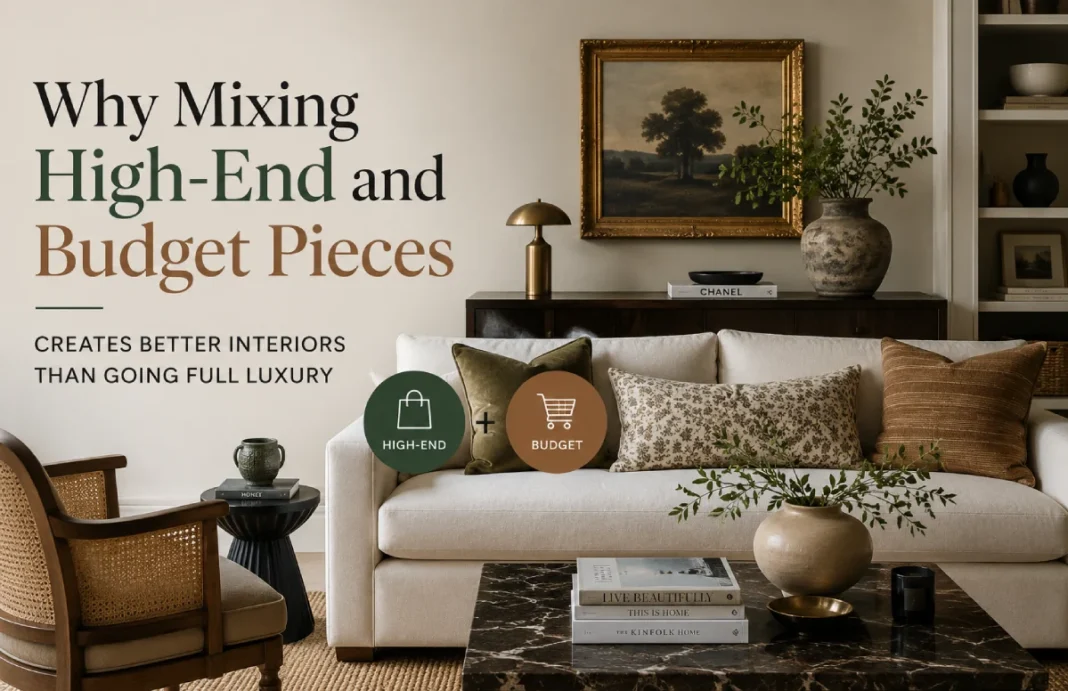
You’ve walked into a room that technically had everything “expensive” — and it felt cold, stiff, and a little like a furniture showroom. There was no tension, no story. That’s the problem with going full luxury. When every piece in a room shouts “I spent a lot,” the space loses personality and warmth.
The truth is, the most beautiful interiors almost always blend high and low. A vintage side table next to a stunning new sofa. A $30 ceramic vase that holds its own beside a brass floor lamp you splurged on. Mixing high-end and budget pieces creates better interiors than going full luxury because it builds layers, contrast, and a collected-over-time feel — without draining your bank account.
Here’s where to invest, where to save, and how to spot quality in even the most affordable finds — with side-by-side comparisons, room-by-room advice, and designer tricks from years of real projects.
Let’s build a home that feels rich, not rigid.
The Case Against a Fully Luxury Room
An all-luxury room often lacks the one thing that makes a space feel like yours: imperfection. When every item is flawless and pricey, the eye has nowhere to rest. There’s no surprise, no contrast. High-end pieces need more humble companions to shine.
Think of it like an outfit. A designer blazer paired with well-worn jeans always looks more interesting than a head-to-toe runway look. The same principle applies to your living room.
A high-low mix signals confidence and a personal point of view. It also lets you take risks. When you’re not sinking your entire budget into one item, you can play with color, pattern, and texture with affordable accents you can swap out later.
The Art of High-Low Mixing: Where to Invest and Where to Save
Some pieces are worth every penny. Others don’t need to be expensive to look incredible. The key is knowing the difference. A solid starting point is the 70/30 rule: roughly 70 percent budget-friendly foundations and 30 percent investment pieces, a ratio that keeps a room grounded without sacrificing polish.
Investment Piece 1: The Sofa
Your sofa is the workhorse of your living room. It takes daily wear, holds your family during movie nights, and anchors the whole space. This is where you invest in solid construction and high-resilience foam or down-wrapped cushions.
Look for a frame made of kiln-dried hardwood and joinery that’s screwed and glued, not stapled. Upholstery should have a rub count of 30,000 double rubs or more — a number you can often find right on the fabric swatch tag. A well-built sofa can last 15 years or more. A cheap one will sag in three.
- Splurge: Maiden Home’s Sullivan Sofa (from around $2,400) with a bench-made hardwood frame and performance linen.
- Save: IKEA’s Kivik Sofa (under $800) fitted with a custom slipcover from Bemz. The cover alone elevates the look, and you can change it when trends shift.
Investment Piece 2: The Bed
You spend a third of your life in bed. A quality mattress transforms your sleep, your mood, and your health. Pair it with a sturdy bed frame that doesn’t squeak, and you have a foundation worth investing in.
- Splurge: Saatva Classic mattress (around $1,700 for a queen) paired with a Thuma bed frame (about $1,100), known for its quiet, tool-free joinery.
- Save: A Zinus Green Tea Memory Foam mattress (under $400) on an IKEA Tarva bed frame that you sand and paint a deep charcoal. Add a plush mattress topper, and the comfort rivals setups twice the price.
Where you can save: nightstands, throw blankets, and decorative pillows — the supporting cast, not the star.
Investment Piece 3: Lighting
Lighting is the jewelry of a room. A single statement pendant or chandelier can define a dining area or entryway. Good lighting changes how every other object looks. Invest in pieces that use quality metals, have a reassuring weight, and come with a warranty.
- Splurge: Visual Comfort’s Marie Flush Mount (from $400) in polished nickel.
- Save: A vintage brass pendant found at a thrift store or Habitat for Humanity ReStore for $40, rewired by a local lamp shop for another $50. You get a one-of-a-kind piece with real patina that no big-box store can replicate.
Where to Save: Accessories & Seasonal Decor
Vases, trays, faux stems, holiday accents, and decorative objects are where your budget can truly breathe. Trends change, and your taste will evolve. There’s no reason to spend a lot on a throw pillow you might love this year and rehome next fall.
Affordable sources I return to again and again:
- H&M Home for linen-blend cushions and stoneware vases that look far more expensive than their $15–$40 price tags.
- Target’s Threshold and Project 62 lines for ceramic lamps and sculptural objects with great weight and finish.
- West Elm for mid-range accent furniture and decor with a modern edge that punches above its price point.
- Thrift stores and estate sales for one-of-a-kind bowls, brass candlesticks, and framed art.
- Chairish and 1stDibs for vetted vintage and secondhand designer pieces you can browse without leaving your couch.
A quick quality check in the aisle: pick up the object. If it feels solid and has a finished bottom (felt pads, a clean glaze line), it will read as high-end on your shelf.
Area Rugs: A Smart Splurge or Save?
Rugs are a bit of a hybrid. In high-traffic zones like living rooms and hallways, a well-made wool rug pays you back in durability and timeless texture. In low-traffic areas or under a dining table where spills happen, an affordable jute or polypropylene blend is perfectly practical — and can be replaced without heartbreak.
- Splurge: Armadillo’s Agra Wool Rug (around $1,500 for a 5×8).
- Save: Rugs USA’s hand-braided jute rug (under $200 for the same size) layered with a smaller vintage wool kilim found on Etsy for under $150.
Side-by-Side Product Comparison: High-End vs. Budget Picks
Here’s how the splurge and save choices come together across key rooms.
| Room | Splurge Pick | Budget Alternative | Why It Works |
|---|---|---|---|
| Living Room | Maiden Home Sullivan Sofa (~$2,400) | IKEA Kivik + Bemz cover (~$800 total) | Custom cover elevates silhouette; high-density foam core holds shape. |
| Bedroom | Saatva Classic Mattress + Thuma Bed (~$2,800) | Zinus Memory Foam + painted IKEA Tarva (~$600) | Mattress topper adds plushness; DIY paint turns basic pine into a statement. |
| Dining Area | Room & Board Parsons Dining Table (~$1,800) | World Market solid acacia table (~$450) | Solid wood construction at both levels; you sand and reseal the budget version for a custom finish. |
| Entryway/Living | Visual Comfort Marie Flush Mount (~$400) | Thrifted brass pendant rewired (~$90) | Real aged brass and custom wiring give authentic patina no reproduction can match. |
When you pair the splurge item with the budget alternative, the room feels intentional, layered, and polished — never like a catalog.
Designer Tricks for Budget Shopping Like a Pro
Great finds aren’t about luck. They’re about knowing where to look and what to look for.
Thrift Stores and Facebook Marketplace Goldmines
I’ve scored solid brass lamps for $20, a vintage walnut dresser for $80, and original oil paintings for $15 — all because I search with intention.
What to search for on Marketplace
“Solid wood dresser,” “brass floor lamp,” “dining table walnut,” “vintage mirror heavy.” Use those exact phrases. Check listings on Saturday mornings and weekday evenings, when new items typically get posted.
At thrift stores, skip the furniture with veneer bubbling or particleboard that’s started to swell. Look for dovetail joinery in drawers, real wood backs on case goods, and lamps that feel heavier than they look — a sign of quality brass or ceramic, not hollow resin.
Timing Your Purchases for the Best Deals
Furniture and decor follow predictable sale cycles. Plan your bigger “save” buys around these windows:
- Late January through February: Retailers clear inventory after the holidays. Great for rugs, accent furniture, and bedding.
- Memorial Day and Labor Day weekends: Mattresses, sofas, and outdoor furniture get deep discounts.
- Black Friday and Cyber Monday: Lighting, small decor, and seasonal items from even high-end brands drop significantly.
- Wayfair’s annual Way Day and similar site-wide events often bring 48-hour steep markdowns.
Set a price alert (using Google Shopping or a browser extension) for the specific items on your wish list. Patience alone can save you 20–40%.
Quality Indicators That Make a $50 Vase Look Like $500
I always teach my clients to shop with their senses, not just the price tag. The difference between “cheap” and “inexpensive but gorgeous” often comes down to a few details you can spot in seconds.
- Weight: A ceramic vase with heft signals high-fire stoneware or porcelain, not lightweight earthenware. Pick it up — if it feels substantial, it will look substantial on your console.
- Bottom Finish: Turn the piece over. If the glaze wraps under the base and there’s a felt pad, you’re holding something made with care. Unfinished, rough bottoms scream mass-produced.
- Lampshade Quality: On a budget lamp, check if the shade is a natural linen or cotton blend rather than shiny polyester. A $30 replacement shade in oatmeal linen instantly upgrades a thrift-store lamp base.
- Wood Surfaces: Run your hand across the top. Solid wood will have subtle grain texture and visible end grain on the edges. If it feels perfectly smooth and plasticky, it’s likely laminate or heavy veneer.
How to Spot Quality in Budget Items — The Checklist
Print this or screenshot it for your next shopping trip. These indicators hold whether you’re spending $40 or $4,000.
- Upholstered furniture: Double rub count of 30,000+ on the fabric tag; cushion cores that spring back quickly when you press down; frames that don’t creak when you lift one corner slightly.
- Wood furniture: Drawers with dovetail joints, solid wood drawer bottoms, and back panels that are at least finished plywood (not flimsy cardboard).
- Ceramics and stoneware: Consistent glaze with no pinholes; a fully finished bottom; weight proportional to size.
- Metal accents (lamps, hardware, side tables): Cool to the touch, heavier than expected, and free of visible seams or mold lines.
- Rugs: Hand-knotted or hand-tufted wool (look at the back — hand-knotted shows the same pattern as the front, just less crisp). Jute rugs should have tight, even braiding without loose strands.
When you train your eye to spot these markers, you’ll stop overpaying for branding and start collecting pieces that genuinely last.
Conclusion
Mixing high-end and budget pieces creates better interiors than going full luxury because it tells a story. The splurge-worthy sofa anchors the room. The thrifted brass lamp adds soul. The affordable ceramic vase on the coffee table makes the whole arrangement feel effortless, not precious.
You don’t need to finish your home in a single weekend. The best rooms come together slowly — an investment piece here, a budget discovery there — guided by your life, not a showroom floor plan. Trust your eye, touch everything before you buy it, and permit yourself to mix.
What’s the best high-low pairing you’ve ever created? Drop a comment below and share your favorite splurge-and-save combo. Your story might be exactly the inspiration someone else needs.

