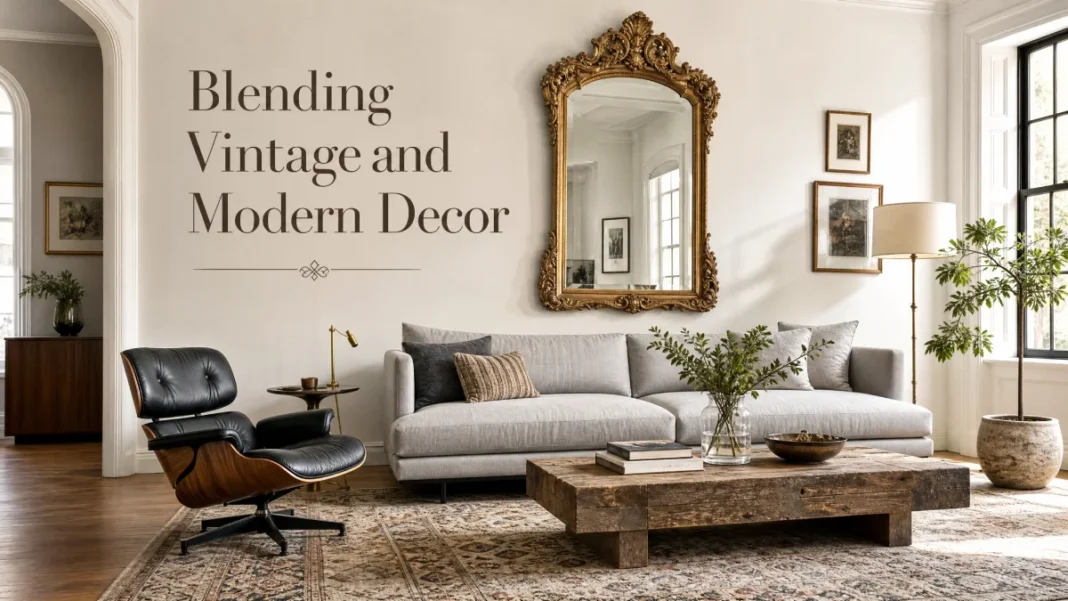
You’ve walked into that room before. The one where a sleek, modern sofa sits next to a timeworn wooden trunk, and a glossy abstract painting hangs above a weathered French sideboard. The space feels collected, intentional, and utterly you. That’s the power of blending vintage and modern decor. It’s the antidote to rooms that look like a furniture showroom staged overnight. It’s also the secret to making a home feel layered with stories instead of pulled from a single catalog page.
If you’ve tried mixing old and new but ended up with a space that feels chaotic, not curated, you’re not alone. The line between eclectic magic and “visual clutter” can feel frustratingly thin.
The good news? There’s a formula designers rely on, and it’s easier to execute than you think.
I’ll walk you through the principles, the golden ratio, exactly where to find those one-of-a-kind pieces, and how to layer them room by room without a single clash.
The Soul of a Collected Home: Why Vintage Meets Modern Works
Spaces that blend eras feel rich because they create tension. A crisp, contemporary armchair gains warmth next to a chippy 19th-century pedestal table. A minimalist white kitchen suddenly has personality when you pull up a set of vintage bentwood stools. The contrast gives the eye something to discover, and that discovery makes the room feel deeply personal.
Before we go further, let’s clarify two terms.
- Vintage items are typically 20 to 99 years old.
- Antiques are 100 years or older.
Both carry a sense of history, but don’t let the labels intimidate you. A 1970s Italian ceramic lamp is technically vintage. So is your grandmother’s 1950s mahogany dresser. What matters is the character they bring—patina (the natural wear that comes with age), provenance (an item’s origin story), and craftsmanship you rarely find in mass-produced pieces today.
The Japanese philosophy of wabi-sabi—finding beauty in imperfection and transience—captures exactly why these pieces resonate so deeply. Choosing vintage also keeps solid, repairable furniture out of landfills—discarded furnishings are among the least recycled household items in the U.S.—making this approach as sustainable as it is stylish.
When you mix these storied objects with clean-lined modern pieces, you get the best of both: a home that feels fresh yet grounded, luxurious yet approachable.
Mastering the Golden Ratio of 70-30 Balance
Over the years, I’ve found that a 70-30 rule creates harmony without feeling like a themed set. Start with a 70% modern foundation—your largest, hardest-working pieces. The sofa, the bed frame, the dining table, the main lighting, the window treatments. Keep these current, neutral, and relatively streamlined. They do the heavy lifting and set the tone.
Then layer in 30% vintage accents. This is where your personality lives. A 1920s Persian Heriz rug under a modern coffee table. A pair of 1960s Murano glass lamps on a minimalist credenza. An antique brass mirror leaning against the wall in a contemporary bathroom. The vintage pieces become the room’s jewelry—small in volume, huge in impact.
Why 70-30 works: Your eye registers the modern backdrop as calm and reliable. The vintage pieces read as intentional treasures, not accidental clutter. If you flip the ratio and fill a room with mostly old pieces, you risk a dusty period-film set. Keep 70% modern, and the space feels livable, fresh, and current.
How to Blend Eras Without Clashing
A unified mix isn’t luck. It’s a few deliberate design moves that tie everything together.
Choose One Unifying Color Story
Pull your color palette from a single vintage piece you love, then repeat those hues across modern and old items alike. Let’s say you find a faded Turkish Oushak rug with soft terracotta, denim blue, and ivory. Paint your walls Benjamin Moore White Dove OC-17, add a modern navy velvet sofa, and repeat the terracotta in a vintage ceramic bowl on the coffee table. The rug is the bridge; everything else falls in line.
Use Materials as Connectors
Mix textures to keep the eye moving. A shiny acrylic side table makes a distressed wooden sculpture pop. A hammered brass vintage tray on a matte black console feels intentional because the metals contrast but both are substantial. Repeat one material—like unlacquered brass or blackened steel—in two or three places across old and new pieces. That repetition whispers “curated” instead of “collected at random.”
Respect Scale and Proportion
A dainty Victorian settee will look lost in front of an oversized sectional. Anchor a room with a substantial modern piece, then bring in smaller-scale vintage accents. That said, one statement vintage piece with presence—like a chunky 1940s oak library table as a desk—can hold its own beautifully next to a sleek modern chair. Always measure, and always trust your gut: if it feels visually heavy on one side, rebalance.
Shape Play
If your modern furniture is all sharp angles, introduce a curved vintage element—a round 1970s Lucite lamp, an arched antique mirror, a tufted velvet slipper chair. The mix of straight and soft lines keeps the room dynamic without fighting.
Sourcing Vintage Pieces Like a Pro
Knowing where to look changes everything. Here are the best channels, whether you prefer browsing from your couch or digging through dusty crates in person.
Online Marketplaces
- Chairish & 1stDibs: Best for curated, high-quality vintage furniture and art. Prices reflect the curation, but you’ll find spectacular verified pieces with detailed condition reports.
- Etsy & eBay: Ideal for smaller accessories—vintage brass candlesticks, old oil paintings, mid-century pottery. Use filters to sort by “vintage” and read seller reviews carefully.
- Facebook Marketplace & Craigslist: The wild cards. You’ll uncover great deals from people clearing out estates, but you need patience. Search “vintage wood dresser,” “antique desk,” or “mid-century chair” locally, and be ready to pick up quickly.
In-Person Goldmines
- Estate sales: You’re walking through someone’s entire life, often priced to sell by the end of the weekend. Use EstateSales.net to find upcoming sales in your area. Go on the first day for the best selection, or the last day for 50%-off bargains. Look for solid wood dovetail drawers, maker’s marks inside drawers, and real marble or stone tops.
- Flea markets: Perfect for smalls—picture frames, trays, vintage books, mirrors. Well-known markets like the Brimfield Antique Show in Massachusetts and Round Top in Texas are destination-worthy, but even your local weekend flea market can turn up gems. Bring cash, a tape measure, and a friendly smile. The best deals come when you ask, “Is this your best price?” and you’re willing to bundle a few items.
- Thrift stores (Habitat for Humanity ReStores, Salvation Army): Hit or miss, but when you spot a heavy brass lamp or a solid cherry side table, grab it. These pieces often need nothing but a good cleaning.
| Platform | Best For | Typical Price Range | Pro Tip |
|---|---|---|---|
| Chairish | Statement furniture & lighting | $$–$$$$ | Create alerts for saved searches to snag new listings fast. |
| 1stDibs | High-end antiques & art | $$$$+ | Use the “Make an Offer” feature—sellers often accept 10–15% less. |
| Etsy | Small decor, pottery, textiles | –$$$$$$ | Filter by shop location to save on shipping and see items faster. |
| eBay | Collectibles, lamps, unique oddities | $–$$$$ | Check “sold” listings to gauge real market value before bidding. |
| Facebook Marketplace | Furniture, case goods, rugs | –$$$$$ | Search generic terms like “old wooden cabinet” to find underpriced gems. |
| Estate Sales | Everything—furniture to linens | $–$$ (often negotiable) | Bring a screwdriver and a tape measure; look for dovetail joints. |
| Flea Markets | Small accessories, art, mirrors | –$$$$$ | Arrive early for the best picks, but stay late for the steepest discounts. |
A quick sourcing checklist
- Measure your space and the piece’s dimensions before you buy.
- Ask about odors, structural wobbles, and upholstery condition.
- Check for woodworm, water rings, and deep cracks. Surface wear is character; structural damage is a headache.
- Negotiate respectfully. “I love this, could you do $___?” works better than “What’s your lowest price?”
Common Vintage-Modern Decorating Mistakes (and How to Avoid Them)
- Too much vintage, not enough breathing room. Crowding every surface with antique treasures looks like a shop, not a home. Let each vintage piece have visual space. A single gallery wall of old landscape paintings makes a statement; plastering every wall with frames dilutes the impact.
- Ignoring negative space. White walls, empty corners, and clear tabletops are not wasted space—they’re visual rest stops. They let your favorite finds stand out.
- Mixing too many distinct styles in one room. A French Rococo mirror, an industrial metal cart, a mid-century lamp, and a rustic farmhouse bench in one living room create confusion. Pick two, maybe three, design eras—mid-century modern, Art Deco, Scandinavian modern, and Bauhaus are popular starting points—and repeat them.
- Over-restoring. Resist the urge to strip every scratch. The patina tells the story. A light cleaning and a coat of wax on a wooden piece preserves its soul while making it livable.
- Forgetting lighting. Vintage pieces often need focused light to shine. A tiny art light above an antique painting or a well-placed floor lamp next to a vintage chair elevates the entire vignette.
- Matchy-matchy wood tones. Don’t try to match your new walnut coffee table to your vintage walnut sideboard exactly. Mixed wood tones add depth. Just ensure the undertones—warm, cool, or neutral—play nicely together.
Room-by-Room Guide: Specific Pieces to Hunt For
Living Room
A vintage Persian, Turkish, or Moroccan rug instantly warms a modern sofa. I often start with a faded red or blue Oushak and then build the room around it. Keep your sofa modern and neutral—think an Article Sven in ivory or a West Elm Andes in performance linen.
Then add a vintage accent chair, like a 1960s Danish teak armchair by Hans Wegner or a similar Scandinavian maker, reupholstered in a creamy bouclé. A pair of mid-century brass swing-arm sconces on the wall ties the eras together without taking up floor space.
Dining Room
A 1920s French farm table with a thick plank top and turned legs makes a striking contrast to sleek, modern chairs. Use molded plastic Eames DSW chairs in black or white, or Hay About A Chairs in a soft grey. Hang a contemporary linear chandelier in matte black above.
Add a vintage 1940s oak buffet as a sideboard—the mix of rustic wood, modern seating, and clean lighting feels sophisticated and relaxed.
Bedroom
Your bed should be a modern upholstered sanctuary—think a low-profile CB2 Drommen bed in a neutral linen. Above it, hang a 19th-century giltwood or carved mahogany mirror horizontally. It adds romance and reflects light, making the room feel larger.
Flank the bed with mismatched vintage nightstands: maybe a 1930s waterfall vanity on one side and a simple 1950s walnut cube on the other. Unify them with matching modern table lamps in ceramic or plaster from a source like Rejuvenation or Cedar & Moss.
Home Office
Start with a clean-lined modern desk—a simple glass-topped brass desk or a matte white writing table. For the chair, go vintage: a 1970s chrome and cane Cesca-style armchair, based on Marcel Breuer’s iconic 1928 tubular steel design, is comfortable and full of personality.
Add a vintage brass banker’s lamp with a green glass shade for a dose of old-world warmth, then set the desk with modern acrylic organizers. The result is disciplined yet inviting.
Entryway
A narrow console table in a glossy modern lacquer finish feels elevated when you hang a distressed vintage gold sunburst mirror above it. Add a 19th-century cast-iron umbrella stand next to a modern round jute rug.
One statement piece—a tall Victorian walnut hall tree—can turn a blank wall into a conversation starter. Keep the rest of the space minimal to let the history shine.
Conclusion
A home that blends vintage and modern decor doesn’t just look beautiful—it feels like a biography of the people who live there. The chipped paint on a dresser holds memories of another life. The sleek sofa says you live here, now, with comfort and ease. That tension between old and new is where the real magic lives.
Start small. Hunt for one vintage piece this weekend—maybe a brass lamp, a small oil painting, or a worn wooden stool. Bring it home, pair it with your most modern piece, and watch the room come alive. Before you know it, you’ll have a home that’s impossible to replicate and unmistakably your own.
What’s the first vintage piece you’d love to track down?

