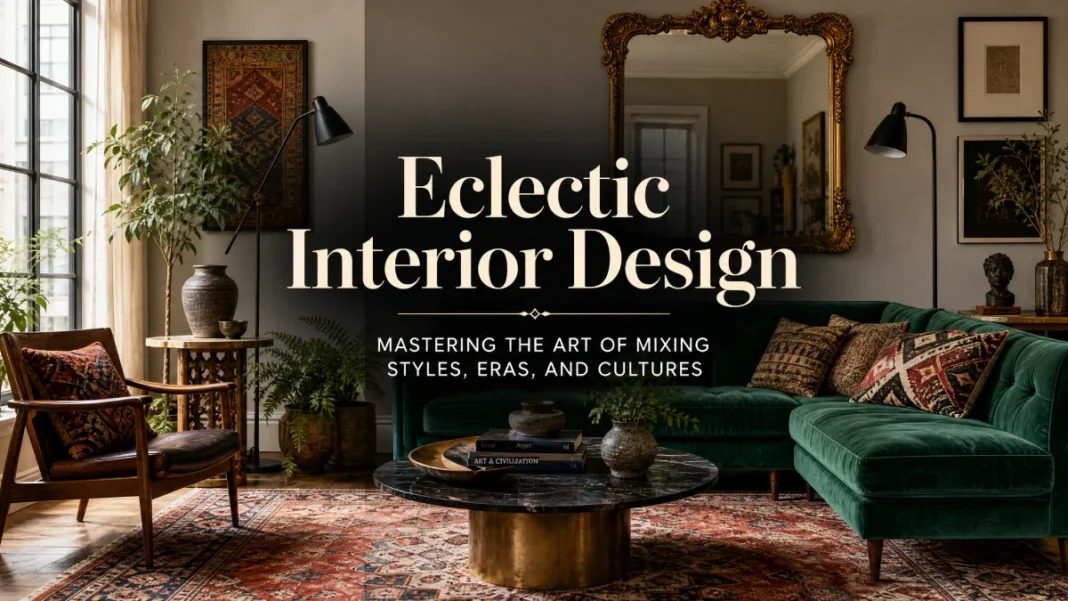
You love that carved wood Moroccan side table. And the sleek Italian leather sofa. And the Art Deco gilt mirror you scored at an estate sale. But when you put them all together, you worry the room will look like a design free-for-all, not a deliberate, layered space. You’re not alone. The idea of mixing styles, eras, and cultures feels risky—like one wrong move and your home becomes a chaotic jumble.
Eclectic interior design isn’t about throwing everything you love into a room and hoping for the best. It’s a disciplined approach to curation. It’s finding the hidden visual threads that connect a Victorian settee to a minimalist floor lamp. Master a few core principles, and you can build rooms that feel collected, personal, and intentional.
Here’s what eclectic design means, the non-negotiable rules that hold it all together, the mistakes that trip up even seasoned decorators, and how to apply the look room by room. You’ll finish equipped to curate a home that tells your story—without the chaos.
What Eclectic Interior Design Really Means (It’s Not Just a Free-for-All)
Eclectic interior design is the art of intentional mixing. You pull together pieces from different design movements, decades, cultures, and color palettes, then unite them under a deliberate framework. The goal is a space that feels layered, personal, and cohesive—not random. Think of it as the difference between a curated gallery wall and a collage of sticky notes. Designers like Kelly Wearstler have built entire careers on this balance—pairing a 1960s brass lamp with a contemporary plaster sculpture and making it look effortless.
A true eclectic room always has a unifying element. That could be a consistent color thread, a repeated material, a shared shape, or a mood. Without it, you’re just collecting clutter. With it, your Victorian velvet chair and industrial metal bookshelf suddenly belong together. It’s curation, not accumulation.
Many people confuse eclectic design with maximalism. While they overlap, maximalism is about abundance and sensory richness. Eclecticism is about contrast and connection. You can have a restrained, minimalist-eclectic space that still mixes eras—like a mid-century modern daybed paired with a Japanese shoji screen and a single abstract canvas. The key is always the relationship between objects, not how many you own.
The 5 Golden Rules of Eclectic Design
These aren’t stiff formulas. They’re the invisible scaffolding that makes every well-mixed room feel right.
Rule 1: Establish One Clear Unifying Element
Every eclectic room needs an anchor—something that ties disparate pieces together. Without it, the space reads as disconnected. The most powerful unifiers are color, material, shape, or texture. Choose one and use it like a thread weaving through each object.
Color is the easiest unifier for beginners. Pick a palette of three to five colors and repeat them in different saturations across the room. You might spot Benjamin Moore’s Hale Navy HC-154 on a velvet ottoman, then echo it subtly in a Persian rug’s border and an abstract painting above the sofa. The eye traces that color and reads cohesion.
Material works beautifully too. A repeated element—like raw brass, blackened steel, or natural rattan—creates rhythm. Imagine a brass floor lamp next to a vintage oak desk. Then add brass picture frames and drawer pulls. Now the metal acts as a visual handshake between the 1970s lamp and the classic wood desk. They belong together.
Shape is more advanced but effective. Repeating an organic curve, a sharp geometric angle, or a specific silhouette (like a drum shape) brings quiet unity. If your sofa has soft rolled arms, look for a round coffee table, arched mirrors, and curved-back dining chairs. The common geometry signals harmony even when colors and materials clash.
Rule 2: Run a Tight Color Thread
A color thread is the most important tool in your arsenal. It’s not a color scheme—it’s a specific, recurring hue that connects objects across the room. You pull this one color through at least three to five spots: upholstery, art, accessories, rugs. The thread makes the eye dance from piece to piece, creating a sense of flow.
You can anchor the thread with a neutral like creamy ivory, soft charcoal, or warm cognac. Or go bold with a saturated teal or burnt orange. The trick is to vary the intensity and texture. One spot might be a high-gloss lacquer tray in deep plum. Another could be the same plum in a nubby wool throw pillow. The hue binds the room, but the textural variety keeps it from feeling matchy-matchy.
If you’re mixing multiple strong colors, give the room one dominant color and two supporting players. For example, 60% of the room’s color might be a dusty blush (walls, large upholstery). 30% could be olive green (drapery, accent chairs), and 10% a surprising pop like marigold (candles, a single side table). Often called the 60-30-10 rule, this ratio ensures the palette feels eclectic but not chaotic.
Rule 3: Balance Scale and Proportion Like a Pro
Scale is the biggest giveaway of an amateur eclectic room. When everything competes at the same visual height and mass, the space feels static and uncomfortable. You need low, medium, and high points. Mix a low-slung sofa with tall floor lamps, then add a horizontal credenza and a vertical oversized mirror. The variation creates energy.
Pay attention to the visual weight of objects, not just physical dimensions. A dark, solid wood armoire carries more weight than a glass-and-brass étagère. Balance a heavy piece on one side of the room with a grouping of lighter pieces—two airy chairs and a slim floor lamp—on the other. The room should feel anchored, not lopsided.
For art and wall decor, never hang everything at the same height. Place one large statement canvas off-center, lean a smaller framed print on a shelf, and hang a woven wall hanging slightly higher. This creates a dynamic, collected feel. A good rule: the center of your main art piece should land around 57–60 inches from the floor—the standard gallery hanging height—but eclectic rooms can break that with intentional asymmetry.
Rule 4: Design Around One Star—Limit Focal Points
Your eye needs a clear place to land first. In an eclectic room, that’s your focal point. It might be a monumental fireplace, an oversized vintage tapestry, a sculptural canopy bed, or a gallery wall with a massive central piece. Everything else in the room plays a supporting role.
Here’s the mistake I see constantly: rooms with three or four “star” moments. A bright red velvet sofa, a life-size ceramic leopard, a crystal chandelier, and floor-to-ceiling graffiti art all screaming for attention. Your brain gets exhausted. Instead, choose one hero piece. Then let the other objects be excellent but quieter. They can be quirky, beautiful, and rich—but they must defer to the star. They enhance; they don’t compete.
Think of it like a dinner party. You can have fascinating guests with strong opinions, but if everyone talks over each other, it’s noise. You need one host who sets the tone, draws connections, and lets the others shine in response.
Rule 5: Curate, Don’t Collect
Collecting is acquiring. Curating is selecting with intention. An eclectic home built on curation feels considered, personal, and surprisingly calm. One built on collecting feels restless and cluttered. The shift comes down to a simple mindset: not everything you love needs to live in the same room.
Before you add a piece, ask three questions. Does it relate to at least one other object through color, texture, or shape? Does it support the room’s overall mood? Do you love it enough that it would still earn its spot if you removed half the other things? If not, edit it out. Edit ruthlessly. The negative space around objects—the breathing room—is what makes them feel important.
| Curated Eclectic Room | Collected (Cluttered) Room |
|---|---|
| Each piece connects to others through a thread | Pieces share no visual relationship |
| Negative space lets objects breathe | Every surface is filled |
| Focal point is clear and dominant | Multiple competing focal points |
| The room tells one cohesive story | The room feels like a storage unit for likes |
| You can immediately name the unifying element | No obvious unifier |
Mixing Eras, Cultures, and Styles: A Balancing Act
You can’t just plop a Queen Anne chair next to a Nakashima-style bench and call it done. You need to understand the visual language of different periods so you can create meaningful pairings.
Juxtaposing Old and New
The magic of eclectic design often lives in the tension between traditional and contemporary. A Louis XVI-style gilded mirror above a raw concrete console. A sleek mid-century modern sofa paired with an ornate Rococo-style coffee table. The contrast highlights the beauty of each piece. The old feels more romantic; the new feels sharper.
Know the period basics:
- Mid-century modern (roughly 1940s–1960s) is all about clean lines, organic forms, and tapered legs.
- Victorian pieces are dark, carved, heavy, and ornamented.
- Art Deco (1920s–1930s) brings geometric patterns, glossy lacquer, and metallic accents.
- Hollywood Regency (1930s–1950s) layers glamour, bold color, and mirrored or lacquered surfaces.
When you understand the personality of each era, you can pair opposites with confidence—the curvy, luxurious Art Deco velvet chair with the stark, functional Bauhaus table. They balance each other out.
Don’t be afraid to mix woods and finishes. A mid-century walnut sideboard looks richer when you place a slick, lacquered white lamp on top. The warm wood and the glossy surface talk to each other. The rule: let each piece have a distinct voice, but make sure they’re in conversation, not an argument.
Layering Cultural Textiles and Art
Bringing in pieces from different cultures is one of the most rewarding parts of eclectic design. But it demands respect and context. A Moroccan Berber rug, a Japanese woodblock print, and a West African mud cloth pillow can coexist beautifully when you treat them as art, not tourist souvenirs. Look beyond big-box retailers—vintage markets, estate sales, and curated platforms like Chairish and 1stDibs carry pieces with real provenance and story.
Give each cultural piece its own visual real estate. Don’t pile them on top of each other. Hang the Japanese print on a clean wall with generous white matting. Place the Moroccan rug where its geometry can anchor the room. Use the mud cloth pillow on a neutral chair where its hand-dyed pattern can be appreciated.
Let the craft speak.
Connect these pieces with a color thread. Many handcrafted textiles share rich, earthy tones—indigo, clay, ochre, charcoal. Pull one of those colors into your modern sofa or drapery. Now your heirloom-quality rug and your IKEA armchair share something elemental. The mix feels curated, not appropriated.
Balancing Formal and Casual
A room that mixes a crystal chandelier with a reclaimed-wood farm table has life. You want those high-low moments. The trick is to keep the foundation slightly informal so the formal pieces feel like a delightful surprise. If everything is dressy, the room feels stiff. If everything is rustic, it feels one-note.
Try this formula: 60% casual, 30% refined, 10% completely unexpected. In a living room, that might be a linen slipcovered sofa (casual), velvet accent chairs (refined), and a neon sign or a disco ball on a stand (unexpected). The casual anchors the room and makes it livable. The refined adds polish. The unexpected brings the personality that says you live here.
Common Eclectic Design Mistakes (and How to Dodge Them)
Too Many Focal Points
This bears repeating: an eclectic room without a clear focal point is noise. If you walk in and your eye bounces frantically, you have a problem. Choose your hero piece. Then dial everything else down a notch. Swap a bright competing painting for a tonal one. Remove half the pillows. Let the star shine.
Ignoring Negative Space
Eclectic rooms need breathing room. That side table doesn’t need seven accessories. Leave space on shelves. Allow a beautiful floor to be visible. Negative space gives the eye a place to rest and makes the objects you do display feel more significant. If every inch is filled, your treasures lose their power.
Color Chaos Without a Thread
You can use many colors, but you must link them. A palette of random brights—turquoise, fuchsia, lime, tangerine—without a connecting thread feels like a candy store explosion. Run one neutral or a deep moody hue through the room as your thread. Or use a consistent undertone. Keep all your brights warm (yellow-based) or all cool (blue-based). The cohesion is invisible but felt.
Forgetting About Texture
A room full of smooth, shiny surfaces is just as flat as a room full of matchy-matchy furniture. Eclectic design thrives on texture contrast: rough with smooth, nubby with sleek, matte with gloss. Pair a coarse jute rug with a velvet sofa. Place a high-gloss ceramic vase on a raw wood table. The tactile variety adds depth and makes the mix feel richer.
Room-by-Room Application: Eclectic Design in Action
Let’s move from principle to practice. Here’s how to apply these rules in specific rooms, with real combinations you can use.
Living Room: The Collected, Lived-in Heart
Your living room is where eclectic design shines brightest. Start with your largest piece—the sofa. A neutral, clean-lined style gives you maximum flexibility. Think a performance velvet sofa in a warm flax or dove gray. This is your canvas.
- Anchor with a rug. Choose a Persian or Turkish vintage rug with a bold geometric border and faded patina. Pull a muted coral or dusty teal from the rug as your color thread.
- Mix seating types. Add a mid-century leather sling chair and an antique carved wood bench with a custom cushion. Three distinct eras, one room.
- Create a gallery wall with a theme. Don’t mix random frames. Unite them by color (all black, all brass, all natural wood) or by subject (botanical prints, abstract shapes, black-and-white photography). The eclecticism comes from the mix of art styles and frame sizes, not from frame colors fighting.
- Add one sculptural element. A starburst chandelier, a floor lamp with an arc arm, or a large-scale vessel on the mantel. This becomes a secondary focal point that supports the room’s energy without stealing the show.
Bedroom: A Personal Sanctuary with Surprising Twists
Eclectic bedrooms need to be restful but not boring. The bed is automatically your focal point, so let the headboard be the hero.
- Layer bedding textures. Combine Belgian linen sheets, a matelassé coverlet, a velvet lumbar pillow, and a handwoven throw. The all-white palette can feel eclectic if the textures are abundant.
- Use unexpected nightstands. A single carved Moroccan table on one side and a stacked set of vintage suitcases on the other. The asymmetry works because the color thread—say, honey-toned wood and leather—ties them together.
- Hang one oversized piece of art above the bed instead of a traditional grouping. A large abstract painting in muted tones or a fiber art wall hanging brings softness and scale.
- Mix lighting eras. A mid-century brass task lamp on one nightstand and a 1970s ceramic mushroom lamp on the other. The common brass accent connects them.
Dining Room: Where Conversations Happen
An eclectic dining room invites people to linger. The table is your focal point. A simple reclaimed wood table sets a casual foundation.
- Mismatch chairs—with a rule. Every chair should share one element: wood tone, leg style, or seat height. For example, all chairs have warm walnut legs and a seat height around 18 inches. One is a modern wishbone, another a Victorian balloon-back, a third a French bistro chair. The shared features make it intentional.
- Hang a statement light fixture. An oversized woven rattan pendant or a cluster of glass globes at varying heights provides visual drama. Keep the rest of the room calm.
- Use a rug to define the zone and introduce pattern. A flatweave kilim adds geometric punch. Pull a small color—like saffron—from the rug and echo it in your napkins or a low bowl on the table.
- Layer art casually. Lean a large framed canvas against the wall on a sideboard rather than hanging it. The relaxed placement feels collected.
Kitchen: Small Doses of Eclectic Soul
Kitchens lean utilitarian, but you can inject eclectic character without sacrificing function.
- Swap hardware. Replace standard knobs with a mix of brass, wood, and ceramic pulls in the same finish family. A row of vintage brass knobs on white Shaker cabinets is instant charm.
- Display pottery openly. Open shelving is an invitation to curate. Gather handmade ceramic mugs, a vintage copper pot, and a small framed landscape. Group items in threes, varying heights. This is your color and texture thread.
- Add a runner with history. A Turkish runner in front of the sink softens the hard surfaces and introduces pattern. Its worn patina plays beautifully against sleek quartz or butcher block.
- Hang one unconventional pendant. A Moroccan metal lantern or a 1960s glass globe above the island becomes the kitchen’s jewelry.
Home Office or Entryway: First Impressions and Focus
Small spaces are perfect laboratories for eclectic design because you can be bolder with fewer pieces.
- Entryway: A round pedestal table in a high-gloss lacquer color (like navy) anchors the space. Place an antique brass tray on top for keys. Hang a large, modern mirror above it. Below, lean an abstract canvas. The mix of high-shine lacquer, aged brass, and modern art in three moves—done.
- Home office: Let your desk chair be the star. A classic 1950s-style leather office chair in a deep cognac leather. Pair it with a simple white desk and a vintage Persian rug underfoot. Add one tall, leafy plant in a woven basket for organic texture.
How to Start Your Eclectic Journey: A Step-by-Step Curating Process
Stop buying things and hoping they’ll work. Use this process to build rooms with purpose.
- Identify your foundation piece. It’s usually the largest item in the room—sofa, bed, dining table. Make it neutral enough to anchor a mix.
- Choose your unifying element. Pick one: a color thread, a material (brass, rattan), or a shape. Write it down so you don’t wander.
- Define your color palette. Select a dominant color (60%), a secondary (30%), and an accent (10%). Stick to it.
- Select your hero focal point. This is the piece that will draw the most attention. It could be an oversized painting, a showstopping light fixture, or a sculptural chair.
- Layer in supporting pieces one by one. For each addition, ask: does this connect to my unifying element? Does it serve the focal point or compete? Does it add a needed texture or era? If yes, it earns its place.
- Edit before you finish. Step back. Remove two things you love but that don’t serve the room. Wait 24 hours. The space will feel calmer and more intentional.
Conclusion
Eclectic interior design isn’t a style you can buy in a boxed set. It’s a process of thoughtful layering, where every piece carries meaning and every contrast is deliberate. When you get it right, your home doesn’t just look good—it feels like a genuine extension of who you are, full of memories, bold choices, and surprising harmony. The power lies in the editing. A collected home built on these principles won’t feel chaotic. It will feel like you.
Now I’d love to hear from you. Which rule feels like the biggest game-changer for your space? Or what beloved piece are you trying to make work with the rest of your home? Drop a comment below—I read every one and often chime in with a quick styling suggestion.

