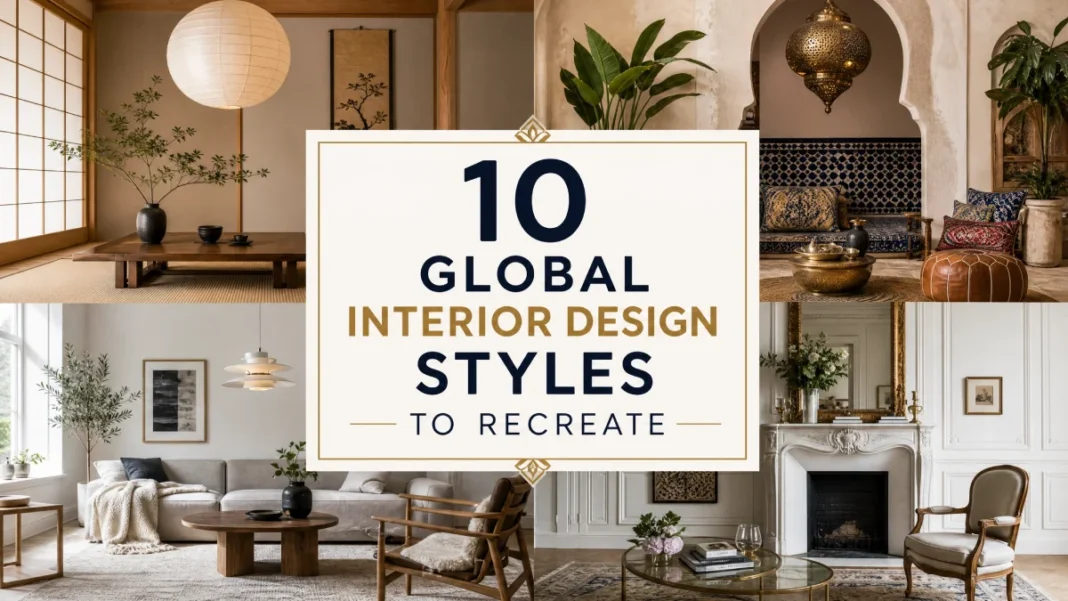
You’ve scrolled past a thousand “modern farmhouse” living rooms this week alone. They all start to blur together, don’t they? Same shiplap, same neutral throw pillows, same barn door leaning against a wall for no real reason.
If you’re craving a home that actually feels like you — layered, storied, a little unexpected — the answer isn’t another trend cycle. It’s looking at the design traditions that have shaped homes for centuries across the globe. Global interior design styles carry history, craftsmanship, and meaning that trend-driven decor simply can’t fake.
This guide walks you through ten of the richest design traditions. For each one, you’ll get the country of origin, the key visual elements that define it, signature colors and materials, and — as important — how to bring it into your home authentically rather than as a costume. You’ll also get one budget-friendly place to start.
10 Global Design Styles at a Glance
| Style | Country of Origin | Signature Color |
|---|---|---|
| Wabi-Sabi | Japan | Muted neutrals, charcoal |
| Moroccan | Morocco | Cobalt blue, terracotta |
| Indian Maximalism | India | Jewel tones, gold |
| Scandinavian | Sweden, Denmark, Norway | White, soft gray |
| Mediterranean | Greece, Italy, Spain | Whitewash, ocean blue |
| Mexican | Mexico | Vibrant pink, marigold |
| African-Inspired | West & East Africa | Earth tones, indigo |
| Chinese | China | Red, black, gold |
| Brazilian Modernism | Brazil | Warm wood, tropical green |
| Middle Eastern | Levant & Gulf region | Deep emerald, brass |
1. Japanese Wabi-Sabi
Japan’s design philosophy centers on one powerful idea: wabi-sabi, the beauty of imperfection. A slightly uneven ceramic bowl or a visibly grained wood table isn’t a flaw here — it’s the point.
Key visual elements:
- Low furniture and open floor plans
- Natural, unpolished textures
- Asymmetry over perfect symmetry
- Minimal ornamentation
Signature colors: Charcoal, warm beige, soft moss green, and unbleached linen white.
Materials and textiles: Raw wood, washi paper, tatami matting, and hand-thrown ceramics.
How to incorporate it authentically: Wabi-sabi isn’t about buying “Zen” decor from a big-box store. It’s a mindset. Choose fewer, better pieces — a handmade ceramic vase over a mass-produced one. Let materials age naturally instead of hiding wear, or embrace kintsugi — the Japanese art of repairing cracked pottery with gold. If you want to reference Japanese craft specifically, look for artisans who actually practice it, rather than generic “Asian-inspired” knockoffs.
Budget-friendly entry point: Start with a single handmade ceramic piece from a small-batch potter on Etsy, around $30 to $50. It’ll anchor a shelf and teach your eye to appreciate imperfection.
2. Moroccan Design
Morocco’s interiors are visually rich, built from centuries of Amazigh (Berber), Arab, and Andalusian craft traditions layered together.
Key visual elements:
- Intricate zellige (hand-cut geometric tile mosaics, perfected in Fez)
- Arched doorways and niches
- Layered textiles and floor cushions
- Ornate metal lanterns casting patterned light
Signature colors: Cobalt blue, terracotta, saffron yellow, and emerald green.
Materials and textiles: Hand-knotted Beni Ourain wool rugs, brass, hammered metal, and hand-glazed tile.
How to incorporate it authentically: Moroccan style is often flattened into generic “boho” decor, which strips away its craftsmanship and cultural specificity. To honor the real thing, buy actual Beni Ourain rugs or Moroccan-made tile when possible, even one piece, rather than mass-produced imitation prints. Read up on which motifs carry meaning before using them decoratively.
Budget-friendly entry point: Peel-and-stick zellige-pattern tile for a backsplash or accent wall runs about $20 to $40 per pack and gives an authentic-feeling focal point.
3. Indian Maximalism
India’s interior tradition rejects the “less is more” rule entirely. Here, color, pattern, and texture pile onto each other in a way that feels intentional, not chaotic.
Key visual elements:
- Bold block-printed textiles
- Carved wood furniture and jali (lattice) screens
- Layered rugs and cushions
- Brass and mirror-work accents
Signature colors: Fuchsia, marigold orange, royal blue, and gold.
Materials and textiles: Hand block-printed cotton, silk, brass, and inlaid wood.
How to incorporate it authentically: Seek out genuine block-print textiles from artisan cooperatives in Rajasthan instead of Western brands’ “ethnic print” lines, which often copy the aesthetic without crediting or paying the source communities. Mix patterns confidently, but let one or two authentic pieces anchor the room.
Budget-friendly entry point: A hand block-printed cotton throw or table runner, typically $25 to $45 from Indian artisan marketplaces, adds color and pattern.
4. Scandinavian Design
Born from long, dark winters, Scandinavian style prioritizes light, function, and hygge — the Danish concept of cozy contentment.
Key visual elements:
- Clean lines and functional furniture
- Abundant natural light
- Cozy textural layering (wool, sheepskin)
- Minimal but warm color palette
Signature colors: Soft white, light gray, pale blue, and blush.
Materials and textiles: Pale woods like birch and ash, wool, and linen.
How to incorporate it authentically: This is one of the more widely adopted global styles in Western markets, so the appropriation risk is lower. Focus on function first: buy furniture that actually earns its place, and layer in warmth through textiles rather than clutter.
Budget-friendly entry point: A chunky knit wool throw, around $35, adds hygge warmth to any neutral sofa.
5. Mediterranean Style
Sun-bleached walls, sea breezes, and centuries of Greek, Italian, and Spanish coastal living inform this relaxed, textural style.
Key visual elements:
- Whitewashed or lime-plastered walls
- Arched windows and doorways
- Terracotta flooring
- Wrought iron details
Signature colors: Whitewash, ocean blue, olive green, and warm terracotta.
Materials and textiles: Terracotta, natural linen, wrought iron, and hand-painted ceramic.
How to incorporate it authentically: Mediterranean style spans multiple countries and cultures, so it helps to pick a specific regional influence — Greek island, Spanish Andalusian, Italian coastal — rather than a vague blend. Hand-painted ceramics, such as Sicilian majolica, from the actual region carry more character than mass-produced versions.
Budget-friendly entry point: A set of hand-painted terracotta or ceramic planters, roughly $15 to $30 each, brings warmth to a kitchen windowsill or entryway.
6. Mexican Design
Mexican interiors balance vivid color with deep craft tradition, from Talavera pottery to hand-woven textiles from Oaxaca.
Key visual elements:
- Bold, saturated color blocking
- Talavera tile and pottery
- Papel picado and folk art accents
- Exposed wood beams
Signature colors: Hot pink, marigold, cobalt, and deep red.
Materials and textiles: Talavera ceramic, hand-loomed cotton, and dark wood.
How to incorporate it authentically: Buy Talavera pottery specifically from Puebla, Mexico, where the craft is protected by designation of origin — many “Talavera-style” pieces sold in the U.S. are unrelated imports. Supporting the actual artisan communities keeps the tradition alive and your decor honest.
Budget-friendly entry point: A single Talavera-style planter or bowl, around $20 to $35 from a verified Mexican maker, delivers color without overwhelming a room.
7. African-Inspired Design
“African design” spans an enormous, diverse continent, so specificity matters here more than almost anywhere else on this list.
Key visual elements:
- Geometric mudcloth and Kente cloth patterns
- Carved wood stools and sculptural furniture
- Woven baskets as both storage and art
- Warm, earthy layering
Signature colors: Indigo, ochre, terracotta, and black.
Materials and textiles: Mudcloth (Mali), Kente cloth (Ghana), raffia, and carved wood.
How to incorporate it authentically: Avoid treating “African print” as one interchangeable aesthetic. Mudcloth and Kente cloth come from specific countries and hold specific cultural meaning; buying directly from West African artisans or cooperatives supports the actual source rather than a diluted copy.
Budget-friendly entry point: A hand-woven basket, roughly $25 to $40, works as wall art or storage and introduces authentic texture immediately.
8. Chinese Design
Rooted in feng shui principles of balance and flow, traditional Chinese interiors blend symbolism with striking color and craftsmanship.
Key visual elements:
- Symmetrical furniture arrangement
- Lattice screens and carved wood panels
- Porcelain and lacquerware accents
- Intentional use of red for luck and prosperity
Signature colors: Red, black, gold, and jade green.
Materials and textiles: Silk, lacquered wood, porcelain, and bamboo.
How to incorporate it authentically: Many symbols and colors in Chinese design carry specific meaning — red for luck, certain motifs for longevity or prosperity. Learn what a piece represents before placing it decoratively, and prioritize authentic porcelain from regions like Jingdezhen or lacquerware over stylized reproductions.
Budget-friendly entry point: A small blue-and-white porcelain vase, around $20 to $30, adds an elegant, authentic accent to a shelf or console table.
9. Brazilian Modernism
Brazilian design fuses midcentury modern structure with the country’s tropical abundance, popularized by architect Oscar Niemeyer and furniture designer Sergio Rodrigues.
Key visual elements:
- Curved, sculptural furniture forms
- Indoor-outdoor flow
- Bold use of tropical wood
- Layered greenery
Signature colors: Warm wood tones, tropical green, and sunset orange.
Materials and textiles: Caviuna and jacaranda wood, rattan, and woven textiles.
How to incorporate it authentically: Brazilian modernism is a design movement, not a folk craft, which makes it lower-risk to adopt. Focus on organic, curved silhouettes and abundant plant life rather than straight lines and sparse styling.
Budget-friendly entry point: A large-leafed plant like a Monstera, around $25 to $40, brings the indoor-outdoor warmth this style depends on.
10. Middle Eastern Design
Spanning the Levant and Gulf regions, Middle Eastern interiors favor rich color, intricate pattern, and hospitality-focused layouts.
Key visual elements:
- Ornate mashrabiya (carved wood screens)
- Low seating arranged for conversation
- Rich, jewel-toned textiles
- Brass and mother-of-pearl inlay
Signature colors: Deep emerald, sapphire, gold, and burgundy.
Materials and textiles: Persian and Turkish hand-knotted rugs, brass, silk, and inlaid wood.
How to incorporate it authentically: A genuine hand-knotted Persian or Turkish rug — from weaving centers like Isfahan or Tabriz — is an investment piece with real cultural and artisanal value; a machine-made “Persian-style” rug is not the same thing. If a full rug isn’t in budget yet, smaller authentic pieces still carry that craftsmanship forward.
Budget-friendly entry point: A brass tray or small side table, around $30 to $50, adds warmth and function while nodding to the region’s metalwork tradition.
Conclusion
You don’t need a full renovation to make your home feel worldly. Each of these ten styles offers small, meaningful entry points — a handmade bowl, an authentic textile, a single well-sourced rug.
The real takeaway is this: authentic global design comes from craftsmanship and context, not just color and pattern. Choose pieces made by the artisans and communities behind each tradition whenever you can, and let your home tell a real story instead of a copied one.
Ready to start? Pick one style from this list that spoke to you most, and try its budget-friendly entry point this week. Then tell us in the comments which style you’re bringing home first.

