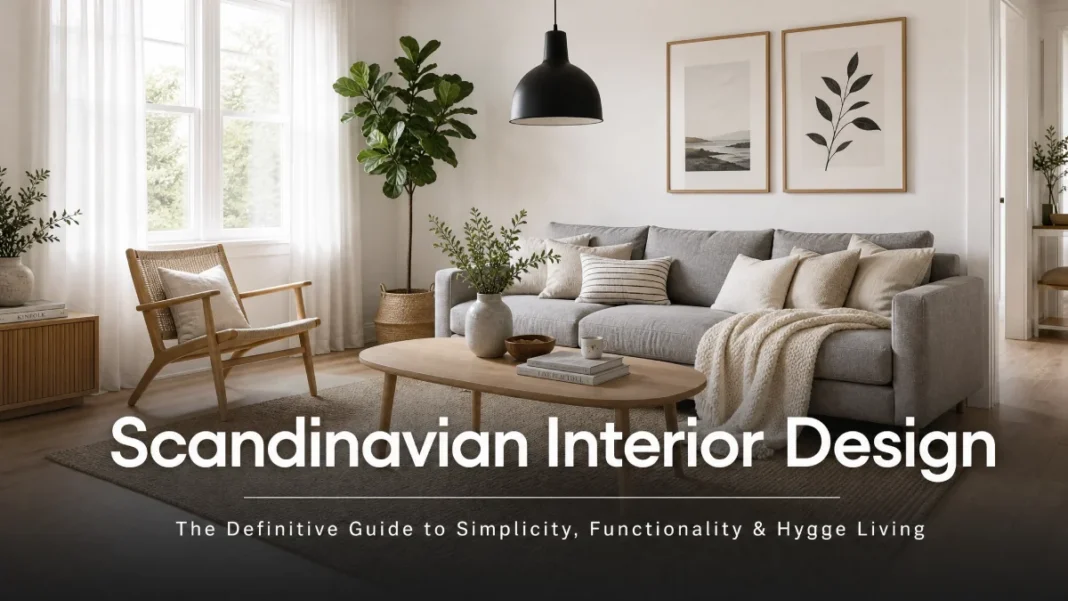
If you’ve ever walked into a home that feels instantly serene — flooded with soft light, anchored by pale wood, and wrapped in layers of texture — you’ve felt the quiet pull of Scandinavian interior design. It’s not about stark minimalism or cold white boxes.
Real Nordic style is warm, deeply functional, and surprisingly livable. I’ve spent over a decade helping homeowners bring this aesthetic to life, and the single biggest lesson is this: you don’t need a Danish passport or a bottomless budget. You just need to understand the principles — and then translate them into your own space.
This guide is a room-by-room roadmap. We’ll explore the design movement’s Nordic roots, decode terms like hygge and lagom, and break down the exact materials, colors, and furniture that make the look tick.
By the end, you’ll be able to layer a home that feels equal parts collected, calm, and cozy — without a single trip to Copenhagen.
The Nordic Roots of Scandinavian Design
Scandinavian design didn’t emerge from a trend report. It grew out of geography, climate, and a deep cultural belief that good design should be for everyone — not just the wealthy. The Nordic countries (Denmark, Sweden, Norway, Finland, and Iceland) endure long, dark winters where daylight is scarce, and homes become sanctuaries. The Swedish painter Carl Larsson captured this instinct early — his luminous watercolors of family life in the late 1800s made the bright, orderly Nordic home a cultural ideal before the movement even had a name. This need for light, warmth, and optimism shaped every aesthetic choice.
In the early 20th century, the functionalism movement swept through Europe, but Scandinavia gave it a human heart. Designers like Alvar Aalto in Finland and Arne Jacobsen and Finn Juhl in Denmark rejected harsh industrial forms. They wrapped function in organic curves, natural materials, and deep respect for craftsmanship.
The result was a design philosophy that never sacrificed comfort for style. By the 1950s, the term “Scandinavian design” had become synonymous with democratic, soulful modernism — furniture and interiors that were beautiful, accessible, and kind to the people who lived with them. A landmark touring exhibition, Design in Scandinavia (1954–1957), carried the movement to audiences across North America and cemented its global reputation.
This is why authentic Scandinavian interiors never feel like a showroom. They’re built on a foundation of empathy. Every chair is comfortable. Every light source has a purpose. And every surface is chosen with the understanding that your home is your daily refuge, not a gallery.
The Core Principles That Define Scandinavian Style
The heart of Scandinavian interior design beats in a handful of concepts you can apply immediately. They aren’t abstract philosophies — they’re practical filters for every decision, from furniture layout to the candle you light tonight.
Hygge — The Art of Cozy Contentment
You’ve likely heard the word hygge (pronounced hoo-gah). It’s not a throw pillow. It’s a feeling — a moment of warmth, safety, and connection. In design terms, hygge translates into intentional layers of comfort. Think a low-slung armchair angled near a window, a sheepskin draped over the seat, and a ceramic mug warming your hands as dusk settles. You create hygge by dialing up soft texture, warm low-light sources, and personal items that spark quiet joy. It’s the antidote to sterile minimalism. When in doubt, add a candle — Danes burn more candles per capita than anywhere else, and that soft flicker is instant hygge.
Lagom — The Beauty of “Just Right”
Sweden’s lagom (roughly “not too much, not too little”) is balance in action. It’s the reason a Scandinavian living room can feel uncluttered without feeling empty. Lagom teaches you to edit with a gentle hand. Keep the things you use and love; let go of visual noise. A shelf with three carefully chosen objects and plenty of breathing room will always feel more intentional than a crowded gallery wall. This principle extends to color, too — a single muted accent chair against a pale backdrop often reads more powerfully than a riot of competing hues.
Functional Beauty — Form That Serves You
In Scandinavian design, every object earns its place. Functionalism demands that a piece work hard — a coffee table with hidden storage, a pendant light that eliminates glare, a dining chair sculpted to support your back during long dinners. But function never excuses ugliness. The genius of Nordic designers lies in their ability to make the practical exquisite.
When you’re shopping, ask yourself two questions: Does this truly solve a problem? And is it lovely enough to use every day? A “yes” to both means you’re on the right track.
Connection to Nature — The Fifth Wall
Nordic culture holds an almost spiritual connection to the outdoors, and this pours into interiors. Natural light is treated as a precious material, maximized with sheer curtains and mirrors. Organic textures — raw wood, stone, leather, wool — ground the palette. And houseplants aren’t an afterthought; they’re essential. A tall fiddle-leaf fig or a cluster of trailing pothos becomes a living sculpture, reinforcing the indoor-outdoor link. This reflects friluftsliv — the Nordic commitment to outdoor living that shapes how Scandinavians think about indoor spaces, too.
The Signature Material Palette
Materials do the heavy lifting in Scandinavian interior design. They provide the texture and warmth that keep a light-filled room from ever feeling cold. Mastering this palette is key to an authentic Nordic home — and because Nordic design prizes sustainability, these materials are chosen to last decades, not seasons. Many Scandinavian manufacturers carry the Nordic Swan Ecolabel, the region’s strictest environmental certification, as proof of that commitment.
Woods — Pale, Honest, and Unfussy
Light wood is the spine of the look. You’ll see birch, pine, ash, and white-oiled oak underfoot and on furniture. These pale timbers reflect whatever daylight you have, bouncing it deep into the room. Instead of heavy, dark-stained pieces, seek out furniture that shows the grain and feels almost unfinished — a solid oak dining table, a birch sideboard with clean lines. For flooring, wide-plank white-oiled oak adds instant Scandinavian soul. If you’re renting or on a budget, a pale wood-look laminate can work beautifully when layered with rugs.
Soft Textiles — Wool, Linen, and Sheepskin
Texture is your secret weapon. Layer chunky knit wool throws, rumpled linen cushion covers, and genuine or faux sheepskin across seating. These fibres trap warmth and invite touch. A flat-weave wool rug anchors a living zone, while linen curtains filter light softly. Don’t over-style them — a throw casually folded over an armchair reads more Nordic than one perfectly draped.
Natural Accents — Leather, Stone, and Ceramic
A cognac leather armchair or a simple stoneware vase introduces depth. Hand-thrown ceramic mugs and unglazed terracotta pots hold a quiet beauty that polished materials can’t match. For surfaces, a honed marble or soapstone countertop in the kitchen contrasts beautifully with wood.
Metal Moments — Brass, Copper, and Matte Black
Metal plays a supporting role. A brass swing-arm sconce, copper pendant, or slim matte black picture frame adds a flicker of refinement without stealing the scene. The key is restraint — think one or two metallic notes per room, not a symphony.
The Scandinavian Color Spectrum
If you take away one thing, let it be this: Scandinavian interiors aren’t just white. They’re a nuanced, layered study in tone that uses color with discipline and intent.
The Foundation — Whites, Creams, and Soft Grays
White walls are a practical choice in Nordic countries because they maximize scarce daylight. But the right white matters enormously. A flat, stark white can feel clinical. Instead, choose a warm white with a gentle undertone. My go-to recommendations: Benjamin Moore White Dove OC-17 for a soft, enveloping warmth; Farrow & Ball All White for a chalky, nuanced finish; and Jotun White Poetry (a Norwegian brand) for a luminous but never cold hue. Pair these with warm grays — think Farrow & Ball Ammonite or Benjamin Moore Gray Owl — on cabinetry or trim for subtle depth.
Accent Hues — Dusty Pastels, Inky Blues, and Warm Terracottas
Color enters through accessories, art, and the occasional feature wall. The Nordic palette favors muted, almost faded tones: dusty pink, sage green, smoky lavender, and deep indigo. A single inky blue wall in a bedroom creates a cocooning effect that still feels light. Warm terracotta and ochre accents bring a sun-baked warmth that balances cool northern light. Introduce these hues through a wool throw, a stack of art books, or a well-placed ceramic vase.
The Power of Black — Defining Space
Black is used sparingly but strategically. Think black window frames, a sculptural black pendant light, or a slender dining chair. These moments create visual punctuation, preventing an all-pale room from flattening out. A single black line — a picture rail or a chair leg — adds just enough contrast to sharpen the whole composition.
Iconic Furniture Pieces and Where to Find Them
You can’t talk about Scandinavian interior design without bowing to the chairs, lights, and shelving systems that defined an era — and still shape our homes today. The beauty is, you can mix high and low freely.
10 Pieces That Changed the Look
- Wegner Wishbone Chair (CH24) — The curved, Y-shaped back is a masterclass in woodcraft. Pairs beautifully with a rustic dining table. Available from Carl Hansen & Søn.
- Panton Chair — Verner Panton’s first single-form injection-molded plastic chair, sculptural and stackable. Vitra produces the current version.
- PH5 Pendant — Poul Henningsen’s layered shade system delivers glare-free, diffuse light. Louis Poulsen still makes this icon.
- Egg Chair — Arne Jacobsen’s enveloping lounge chair for Fritz Hansen is the ultimate statement of sculptural comfort.
- String Shelving — Nils Strinning’s modular, minimalist system that defined mid-century Scandinavian storage. Still produced by String Furniture.
- Aalto Stool 60 — Alvar Aalto’s bentwood three-legged stackable stool from Artek. Use it as a side table or extra seat.
- Muuto Undercover Chair — A contemporary take on the wooden shell chair with a felt seat. Entirely modern yet timeless.
- Hay Mags Sofa — Deep, low, and modular, this is the sofa every Scandinavian living room wants now. Hay offers a range of configurations.
- Louis Poulsen AJ Lamp — Arne Jacobsen’s asymmetrical table lamp graces countless desks. Its angled shade casts perfect task light.
- IKEA Stockholm Rug — A handwoven wool flatweave that delivers Nordic pattern for a fraction of the price. Proof that democratic design is alive and well.
How to Mix High and Low
You don’t need a full home of designer originals. One investment piece — say, a set of Wishbone chairs around a simple IKEA table, or an Eero Saarinen Tulip Table anchoring a dining nook — elevates the entire room. Anchor the space with affordable basics: white linen curtains, a low-profile sofa from Article or West Elm, and vintage teak finds from local flea markets. This high-low blend is authentically Nordic because it prioritizes soul over status.
Applying Scandinavian Design to Your Home
Theory meets reality here. Each room has a role, and Scandinavian design gives you a clear script for making it serene, functional, and undeniably you.
Living Room — The Heart of the Home
Arrange seating for conversation, not just TV watching. A low-profile sofa in oatmeal linen, flanked by a pair of lounge chairs, pulls focus to the people around you. Place a large jute or wool rug underfoot to anchor the grouping. Layer in at least three light sources — a central paper pendant, a floor lamp in the corner, and a task light next to the sofa — so you can shift the mood from bright to intimate. Keep surfaces almost empty, displaying only a stack of art books, a ceramic bowl, and a single green plant.
Kitchen — Functional Simplicity
Handle-less cabinetry in matte white or pale birch plywood sets the stage. Swap upper cabinets for open shelving — it forces you to keep only the beautiful and useful. A butcher-block countertop warms up the room and can be sanded and re-oiled instead of replaced. Use a subway-tile backsplash with warm white grout and add under-cabinet task lighting in a warm 2700K temperature. A single brass rail for utensils and a row of potted herbs on the windowsill do the decorating for you.
Bedroom – A Serene Sanctuary
Strip the bedroom back to essentials. A low platform bed with a soft upholstered headboard in a natural fabric. Linen bedding in white, oatmeal, or a washed clay-pink — skip the decorative pillows that end up on the floor. Instead, fold a wool blanket at the foot of the bed. Wall-mounted swing-arm sconces free up nightstand space. Block out light with blackout roller blinds behind sheer linen curtains, so you control the room’s mood completely.
Home Office — The New Nordic Workspace
A slim oak desk, an ergonomic wool-covered task chair, and a flexible task light set you up. Mount a pinboard or a single picture ledge for rotating inspiration — artwork, a small plant, a handwritten note. Keep cords managed and hidden inside a simple cable box. A sheepskin draped over the chair makes marathon workdays feel a little more human. And yes, add at least one plant; a snake plant tolerates low light and quietly cleans the air.
Bathroom — Spa-Like Calm
White square tiles with dark grout create a graphic yet calm shell. Install a floating wood vanity with a white countertop basin. Heated towel racks aren’t just luxurious — they cut moisture and keep towels fluffy. A teak bath mat and a small eucalyptus bundle hanging from the showerhead turn a simple bathroom into a steamy, Nordic-style retreat.
Common Misconceptions About Scandinavian Design (and How to Get It Right)
I hear the same doubts from clients again and again. Let’s clear them up so you can move forward with confidence.
“It’s all white and cold.”
Only if you forget the layers. The pale shell is a canvas — texture, wood, and warm lighting fill it with soul. Even a room painted entirely in Benjamin Moore White Dove will feel like a hug when a wool rug, linen curtains, and candlelight enter.
“It’s too minimal — there’s no personality.”
Scandinavian minimalism leaves room for what matters. Display your grandmother’s ceramics, your stack of well-loved novels, your child’s drawing in a simple wooden frame. The absence of clutter makes the meaningful objects sing.
“You have to buy expensive Danish furniture to do it right.”
Design democracy is baked into Nordic culture. IKEA’s fundamentals are purely Scandinavian. Pair a high-quality sofa with flea-market teak side tables, or splurge on one PH5 pendant above a simple secondhand dining set. Authenticity comes from the logic of your choices, not the price tag.
“Scandinavian design is just IKEA.”
IKEA is an important chapter — Ingvar Kamprad founded it in Sweden in 1943 on the conviction that good design should be affordable — but not the whole book. The design heritage spans master craftsmen, mid-century pioneers, and contemporary brands like Muuto, Hay, and Normann Copenhagen, alongside heritage houses like Georg Jensen, Marimekko, Iittala, and Vipp. Understanding that lineage gives you a richer lens — and lets you mix IKEA basics with storied design objects seamlessly.
“It only works in lofts or small apartments.”
The principles scale beautifully. A large suburban home can feel just as connected and grounded. Use the same light woods, layered textures, and a disciplined palette to create zones that feel intimate even in open-plan sprawl.
Conclusion
Scandinavian interior design isn’t a set of rigid rules. It’s an ongoing conversation between your home and your wellbeing — a conversation built on light, natural materials, and a gentle refusal to fill space for the sake of it. If you start with just one shift — a warm white wall, a linen cushion, a single well-placed candle — you’ve already begun.
Your home doesn’t need to be perfect. It just needs to feel like a place where you breathe a little easier. So pick one room, take your time, and layer with intention. That’s the Nordic way. When you do, I’d love to hear about it — share a photo of your space or drop a comment below and tell me which principle you’re trying first.

