You’ve pinned dozens of living rooms. You’ve saved “modern farmhouse” and “contemporary chic” to the same board. And now, standing in a furniture store or scrolling through your saved inspiration, you’re not sure what makes one sofa modern and another contemporary.
You’re not alone. I hear this confusion almost weekly from readers planning a renovation. The two words get used so interchangeably that they’ve lost their meaning — and that makes designing a cohesive home unnecessarily hard.
Here’s the truth: modern design and contemporary design are not synonyms. They have different roots, different rules, and different personalities.
In this post, I’ll give you clear visual definitions, a table of the 5 key differences, and side-by-side room comparisons so you can tell them apart in seconds.
By the time you finish reading, you’ll know exactly which direction suits your home — and why the distinction matters.
Why the Confusion Happens (And Why It Matters)
The word “modern” does double duty in everyday English. We use it to mean “current” or “of the moment.” But in the design world, Modern Design (with a capital M, if you like) refers to a specific historical style rooted in the early-to-mid 20th century. It’s a defined movement, much like Art Deco or Victorian. Contemporary Design, on the other hand, literally means “of the time.” It’s fluid, ever-changing, and absorbs what’s happening right now in architecture, fashion, and art.
If you blur the two, you risk creating a space that feels off — a room with a strict mid-century pedigree trying to play nice with trendy sculptural pieces, or a sleek current setup clashing with warm retro woods. When you understand the difference, you shop with intention, communicate clearly with contractors, and build a home that feels layered on purpose, not accidentally mismatched.
What Is Modern Design, Really?
Modern design traces its lineage to the German Bauhaus school, Scandinavian functionalism, and the mid-century modern movement that followed. Designers like Ludwig Mies van der Rohe, Arne Jacobsen, and Charles and Ray Eames defined its language. It’s built on architect Louis Sullivan’s principle that form follows function. Every piece must serve a purpose, and decoration for decoration’s sake is stripped away.
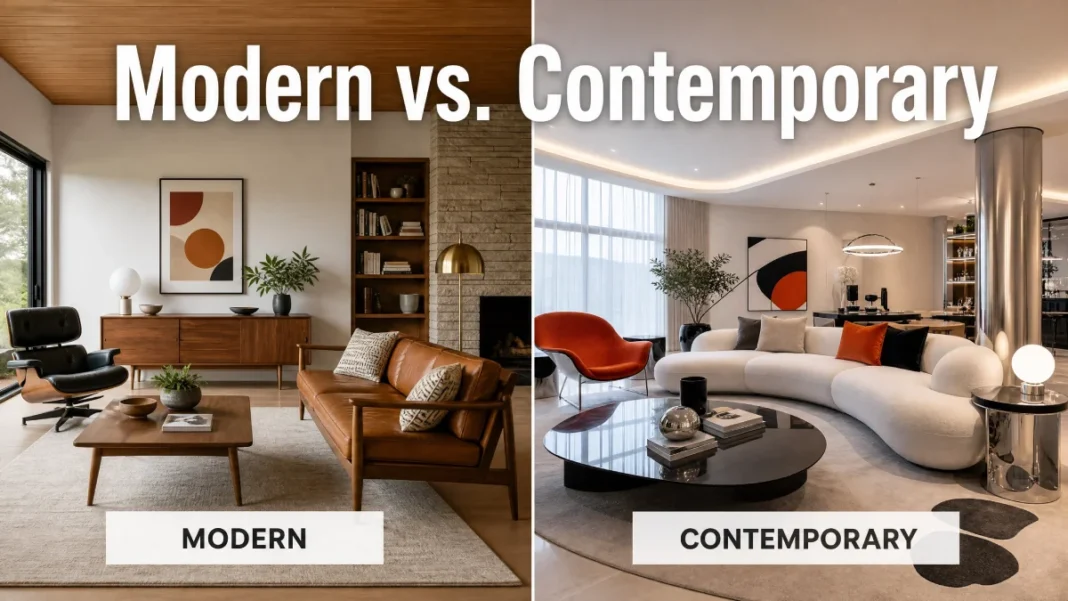
Imagine stepping into a room where clean horizontal lines dominate. You see a low-slung sofa with tapered wooden legs, a simple credenza in warm walnut, and a palette rooted in earthy neutrals. The windows are unadorned or dressed with simple linen panels. The art is abstract but never fussy. Materials do the talking: wood, leather, natural stone, and chrome. There’s a sense of warmth beneath the restraint because modern interiors rely heavily on natural textures and organic shapes.
Key markers of modern design:
- Furniture with exposed legs and clean silhouettes
- Warm wood tones like teak, walnut, or oak
- A focus on negative space — no clutter
- Vintage or reproduction pieces from the mid-century era
- Function-first layout where traffic flows naturally
If you want to paint a modern room, reach for a clean but soft white like Benjamin Moore’s White Dove OC-17. It reads warm without going creamy, and it lets the wood tones shine.
What Is Contemporary Design, Then?
Contemporary design isn’t tied to one decade. It’s a snapshot of what feels fresh right now — and it will keep evolving. Today’s contemporary leans into sculptural forms, bold contrasts, and a mix of materials that can change with the seasons. Think of a room where a curved, pillow-like sofa sits across from a sharp-lined metal coffee table. The palette might be mostly quiet with a single dramatic gesture: a charcoal accent wall, a large-scale abstract canvas, or a jet-black framed mirror leaning against the wall.
Comfort and minimalism shake hands here. Lines can be curved or straight, but they tend toward the architectural. You’ll see materials like glass, polished steel, and engineered stone used freely — the kind of material play you’d spot in projects by designers like Kelly Wearstler or Vincent Van Duysen. While modern design feels warm and nostalgic, contemporary design feels current and a little bit curated.
Key markers of contemporary design:
- Mix of geometric and organic shapes — a round table paired with a linear sofa
- Neutral base colors punctuated by strong black, navy, or jewel-tone accents
- Statement lighting as functional sculpture
- Smooth surfaces: lacquered cabinetry, polished concrete, or glass
- An ever-evolving color and accessory story — swap pillows, and the room shifts
For a contemporary wall color that stays flexible, try Sherwin-Williams Alabaster SW 7008 — a creamy white that pairs well with both cool grays and warm metals. It gives you a neutral canvas that welcomes change.
The 5 Key Differences Between Modern and Contemporary Design
Understanding the philosophical difference is one thing, but you need concrete, at-a-glance distinctions. Here’s how they stack up side by side.
| Category | Modern Design | Contemporary Design |
|---|---|---|
| Materials | Natural and honest: solid wood (walnut, teak, oak), leather, linen, natural stone, chrome. Materials are often left in their authentic state. | Engineered and mixed: glass, polished steel, lacquer, concrete, acrylic, and matte-finished metals. Texture comes from contrasts rather than raw grain. |
| Colors | Earthy and warm: terracotta, olive green, mustard, warm brown, and off-white. Pops come from nature-inspired hues. | Neutral backbone with bold accents: white, gray, greige, taupe, then sharp hits of black, navy, or saturated jewel tones. |
| Forms | Clean horizontal lines, organic curves from nature, tapered legs. Furniture sits low to the ground; shapes are functional and gentle. | Sculptural and geometric: high-contrast silhouettes, strong verticals, unexpected curves. |
| Era | Rooted in a fixed period — the early-to-mid 20th century. Modern design is a historical style, not a moving target. | Rooted in the now. Contemporary design is fluid; what’s “contemporary” today will be different a decade from now. It absorbs new influences. |
| Philosophy | “Form follows function.” Everything has a job. Ornamentation is eliminated; beauty lives in simplicity and proportion. | “Less is more, but make it current.” It values minimalism yet welcomes drama. Comfort, individuality, and visual impact guide decisions. |
These five categories will help you decode any room in seconds. If the space feels warm, vintage-leaning, and thoughtfully sparse, you’re probably looking at modern. If it feels crisp, curated, and of-this-moment — that’s contemporary.
Real Room Examples: A Side-by-Side Comparison
Let’s make this tangible. I’ll walk you through a living room designed in each style. Both use a neutral shell, but the furniture, materials, and personality diverge.
The Modern Living Room
Imagine walking into a sun-filled space anchored by a low-profile sofa upholstered in a nubby oatmeal linen. It rests on slim, tapered walnut legs. In front of it, a kidney-shaped coffee table in solid teak holds nothing but a ceramic bowl and a single book. A pair of brown leather armchairs with bent wood frames flank the sofa.
The rug underfoot is hand-knotted wool with a subtle geometric pattern in rust and tan. The only art is a large, unframed abstract canvas in muted olive and ochre. A floor-to-ceiling window wears simple ivory linen drapes on a black iron rod. The light fixture is a Sputnik chandelier — a mid-century icon that adds a hint of whimsy. Everything feels grounded, warm, and intentional. There’s no clutter, but the natural textures keep the space from feeling cold.
The Contemporary Living Room
Now walk into a room of similar size, but the atmosphere shifts immediately. A deep, low-slung sectional in charcoal gray curves along one wall. Opposite it, a sculptural white acrylic coffee table looks almost like a piece of polished ice. The fireplace surround is clad in a smooth, matte-black porcelain slab that reaches to the ceiling.
The walls are painted Sherwin-Williams Alabaster, but one feature wall holds an oversized piece of art: bold black brush strokes on raw canvas. The rug is a high-low loop in undyed wool that reads as tone-on-tone texture. A brass arc floor lamp — think the Castiglioni brothers’ Arco — swoops over the sectional. Pillows are few — just two in a deep rust velvet that you could swap for cobalt blue next season. The room feels current, a little daring, and adaptable. It doesn’t belong to a specific decade; it belongs to right now.
Side-by-side element comparison:
| Element | Modern Room | Contemporary Room |
|---|---|---|
| Sofa | Low, straight-line, oatmeal linen with walnut legs | Curved, deep charcoal sectional, low to the floor |
| Coffee Table | Kidney-shaped solid teak, organic form | Sculptural white acrylic, geometric |
| Lighting | Brass Sputnik chandelier (mid-century icon) | Brass arc floor lamp, sculptural statement |
| Wall Color | Benjamin Moore White Dove OC-17 (warm white) | Sherwin-Williams Alabaster SW 7008 (flexible neutral) |
| Decor Accents | Ceramic bowl, single book, abstract canvas | Large black-stroke art, rust velvet pillows, minimal accessories |
You can already feel the difference. One room is a warm nod to the past; the other is a confident expression of the present.
When to Choose Modern Design
Choose modern design if you’re drawn to homes that feel collected, not decorated in a weekend. This style suits you when:
- You love the look of vintage furniture and aren’t afraid to hunt for a 1960s credenza.
- You want a space that feels warm even with minimal stuff.
- You’re comfortable committing to a consistent material palette — lots of wood, leather, and natural fibers.
- You appreciate the idea that your home doesn’t need to chase trends; it already has a timeless anchor.
Modern design works beautifully in mid-century homes, ranches, and any space with open floor plans and large windows. It also pairs well with architectural details like exposed beams or brick. If you want to add a modern touch without a full overhaul, start with a classic piece: a teak sideboard, an Eames-style lounge chair, or a rug with a subtle, earthy geometric pattern.
Skip modern if you find warm wood tones too heavy or you crave the high-contrast drama of black steel and white marble. Modern’s warmth can feel dated if you don’t genuinely love the retro undertones.
When Contemporary Makes More Sense
Contemporary design is ideal if your tastes shift often and you want a backdrop that lets you play. You’ll love it when:
- You enjoy refreshing your space with new accents rather than a full renovation.
- You’re drawn to clean, crisp architecture — think slab-front cabinets, frameless mirrors, and seamless surfaces.
- You’re comfortable mixing finishes like brass, matte black, and polished nickel in one room.
- You want your home to feel current but not tied to any single design era.
This style shines in new-builds, urban lofts, and homes where the architecture itself makes a statement. Start with a gallery-white wall color, then layer in one sculptural piece — an asymmetric mirror, a ceramic stool, or a light fixture that doubles as art. Because contemporary design is so responsive to what’s happening now, you can pivot the look every few years by changing pillows, throws, and art.
Skip contemporary if you dislike sharp contrasts or a curated, somewhat edited feel. It can read as impersonal without some deliberate texture and warmth.
Can You Mix Modern and Contemporary? Carefully, Yes.
The risk in mixing them is that each style pulls from a different philosophy. Toss a mid-century wood armchair next to a glossy black-and-glass media console, and the two can fight for attention. But with a little restraint, you can borrow from both.
The safest bridge is materials. A contemporary curved sofa in a warm ivory bouclé can sit comfortably above a vintage-inspired wool rug with a subtle mid-century motif. Or you might pair a classic walnut dining table with sculptural, contemporary chairs in molded plastic. Keep your color palette narrow — three or four neutrals, one accent — and let the shapes do the work. If the room has a modern backbone (wood tones, organic lines), add contemporary touches through lighting, art, or accessories. If your base is contemporary, bring in one heroic modern piece, like a vintage credenza, as a focal point.
The key is intentional contrast, not accidental clash. Make sure each piece looks like it belongs because you chose it, not because you couldn’t decide.
Conclusion
You now have a clear lens. Next time you scroll through inspiration images, ask yourself: “Is this warm, vintage-leaning, and driven by natural materials, or is it crisp, sculptural, and tuned into the right now?” That one question will sort modern from contemporary every time.
The real takeaway? Neither style is better — they just serve different moods and homes. If your home craves warmth and nostalgia, lean modern. If you want a space that feels sharp, flexible, and utterly current, contemporary has your name on it.
Start small. Pick one element from your preferred style — a paint color, a coffee table, a single piece of lighting — and build from there. If you’d like a personalized recommendation of what to tackle first, drop me a comment below. I read every one and would love to help you take that first, confident step.

