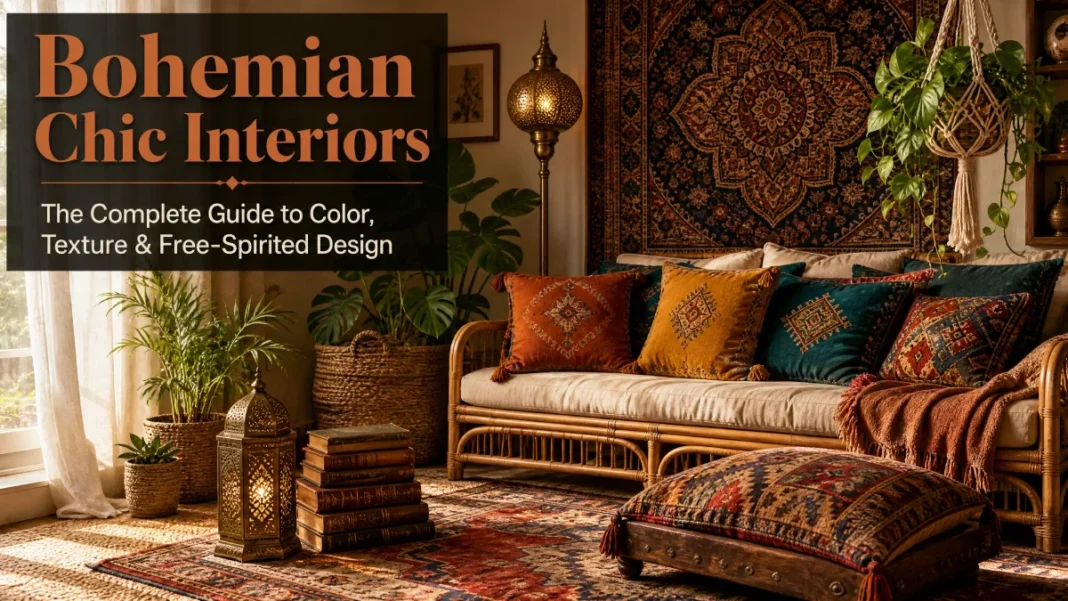
You’ve pinned a hundred photos of rooms that feel like a well-traveled soul lives there. Plants tumble from macramé hangers, jewel-toned pillows pile onto a velvet sofa, and at least three rugs overlap underfoot. It looks effortless, lived-in, and personal. Then you glance at your own space and worry you’ll end up with clutter, not character.
That’s the paradox of Bohemian chic interiors: when they’re done right, they feel like a collected sanctuary. When they’re done without a plan, they feel chaotic.
You’ll learn how to layer color, texture, and global treasures so your home radiates free-spirited energy — without the mess. Room-by-room blueprints, sourcing strategies, and a color palette toolkit follow.
The Roots of Bohemian Chic
Bohemian style didn’t start on a mood board. The term bohemian first described 19th-century French artists, writers, and musicians who rejected bourgeois conventions. They lived with little money but surrounded themselves with unconventional beauty — tapestries from travels, stacks of books, flea-market finds. Over time, that romanticized lifestyle absorbed influences from the Romani people’s nomadic traditions, as well as global trade routes. Moroccan rugs, Indian block-printed textiles, Turkish kilims, and Mexican embroidery all wove their way into the aesthetic.
The 1960s and ’70s counterculture embraced this global mix, adding macramé, rattan, and a flood of houseplants. Today’s bohemian chic interior isn’t about historical accuracy; it’s about honoring that tapestry of influences while letting your own personality shine.
Designers like Justina Blakeney and her Jungalow brand proved that maximalist pattern paired with abundant greenery could feel fresh, not fussy. Think of it as curated eclecticism — a style that feels collected across continents and decades, not purchased in one Saturday afternoon at a big-box store. When you understand these roots, every piece you bring into your home carries a story, not just a barcode.
Key Elements of Bohemian Chic Interiors
Some people think boho means piling everything you love into one room. Real bohemian chic relies on a few anchor ingredients that tie the look together. Master these, and you can layer with confidence.
Layered Rugs
Floor seating, bare feet, and an almost nomadic sense of comfort — that’s what layered rugs deliver. Start with a large, natural-fiber base like a jute or sisal rug in a neutral tone. It grounds the room and hides a multitude of sins. On top, angle a vintage Turkish kilim or a faded Moroccan Beni Ourain with bold geometric patterns. Then, if the space allows, toss a smaller, high-pile flokati or sheepskin beside the sofa.
This mix of textures, patterns, and sizes creates what I call a “floor collage.” It defines zones in an open-plan room and makes a space feel collected over time. Pro tip: let rugs overlap by at least 12 to 18 inches so it looks intentional, not like you’re hiding a stain.
Macramé
Macramé — that knotted cotton cord art you remember from the ’70s — has evolved. Today’s versions range from massive wall hangings to delicate plant holders. The beauty of macramé is the way it softens hard walls and bare corners. It brings organic texture, subtle movement, and a handmade quality no machine-made piece can replicate. Use a large macramé tapestry behind your bed instead of a traditional headboard.
Hang a trio of cord planters at different heights near a sunny window. You don’t need to go full 1970s craft fair; one or two statement pieces add enough boho soul without overwhelming the room.
Plants
A bohemian chic interior without plants isn’t really boho — it’s just furniture. The goal is an indoor jungle that feels tended, not abandoned. Go for variety in leaf shape, height, and planter style. Trailing plants like pothos or string of pearls soften shelves and high ledges. Statement floor plants such as a fiddle-leaf fig or a Monstera deliciosa anchor empty corners. Group smaller plants on a vintage brass tray to create a mini oasis.
Don’t forget unconventional hangers: a woven basket suspended from a ceiling hook or a repurposed ceramic pot strapped into a macramé sling. The key is layering greenery at different levels so your eye moves around the room.
Global Textiles
Here’s where bohemian chic truly shines. Handcrafted textiles from around the world inject color, pattern, and cultural depth. A few iconic pieces to know:
- Suzani — a hand-embroidered textile from Central Asia, often featuring sunbursts or floral medallions. Use it as a bed cover or stretch it over a canvas frame as wall art.
- Kilim — a flatwoven wool rug, usually with sharp geometric motifs. Perfect for layering on floors, draping over a sofa back, or even upholstering an ottoman.
- Mudcloth — a Malian fabric hand-painted with earthy symbols in black and rust. It makes a stunning throw pillow or framed panel.
- Kantha quilts — vintage Indian cotton blankets stitched together with a signature running stitch. Lightweight and reversible, they’re ideal for casual throws.
- Ikat — a resist-dyed fabric from Central and Southeast Asia, recognizable by its blurred, feathered patterns. It works beautifully as curtain panels or accent pillows.
When you choose these pieces, you’re not just adding color. You’re introducing craftsmanship, tradition, and an authenticity that mass-produced polyester pillows can’t touch.
Boho Color Palettes: Earth Tones Meet Jewel Box Richness
The right color palette keeps your bohemian chic interior cohesive. Two main families are at play — often within the same room. Warm earth tones ground the space, while jewel tones bring the drama. Used together, they create a soulful, layered effect.
| Palette Type | Key Colors | Mood | Paint Picks to Try |
|---|---|---|---|
| Warm Earth Tones | Terracotta, sand, ochre, rust, cognac, creamy ivory | Grounded, calm, sun-baked | Benjamin Moore’s Terracotta Tile 2140-30, Farrow & Ball’s India Yellow No.66, Sherwin-Williams’ Antique White SW 6119 |
| Jewel Tones | Emerald, sapphire, amethyst, deep magenta, teal | Rich, vibrant, a little mysterious | Benjamin Moore’s Jewel Box CSP-575, Behr’s Nocturne Blue HDC-CL-18, Farrow & Ball’s Brinjal No.222 |
Start with a warm neutral canvas — walls in a creamy off-white or soft greige. Then introduce your chosen palette through textiles, art, and accessories.
A velvet emerald sofa against terracotta walls? Stunning.
If you’re color-shy, paint one accent wall in a deep ochre and layer jewel-toned pillows on a neutral sofa. The 60-30-10 rule works beautifully here: 60% dominant color (your walls and large furniture), 30% secondary color (rugs, drapes), and 10% accent (pillows, vases, art). That structure prevents the palette from turning into a crayon box explosion.
Layering Rules: How to Do Boho Without the Mess
This is where many boho lovers stumble. Without a few design guardrails, curated eclecticism slides into chaotic clutter.
1. Mix Pattern Scales, Not Just Patterns
A room full of tiny, busy prints exhausts the eye. A room with only large-scale motifs feels heavy. Combine large, medium, and small patterns. Say you have a Moroccan rug with bold diamond motifs (large scale). Add pillows with a delicate block print (small scale) and a suzani throw with mid-sized flowers. The contrast creates rhythm, not competition.
2. Anchor With Solids and Negative Space
For every pattern you introduce, give the eye a resting place. A solid velvet sofa, a jute rug, a wall painted in a quiet warm white — these anchors keep the visual noise in check. If your gallery wall is a riot of frames and colors, keep the furniture underneath neutral. If your bed is draped in patterned kantha quilts, let the surrounding floor be bare wood or a simple sisal rug.
3. Repeat a Unifying Color
Pick one color that appears in at least three spots across the room. It might be a deep rust that shows up in a kilim pillow, a ceramic vase, and a slice of a framed landscape. This thread ties disparate elements together and makes the whole space feel intentional.
4. Vary Textures Deliberately
Bohemian chic relies on tactile contrast. Pair rough with smooth, shiny with matte, nubby with soft. Think: a chunky wool throw draped over a sleek leather chair, a brass side table next to a woven rattan pouf, a ceramic lamp with a linen shade. When you layer texture this way, even a neutral room feels rich.
5. Group Collections in Odd Numbers
That cluster of vintage brass candlesticks on the mantel? Use three or five, not two or four. Odd-numbered groupings feel more dynamic and less static. Apply this to throw pillows, wall hangings, and small objects on a tray. It’s a tiny tweak with a big visual payoff.
6. Let Lighting Work at Multiple Levels
Overhead lighting alone kills boho vibe. Combine floor lamps, table lamps, string lights, and candlelight to create pockets of warmth. A rattan pendant, a brass arc floor lamp, and a cluster of flickering pillar candles in hurricane glasses turn a room into a sanctuary after dark.
Sourcing Authentic Pieces: Skip the Tourist-Trap Imitations
Your bohemian chic interior deserves pieces with soul, not mass-produced copies that lose their charm after one season. While retailers like West Elm and Anthropologie carry boho-inspired lines, authentic sourcing from artisan communities delivers something those stores can’t replicate. Here’s where to hunt.
- For Vintage Rugs: Etsy’s Turkish rug shops are a goldmine for affordable kilims and patchwork rugs under $300. Chairish and 1stDibs carry higher-end vintage finds. If you have a local Persian rug dealer, stop in — sometimes you can negotiate a deal on a slightly worn beauty.
- For Global Textiles: Fair-trade marketplaces like The Citizenry and Minzuu work directly with artisan cooperatives. You’ll find genuine mudcloth, suzani, and kantha throws with transparent sourcing. Search Etsy for “vintage suzani” and filter by location to find pieces shipped from Uzbekistan or India, often at a fraction of Western retail prices.
- For Handmade Ceramics and Baskets: Local pottery studios and farmers’ markets are a treasure trove. The imperfect glaze, the maker’s thumbprint — those details make a room feel human. For baskets, look to fair trade retailers like Ten Thousand Villages or Baskets of Africa.
- For Macramé and Fiber Art: Support independent artists on Instagram or at craft fairs. You’ll often spend about the same as a mass-produced piece, but you get a one-of-a-kind work and a direct connection to the maker. Search hashtags like #macrameartist or #fiberartforsale.
A quick rule of thumb: if a textile is suspiciously cheap and perfectly uniform, it’s likely machine-made. Real hand-embroidery has slight irregularities. Real vegetable-dyed wool has subtle variations in hue. Those quirks aren’t flaws; they’re proof of human hands.
Room-by-Room Bohemian Chic Guide
Each room gets its own boho strategy.
Living Room
Start with a comfortable base — a deep, relaxed sofa in a neutral or jewel-toned velvet. Layer a vintage kilim over a jute rug. Arrange a mix of seating: a rattan accent chair, a leather Moroccan pouf, oversized floor cushions. Build a gallery wall of vintage botanical prints, woven baskets, and a circular macramé piece. Stack books and collected objects on a vintage trunk used as a coffee table to add patina. Plants should range from a tall fiddle-leaf fig by the window to trailing pothos on a high shelf.
Bedroom
Bohemian bedrooms are cocoons. Swap a traditional headboard for a wall-mounted suzani or a rattan room divider. Pile the bed with a kantha quilt, linen sheets, and an assortment of pillows in different shapes and textures — mudcloth lumbar, velvet square, fringe-trimmed boudoir. Hang a macramé planter in the corner with a cascading spider plant. Drape string lights or a fabric canopy overhead for softness. Keep the nightstand simple: a brass task lamp, a stack of books, a small ceramic dish for jewelry.
Kitchen
Even a modern kitchen can embrace boho warmth. Replace upper cabinet doors with open shelving and display mismatched vintage plates and woven baskets. Add a vibrant runner in a flatwoven kilim along the floor. Hang a tiered wire basket for onions and garlic, and let a pot of trailing ivy cascade from the top shelf. Swap generic cabinet knobs for hand-painted ceramic ones. If your backsplash is plain white tile, stencil a Moroccan-inspired pattern with tile paint.
Bathroom
Boho bathrooms transform into tiny spas. Hang a bold patterned shower curtain — think block-print floral or tribal motif. Choose a vintage-style rug, but make sure it’s washable or use a bath mat with a Persian-inspired print. Add a wooden stool to hold a candle, a small trailing plant, and a stack of rolled towels. Swap chrome fixtures for aged brass or matte black. A wall-mounted macramé shelf holds extra toiletries and adds texture.
Home Office
Make your workspace inspiring. Use a warm-toned accent wall behind your desk — try terracotta or muted clay. Hang a gallery wall of personal art, postcards, and a circular woven piece. A rattan peacock chair or a vintage wooden desk chair adds character. A trailing pothos on a high shelf softens the tech. Layer a small Turkish rug under your chair to define the zone. Use ceramic cups as pen holders and a woven basket for office supplies.
Outdoor Spaces
A balcony or patio can feel like a Moroccan courtyard. Start with an outdoor rug in a faded tribal print. Layer floor cushions, a low wooden table, and plenty of lanterns with LED pillar candles. String festoon lights above for magic. Use drought-tolerant plants in terracotta pots — think snake plants, aloe, and bougainvillea. Drape a cotton throw over a bench for chilly evenings. The goal is an intimate, relaxed gathering spot that feels miles away.
Budget-Friendly Boho Tips: High Style, Low Spend
You don’t need a trust fund to create a bohemian chic interior. The best pieces often come from tight budgets and a little creativity.
Thrift with a Sharp Eye
Head to secondhand stores and flea markets early in the morning. Look for brass candlesticks, woven baskets, ceramic ginger jars, and old landscape paintings — all can be transformed with a cleaning or a quick spray of Rub ‘n Buff. Reupholstering a thrifted chair in a vintage fabric costs far less than buying new.
DIY Macramé Plant Hangers
A ball of 4mm cotton cord and a wooden ring cost under $15. Countless free video tutorials walk you through basic knots. Within an afternoon, you can make multiple hangers that look like they came from a boutique.
Fabric as Art and Throws
Large vintage scarves or a length of block-printed Indian fabric can be framed as art or simply draped over a rod. Indian kantha quilts and Mexican serape blankets often sell for under $40 online. Fold one over the arm of your sofa for instant color.
Temporary Transformations
Peel-and-stick wallpaper with a Moroccan trellis or tile pattern works wonders in a rental. Paint a thrifted dresser with deep emerald chalk paint and swap the knobs for brass ones. A $20 stencil and a bit of paint can turn a plain concrete patio floor into a faux encaustic tile masterpiece.
Propagate Your Own Plants
Ask friends for pothos, spider plant, or jade cuttings. Root them in water, then pot them in thrifted mugs or ceramic bowls with drainage holes drilled in. You’ll fill your home with greenery for almost nothing.
Shop Your Own Home
Move a patterned rug from the bedroom to the living room, restyle your bookshelf by color, drape a sarong as a tablecloth. Often, reimagining what you already own costs nothing and yields the most personal results.
Conclusion
Bohemian chic interiors are never truly “finished” — and that’s the beauty. They evolve as you travel, collect, and grow. The secret isn’t about buying more stuff. It’s about layering what you love with confidence and a few design rules that keep the chaos at bay. Start small: layer two rugs, add a trailing plant, hang a piece of textile art you truly cherish. Let your home become a gallery of your life.
A curated, free-spirited home doesn’t require a huge budget — it requires a point of view. Yours. So grab that vintage suzani, paint that accent wall a deep mustard, and turn up the music while you rearrange. This is your space, and it’s time it felt like you.

