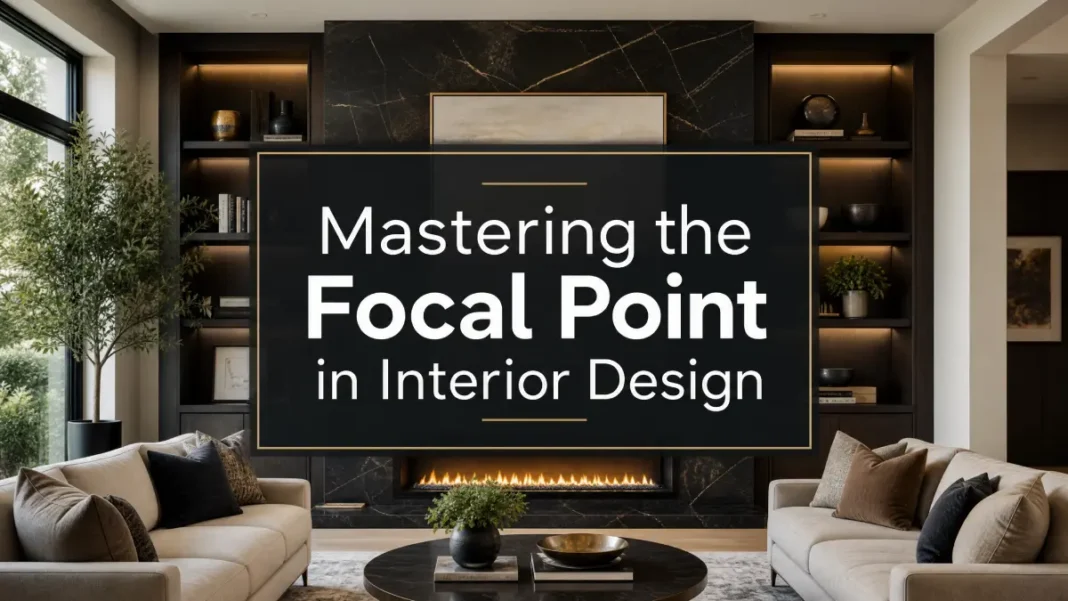
You walk into a beautifully decorated room, and something clicks. Your eyes know exactly where to land. Now you walk into your own living room, and your eyes just… wander.
That’s not bad taste. It’s a missing focal point.
A focal point in interior design is the one element that anchors a room and gives your eye somewhere to go first. Without it, even a room full of gorgeous furniture can feel scattered and unfinished.
After reading this, you’ll know what a focal point is, how to spot one you already have, and how to build one from scratch when your room comes up empty.
What Is a Focal Point, Exactly?
A focal point is the dominant visual element in a room — the thing your eye is drawn to first, before it takes in anything else. Think of it as the “main character” of the space. Everything else, from furniture placement to lighting, plays a supporting role.
Designers also call this visual hierarchy: a clear order of what matters most in a room, down to what matters least. A focal point sits at the top of that order.
Here’s a simple test. Stand in your doorway and notice where your eyes go first. If the answer is “everywhere at once,” your room doesn’t have a strong focal point yet. If your eyes land on one clear spot, that’s your focal point, whether you planned it or not.
A good focal point does three things for a room:
- Creates order. It tells your eye where to start, so the rest of the room makes visual sense.
- Adds intention. Rooms with a clear focal point read as designed, not just furnished.
- Anchors furniture placement. Once you know your focal point, arranging everything else gets a lot easier.
Natural Focal Points vs. Created Focal Points
Every room falls into one of two camps: it either comes with a built-in focal point, or you have to build one yourself. Knowing which camp you’re in changes your whole approach.
Natural focal points are architectural. They’re baked into the bones of the room, and you didn’t have to lift a finger to create them. Common examples include:
- A fireplace, especially one with a detailed mantel or surround
- A large window with a strong view, like trees, water, or skyline
- Vaulted or beamed ceilings
- An exposed brick or stone wall
- A staircase with an interesting shape or railing
Created focal points are ones you design on purpose, usually because the room doesn’t have an architectural feature strong enough to carry the job. These include:
- A gallery wall or large-scale art piece
- A statement furniture piece, like a bold sofa or a canopy bed
- A standout lighting fixture, like a sculptural chandelier
- An accent wall in paint, wallpaper, board and batten, shiplap, or wood paneling
Neither type is better than the other. A furnished rental with plain walls can look just as intentional as a historic home with original crown molding. The difference is only in how much work you have to do to get there.
| Natural Focal Point | Created Focal Point | |
|---|---|---|
| Source | Built into the room’s architecture | Added through design choices |
| Examples | Fireplace, window view, vaulted ceiling | Art wall, statement sofa, accent wall, lighting fixture |
| Effort required | Low — you highlight what’s already there | Higher — you choose and place the element yourself |
| Best for | Older homes, homes with architectural detail | New builds, rentals, boxy or plain rooms |
How to Create a Focal Point When Your Room Doesn’t Have One
Plenty of rooms, especially in newer builds and apartments, don’t come with anything architecturally interesting. Four flat walls, one window, a door. That’s normal, and it’s still fixable.
Here’s how to build a focal point from a blank room, step by step:
- Pick your wall first. Choose the wall your eye naturally meets when you walk in, usually the one directly opposite the entry. This is where your focal point will live.
- Choose your anchor element. Decide whether it will be art, furniture, color, or lighting. Don’t try to combine all four; pick one lead and let the rest support it.
- Size it properly. Your focal point should feel substantial, not timid. As a rule of thumb — often called the two-thirds rule — art or a headboard should span roughly 60% to 75% of the width of the furniture beneath it.
- Commit to contrast. A focal point only works if it stands out. If your walls are neutral, go bold with a saturated color that contrasts the room’s palette. If your room already has a lot going on, choose something calmer but larger in scale.
- Arrange the room around it. Once your anchor is set, angle your furniture, lighting, and rugs toward it. Leave breathing room around the focal point — negative space strengthens its impact. A sofa facing the accent wall does more work than one facing a blank corner.
A quick example: say you have a rectangular living room with plain white walls and no fireplace. You paint the wall opposite the entry in a deep green, like Benjamin Moore’s Hunter Green HC-154, and hang a single oversized piece of art centered on that wall. Then you float your sofa a few feet off the wall, facing it. In one afternoon, that plain room now has a clear focal point and a reason for every other piece of furniture to be exactly where it is.
Room-by-Room Focal Point Examples
The idea of a focal point looks a little different depending on which room you’re standing in. Here’s how it plays out in the spaces you use most.
Living room
This is usually where a fireplace or a large window takes the lead. No natural feature? A media console with a gallery wall above it, or a large sectional in a bold fabric, works just as well.
Bedroom
The bed is almost always the star, whether you help it along or not. A statement headboard, a canopy frame, or an oversized piece of art centered above the bed all reinforce that role instead of fighting it.
Dining room
The table itself can anchor the space, but a lighting fixture is often the stronger choice here. A sculptural pendant — think Sputnik, globe, or tiered glass — or a chandelier hung at the correct height (typically 30 to 36 inches above the tabletop) draws the eye down to where people actually gather.
Kitchen
An island with a contrasting countertop or cabinet color — quartz against dark cabinetry, or a painted island against white perimeter cabinets — is the most common created focal point. A dramatic range hood or a tiled backsplash that runs floor to ceiling can do the same job.
Bathroom
A freestanding tub, a bold vanity, or a statement mirror tends to carry the room. In smaller bathrooms, a single wallpapered wall behind the toilet or tub often works better than trying to anchor the whole space.
Common Focal Point Mistakes to Avoid
Even with the right idea, a few missteps can undo a focal point before it has a chance to work.
Competing focal points
- This is the most common mistake. You paint a bold accent wall, then hang a giant mirror on the opposite wall, then add a statement light fixture in the middle. Now your eye has three places to go and no idea which one matters.
- Fix: Choose one dominant focal point per room, then let everything else read as secondary.
Undersized elements
- A small piece of art on a huge wall reads as an afterthought, not a focal point.
- Fix: When in doubt, size up. A too-large piece is far more forgivable than a too-small one.
No supporting cast
- A great focal point surrounded by furniture that ignores it still won’t land.
- Fix: Angle seating, rugs, and lighting toward your focal point so the whole room reinforces it.
Choosing based on trends instead of layout
- An accent wall behind a bed you rarely see, because the room’s layout hides it, wastes the effort.
- Fix: Pick your focal point location based on where people actually stand and look, not just where a trend photo placed it.
FAQs
Can a room have more than one focal point?
Yes, but keep it to a maximum of two or three in larger, multi-use rooms, and stick to one in smaller spaces. If you do have more than one, choose a single dominant focal point so the room still has a clear starting point.
Does every room need a focal point?
Almost every room benefits from one, even small or purely functional spaces like a hallway or powder room. It’s the fastest way to make a room feel designed instead of just filled.
What if my room has a TV? Does that count?
A TV can function as a focal point, but most designers treat it as a secondary element rather than the star, since it’s off most of the time. Art-display TVs like Samsung’s The Frame solve this by showing artwork when idle. Building your real focal point around or near the TV — a media wall with texture, built-in shelving, or flanking art — often works better than letting the screen stand alone.
The Bottom Line
A focal point is simply the one element you want your eye to find first, and once you spot it or build it, the rest of the room falls into place around it. Whether it’s a fireplace you already have or an accent wall you paint this weekend, the goal is the same: give your eye one clear place to land.
Start with the wall you face when you walk in, choose one anchor element, and size it with confidence. That’s the whole formula.
Ready to put this into practice? Pick one room in your home this week and identify (or create) its focal point. Then tell us in the comments what you landed on.

