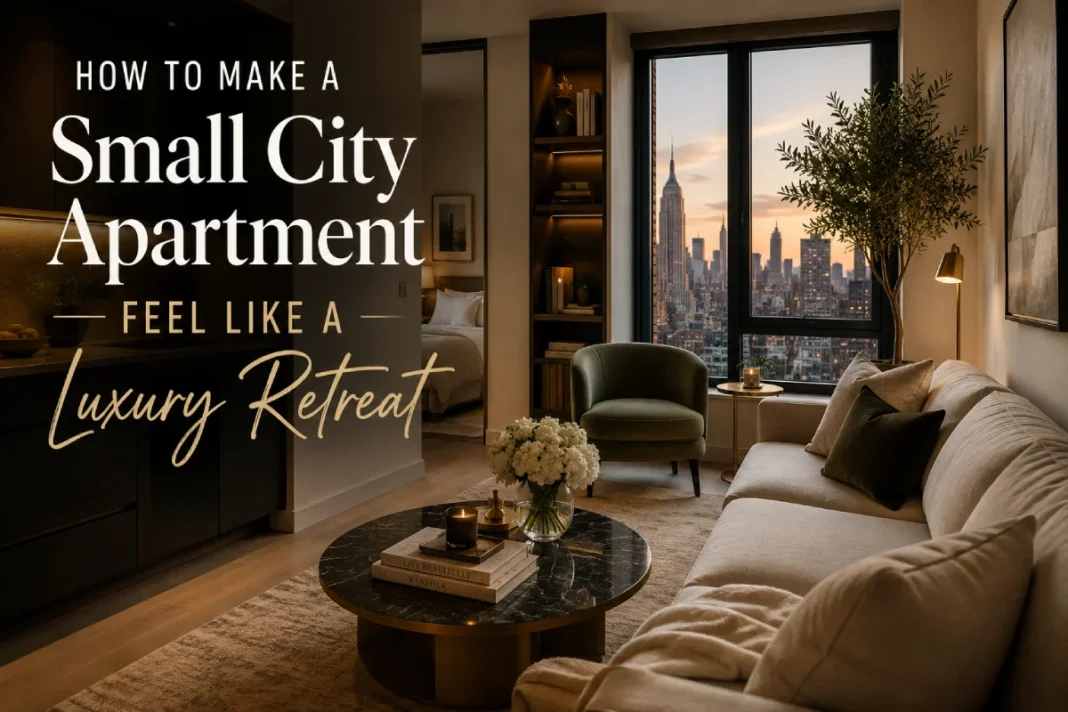
Your 420-square-foot studio doesn’t have to feel like a shoebox. According to Statista (2023), the average American apartment now measures under 900 square feet, and city dwellers often live with far less. Yet the smallest spaces can feel the most indulgent if you know which tricks actually work.
Most small-space advice tells you to “declutter” and “add plants,” as if that solves everything. It doesn’t. You need strategies that create the illusion of scale, layer luxury materials, and use every inch without looking like a storage unit.
This guide walks you through how to make a small city apartment feel like a luxury retreat — from mirror placement to multi-functional furniture, lighting layers, and budget breakdowns for every price point. You’ll finish with a clear action plan you can start this weekend.
What Makes a Small Apartment Feel Luxurious?
A space feels luxurious when it combines visual depth, cohesive materials, and intentional lighting — regardless of square footage. It’s not about size. It’s about how confidently a room uses the space it has.
Environmental psychologists call this perceived spaciousness: your brain reads openness through sightlines, reflection, and colour continuity, not floor area. Spatial perception research from the Academy of Neuroscience for Architecture supports this — the brain processes room volume through visual cues like parallel lines and reflected light, not tape measurements. Once you understand that, small-space design stops being about hiding limitations and starts being about directing attention.
Use Mirrors to Create Visual Depth
Mirrors remain the most effective trick for making a small room look bigger. Placement matters more than size.
Try these three approaches:
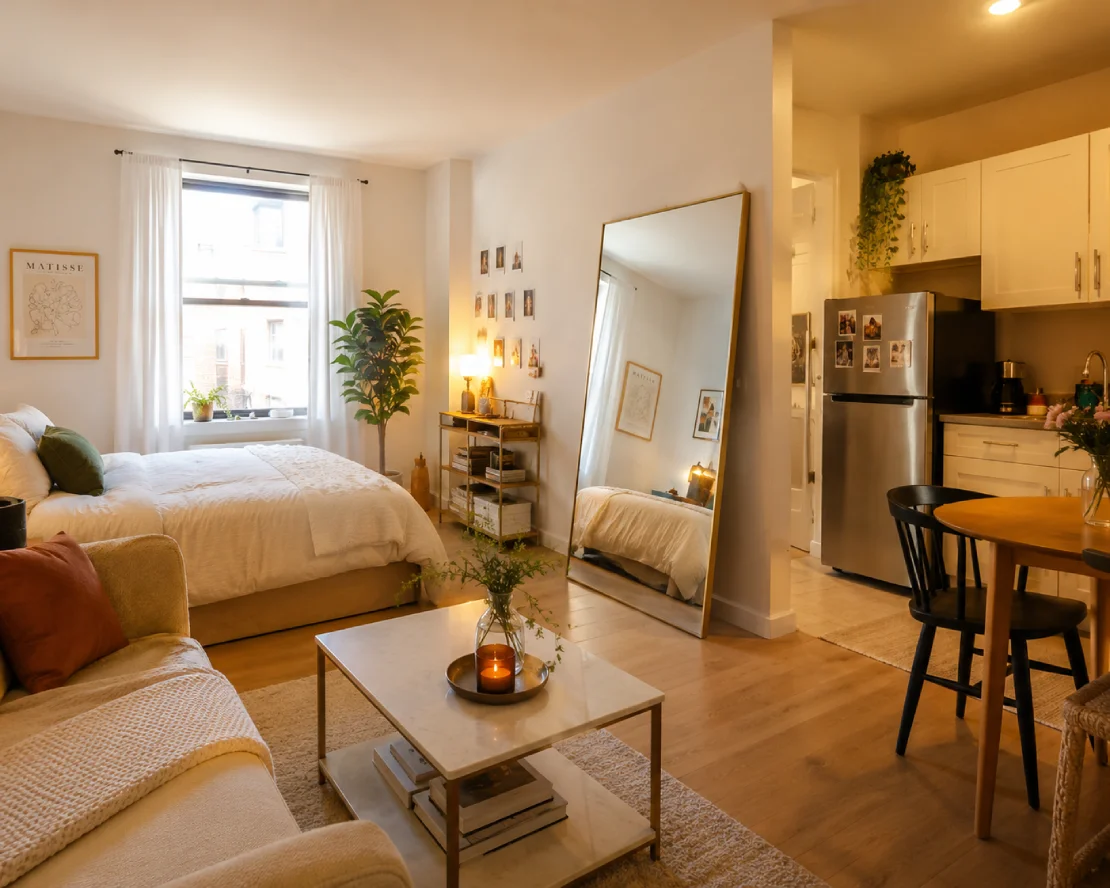
- Lean an oversized mirror against the wall opposite your main window. This doubles the natural light and creates an illusion of another room beyond it.
- Use a mirrored closet door instead of a solid one in your bedroom. It reflects light without taking up floor space.
- Add a mirrored console table in your entryway. This works especially well in narrow city hallways where every inch counts.
Budget tip: IKEA’s Nissedal mirror (roughly £30–£60) does the same visual work as designer leaning mirrors costing five times more. West Elm and Anthropologie carry mid-range arched options in the £150–£300 range if you want a statement frame without a four-figure price tag.
Layer Your Lighting Like a Boutique Hotel
One overhead bulb makes any room feel like a waiting area. Luxury hotels never rely on a single light source, and neither should you.
Aim for three layers in every room:
- Ambient light — your overhead fixture, dimmed if possible.
- Task light — a reading lamp or under-cabinet strip near where you work or cook.
- Accent light — a warm-toned floor lamp or LED strip behind furniture, casting a soft glow rather than direct light.
Warm bulbs (around 2700K) read as cosier and more expensive than cool white ones. Smart bulbs from Philips Hue or LIFX let you shift colour temperature throughout the day without rewiring. Swapping your bulbs alone can transform a rental’s feel for under £20.
Budget breakdown for lighting:
| Budget Level | What to Buy | Approx. Cost |
|---|---|---|
| Low | Warm-white LED bulbs + string lights | £15–£35 |
| Mid | Dimmable floor lamp + smart bulbs (Philips Hue or LIFX) | £60–£120 |
| High | Designer floor lamp + smart lighting system | £150–£400+ |
Choose Multi-Functional Furniture Over More Furniture
Small apartments don’t need less furniture. They need furniture that works harder. A single piece that serves two purposes will always beat two separate items competing for the same corner.
Consider these swaps:
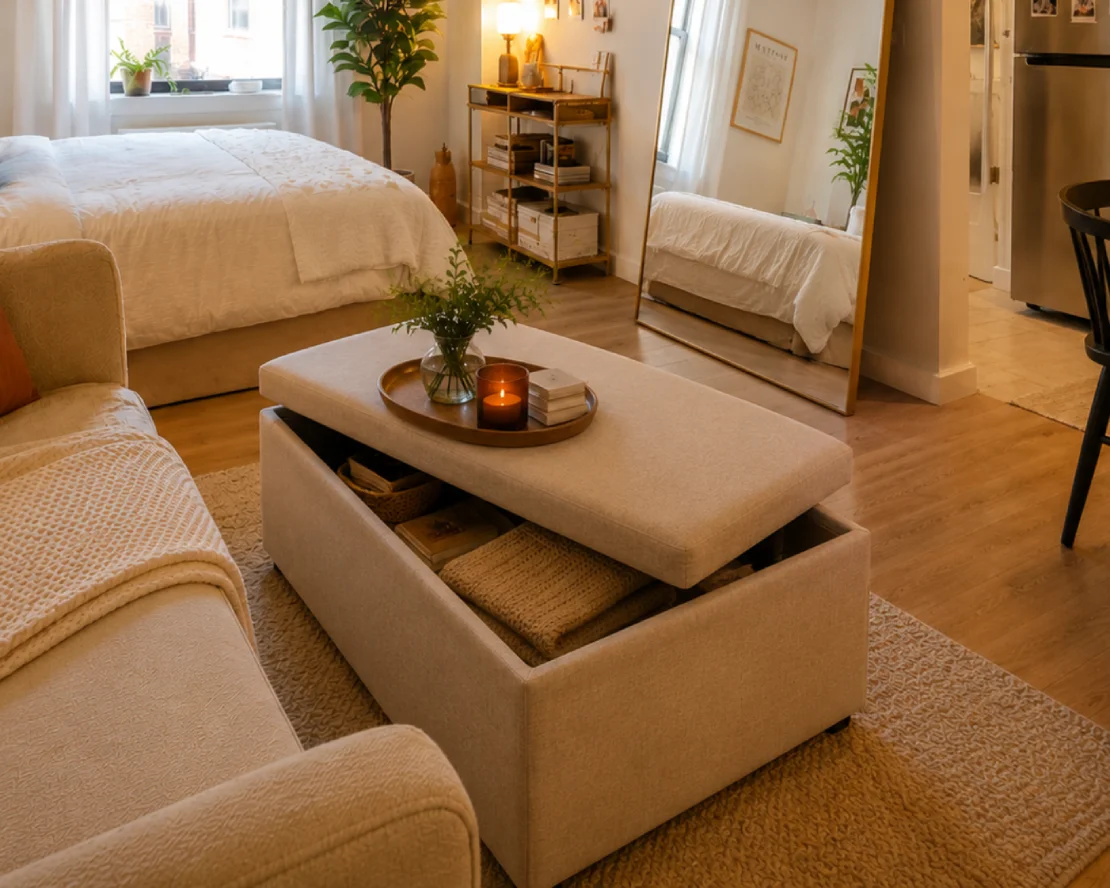
- Ottoman with storage instead of a coffee table plus a blanket basket.
- Extendable dining table instead of a fixed four-seater you rarely fill.
- Daybed with drawers underneath instead of a sofa plus a separate guest bed.
For example, a client in a 380-square-foot Brooklyn studio replaced her coffee table and side table with one storage ottoman and gained enough floor space to add a reading chair. That’s the kind of trade-off that changes how a room feels day to day.
Solve Storage Without Looking Like a Storage Unit
Visible clutter is the fastest way to undercut a luxury feel, no matter how good your lighting is. Storage needs to disappear into the design rather than sit on top of it.
Vertical storage
Vertical storage is your best friend in a small footprint. Floating shelves, tall bookcases, and over-the-door organisers all use wall space your floor plan can’t offer.
Baskets and boxes matter too. Mismatched plastic bins undo the effect instantly. Stick to one or two materials — woven rattan, or matching linen boxes — so storage reads as styling, not overflow.
Pick a Tight, Cohesive Colour Palette
A scattered colour scheme makes a small room look busier and, as a result, smaller. Luxury retreats almost always work within a narrow palette: two or three main tones, plus one accent.
Try warm neutrals like Farrow & Ball’s Skimming Stone or Benjamin Moore’s White Dove OC-17 as your base. These read as calm and expensive rather than stark. Add one deeper accent colour through cushions, art, or a single statement chair. If you’re renting and can’t paint, peel-and-stick wallpaper from brands like Tempaper or Wallsauce gives you the same colour cohesion without losing your deposit.
A cohesive palette makes small rooms feel larger because the eye doesn’t stop at colour transitions between walls, furniture, and textiles — it reads the space as one continuous area instead of separate, boxed-in zones.
Bring In Genuine Texture, Not Just Decor
Texture is the detail most small-space guides skip, yet it’s what separates a “nice” apartment from one that feels like a retreat. Smooth, flat surfaces everywhere read as budget. Mixed textures read as considered.
Layer at least three textures in your main living area:
- A bouclé or linen throw over the sofa.
- A jute or wool rug underfoot.
- Brass or matte-black hardware on cabinets and lamps.
Budget breakdown for textiles and texture:
| Budget Level | What to Buy | Approx. Cost |
|---|---|---|
| Low | Linen cushion covers + jute rug | £40–£90 |
| Mid | Bouclé throw + wool rug | £120–£250 |
| High | Designer textile bundle + wool-silk rug | £300–£600+ |
Frame Your Space with Scent and Sound
Luxury retreats engage more than sight. A signature scent and quiet, considered sound design finish the effect once your visuals are in place.
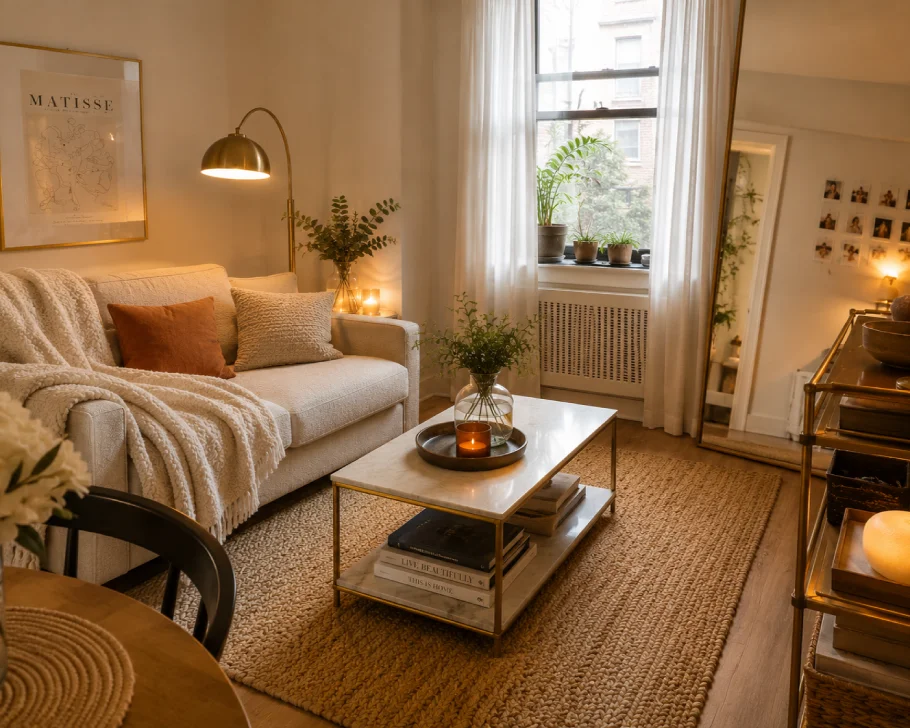
A reed diffuser or one well-placed candle does more for atmosphere than another decorative object. Diptyque’s Baies or Aesop’s Istros room spray are common choices, but even a single high-quality soy candle from a local maker works — the point is a consistent scent, not a brand name. Similarly, a small wireless speaker like the Marshall Stanwell or Sonos One playing low-volume ambient music turns a studio into somewhere that feels curated, not just decorated.
Conclusion
- Mirrors placed opposite windows create depth and double natural light for under £60.
- Layer three types of lighting — ambient, task, and accent — instead of relying on one overhead bulb.
- Choose multi-functional furniture, like storage ottomans, over adding more separate pieces.
- Keep your colour palette to two or three tones so the eye reads the room as one continuous space.
- Layer texture through textiles, rugs, and hardware finishes to avoid a flat, budget look.
Making a small city apartment feel like a luxury retreat comes down to a handful of deliberate choices, not a bigger budget. Start with mirrors and layered lighting — those two changes alone will shift how your entire space feels within a weekend.
Pick up one leaning mirror and a warm-toned floor lamp this weekend, then work through the storage and texture sections as your budget allows.
Explore our guide on choosing a cohesive paint palette for renters for your next step.

