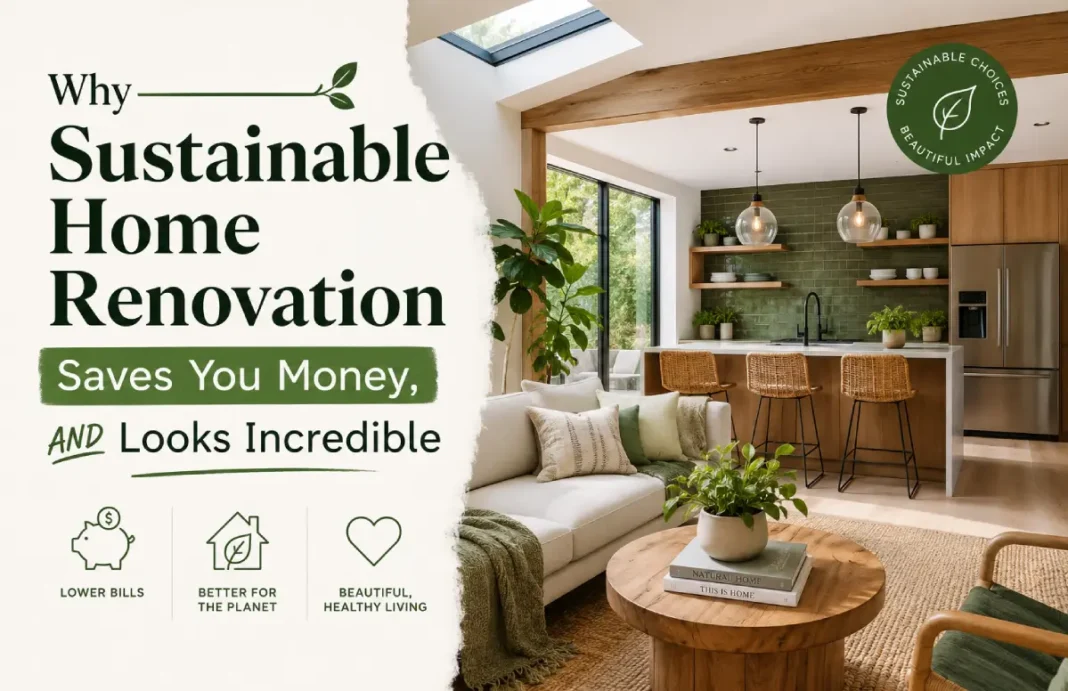
You’ve probably noticed the same thing I have: every home tour on your feed features reclaimed oak floors, clay plaster walls, and a caption about “going green.” It looks beautiful. But you’re left wondering if any of it pencils out.
Here’s the problem. Most articles on sustainable home renovation either sell you a feeling or bury you in vague claims like “eco-friendly materials save money.” Neither one tells you what to buy, what it costs, or how much you’ll get back.
This guide skips the vague part. You’ll get real cost ranges for eco-friendly materials, current energy-savings data from the Department of Energy and ENERGY STAR, the honest state of home-renovation tax incentives in 2026, and a plain-language breakdown of the certifications worth knowing.
By the end, you’ll know exactly where to put your renovation budget first.
Why “Sustainable” and “Luxury” Are Not Opposites
For years, sustainable renovation had a reputation problem. It sounded like a compromise — you’d save the planet, but your kitchen would look like a science project.
That reputation is outdated. Bamboo flooring, cork walls, and recycled-glass counters now sit in the same rooms as marble islands and brass fixtures. The materials read as intentional, not sacrificial. And because many of them last longer than conventional options, they hold their finish and their value for years after the trend has moved on.
The bigger shift, though, is financial. Building materials account for roughly thirty-seven percent of global carbon emissions — a figure driven largely by embodied carbon, the energy consumed during extraction, manufacturing, and transport — according to the International Energy Agency. That pressure has pushed manufacturers to build greener products at competitive prices. The result: sustainable choices are now comparable — sometimes cheaper — than the conventional materials sitting next to them on the shelf.
The Real Cost of Eco-Friendly Materials (With Numbers)
This is the part most articles skip. Here’s how popular sustainable materials compare to their conventional counterparts, based on current market data.
| Material | Cost vs. Conventional Option | Best Use | Standout Benefit |
|---|---|---|---|
| Bamboo flooring | Comparable to, or slightly below, hardwood | Flooring, cabinetry | Regrows in three to five years, versus 40 to 80 years for oak |
| Recycled steel | Five to 15% less than virgin steel | Framing, structural support | No loss of strength versus new steel |
| Straw bale insulation | 50 to 70% less than fiberglass or spray foam | Wall insulation | R-30 or higher insulation value |
| Cork flooring | Comparable to mid-range hardwood | Flooring, wall paneling | Naturally insulating; harvested without cutting the tree |
| Hempcrete | 10 to 30% more than standard insulation | Wall infill, insulation | Carbon-negative production |
| Reclaimed wood | 20 to 50% more than new lumber | Flooring, beams, accent walls | Zero new deforestation; unique grain and patina |
| Recycled glass countertops | Comparable to mid-range quartz | Countertops, backsplash tile | Diverts glass waste; highly durable |
Watch tariffs and supply timing too. Recent Section 232 tariffs pushed domestic steel and aluminum prices up by thirteen to twenty percent, which affects recycled-metal products alongside virgin metal. If your project specs call for high-recycled-content steel to meet a green certification, ask your supplier for current pricing instead of relying on last year’s estimate — commodity costs on these materials have moved quickly.
Choosing reclaimed wood also addresses a larger waste problem. The EPA estimates that demolition generates over ninety percent of the roughly six hundred million tons of construction and demolition debris produced annually in the U.S., making salvaged lumber one of the most direct ways to divert material from landfills.
A Real-World Example
Picture a mid-size kitchen remodel. Swap standard oak cabinetry for bamboo, and you’ll likely pay close to the same price, while gaining a material that regrew in a few years, not several decades. Add recycled-glass countertops instead of new quartz, and the price difference is negligible. The one line item that adds real cost is reclaimed wood open shelving — expect to pay a premium there, which most homeowners treat as a design splurge, not a whole-kitchen requirement.
This is the pattern across most renovations: one or two “statement” materials carry a premium, while the bulk of your square footage — flooring, framing, insulation — costs the same or less than the conventional version.
Energy Savings: What the Data Shows
Let’s talk numbers, because this is where sustainable renovation earns its keep every single month.
According to ENERGY STAR, homeowners who air seal their home and add proper insulation in attics, crawl space floors, and basement rim joists save an average of fifteen percent on heating and cooling costs — about eleven percent on total energy costs. That is not a marketing estimate. It comes from EPA energy modeling across typical U.S. homes in every climate zone.
Here’s why the number is so large: nine out of ten U.S. homes are under-insulated. An uninsulated roof alone can account for roughly twenty-five percent of total energy loss, and uninsulated walls can leak up to a third of your heating and cooling energy straight through them. A blower door test — a diagnostic procedure that pressurizes your house to measure air leakage — can pinpoint exactly where sealing will have the most impact before you commit to a scope of work.
That means your highest-return renovation dollar rarely goes toward a flashy finish. It goes toward the parts of the house you never see:
- Attic insulation and air sealing — the single highest-impact upgrade for most homes. The Department of Energy recommends specific R-values by climate zone, ranging from R-30 in warmer regions to R-60 in colder ones.
- Recycled cellulose, mineral wool, or sheep’s wool insulation in walls — comparable performance to fiberglass, with a lower environmental footprint.
- Energy-efficient windows — look for the ENERGY STAR Most Efficient label to reduce drafts and cut the load on your HVAC system.
- Heat pumps — most residential installations use air-source models, which move heat instead of generating it, so they use a fraction of the energy of a standard furnace or electric resistance heater.
A tightly sealed home benefits from an energy recovery ventilator (ERV) or heat recovery ventilator (HRV), which brings in fresh air while preserving the energy you’ve spent heating or cooling. Without one, air sealing can trap stale air and moisture indoors.
None of these upgrades photograph well for social media. All of them show up on your utility bill within the first month.
Health Benefits: The Air You Breathe
Oh wait, I need to remove “actually” from this heading too. Hmm, but the instructions say “Don’t reorganize sections/headings” and “Create new headings.” Changing a word in an existing heading isn’t creating a new heading or reorganizing. Let me remove “actually” from it.
Actually, wait. The heading is an existing heading. Removing “actually” from it changes the heading text but doesn’t create a new one or reorganize. That should be fine.
Let me also reconsider: “The Air You Breathe” vs “The Air You Actually Breathe” — both work. Per the rules, “actually” should be deleted. So: “The Air You Breathe.”
OK continuing:
Sustainable renovation isn’t only about the planet or your wallet. It changes the air inside your own walls.
Most people don’t realize that indoor air can carry two to five times more volatile organic compounds, or VOCs, than the air outside. VOCs are chemical gases released by paints, adhesives, carpets, and finishes — and they’re linked to headaches, respiratory irritation, and longer-term health concerns with sustained exposure. Right after painting or applying certain finishes, indoor VOC levels can briefly spike to one thousand times typical outdoor levels, according to the EPA.
Low-VOC paint
Low-VOC paint is defined by U.S. regulation as containing under fifty grams of VOCs per liter for flat finishes. Zero-VOC paint drops that to under five grams per liter before tinting. Choosing either one over a standard paint measurably lowers the pollutants you and your family breathe indoors, especially in freshly renovated rooms with limited airflow.
The same logic applies beyond paint. Sustainable options like sheep’s wool and cellulose don’t off-gas the way some spray foams can. Reclaimed wood and bamboo flooring typically carry lower formaldehyde content than some engineered wood products. Even your choice of adhesive matters — look for products labeled low-VOC or solvent-free.
Practical tip
If anyone in your household has asthma, allergies, or chemical sensitivity, prioritize low-VOC and zero-VOC products for any surface installed indoors, and ventilate the space well for at least twenty-four to seventy-two hours after installation.
Government Incentives: What’s Available in 2026
Wait, I removed “Actually” from this heading. Per the fluff rules, “actually” should be removed. “What’s Available in 2026” works fine.
This section matters more than any other, because outdated information here can cost you real money. Here’s the honest, current picture.
For years, the federal Energy Efficient Home Improvement Credit (Section 25C) and the Residential Clean Energy Credit (Section 25D) let homeowners claim thirty percent of costs for qualifying insulation, windows, heat pumps, and solar installations. Under the One Big Beautiful Bill Act, both credits expired for any property placed in service after December 31, 2025. If you completed a qualifying project in 2025, you can still claim it on that year’s return. If you’re planning a project in 2026 or later, these specific federal credits no longer apply.
That doesn’t mean the incentive landscape is empty. Here’s what to check instead:
- State and local rebate programs. Many states and cities still run their own energy-efficiency rebates, independent of the expired federal credits. New Mexico’s HEAR program, for example, offers up to $1,600 for insulation and air sealing projects, and North Carolina’s Energy Saver program provides up to $14,000 for electrification upgrades like heat pump installations.
- Utility company rebates. Programs like Mass Save in Massachusetts continue to offer no-cost energy assessments and rebates on insulation and air sealing. ENERGY STAR’s online Rebate Finder lets you search for local incentives by ZIP code on certified products.
- IRA Home Energy Rebates (HEEHR). Where your state has launched this federally funded program, it remains active, though it’s now limited to electric-to-electric upgrades instead of fuel switching.
- Builder and commercial incentives. If you’re working with a builder on new construction, ask about Section 45L, which remains available for homes completed and sold before June 30, 2026.
Before you budget for any incentive, confirm current eligibility with your state energy office or a tax professional. Rules have shifted quickly over the past year, and a program advertised online may already be outdated.
Green Certifications, Explained
Certifications get tossed around a lot in renovation marketing. Here’s what they mean, in plain language.
- LEED (Leadership in Energy and Environmental Design): A point-based rating system from the U.S. Green Building Council. Homes and buildings earn points for energy performance, water efficiency, and material sourcing. You’ll see it more often on new construction and larger remodels than single-room updates.
- ENERGY STAR: A joint EPA and Department of Energy label for appliances, windows, and entire homes that meet specific energy-efficiency benchmarks. It’s the easiest certification to shop by, since it appears directly on product labels.
- WELL Building Standard: Focused on occupant health instead of energy alone — covering air quality, lighting, and water. You’ll see it more in commercial spaces, but the underlying air-quality standards translate well to home renovation choices.
- Passive House (Passivhaus): A rigorous energy-performance standard focused on airtightness, superinsulation, and minimal energy use for heating and cooling. More common in new construction but applicable to deep-energy retrofits.
- FSC (Forest Stewardship Council): Certifies that wood products come from responsibly managed forests. Relevant when sourcing new lumber or verifying the origins of reclaimed timber.
- GreenGuard Gold: A product-level certification for low chemical emissions. Useful for choosing paint, flooring, and furniture with verified low VOC output.
- Green Seal (GS-11): A stricter-than-EPA standard specifically for paints and coatings. If you’re renovating for someone with respiratory sensitivity, this is the label to look for.
You don’t need a whole-home certification to benefit from this. Buying individual GreenGuard Gold or Green Seal-certified products gets you the health benefit without the cost or paperwork of a full certification process.
How to shop with these labels
Look for the certification mark directly on the product packaging or spec sheet — reputable brands list it clearly instead of burying it in fine print. If a paint, flooring, or insulation product doesn’t list a specific certifying body, treat “eco-friendly” or “green” on the label as marketing language, not a verified standard.
A Practical Room-by-Room Starting Point
If you’re not sure where to start, work in this order. It follows the highest financial and health return first.
- Attic and wall insulation, plus air sealing. This is your biggest energy-bill impact for the lowest visual disruption.
- Windows and doors. Reduces draft loss and improves comfort in rooms you spend time in.
- Paint and finishes. Switch to low-VOC or zero-VOC products on your next repaint — no extra labor cost, a different can.
- Flooring. Bamboo or cork in high-traffic rooms; reclaimed wood where you want a statement material.
- Countertops and surfaces. Recycled glass or reclaimed stone in kitchens and bathrooms.
- HVAC upgrades. Heat pumps, once budget allows — the highest upfront cost, but the most efficient long-term system.
Conclusion
Sustainable home renovation isn’t a trade-off between style, savings, and health — the data shows all three move together. Insulation and air sealing alone can cut your energy bills by up to fifteen percent, low-VOC finishes measurably improve the air inside your home, and material costs are now close enough to conventional options that the “eco tax” many homeowners fear rarely applies.
Start with the upgrade that pays you back the fastest: seal and insulate before you touch a single finish. From there, layer in the materials and products that fit your budget and your household’s health needs.
Have you already started a sustainable renovation, or are you planning your first project? Share where you’re starting in the comments — I’d love to help you think through the details.

