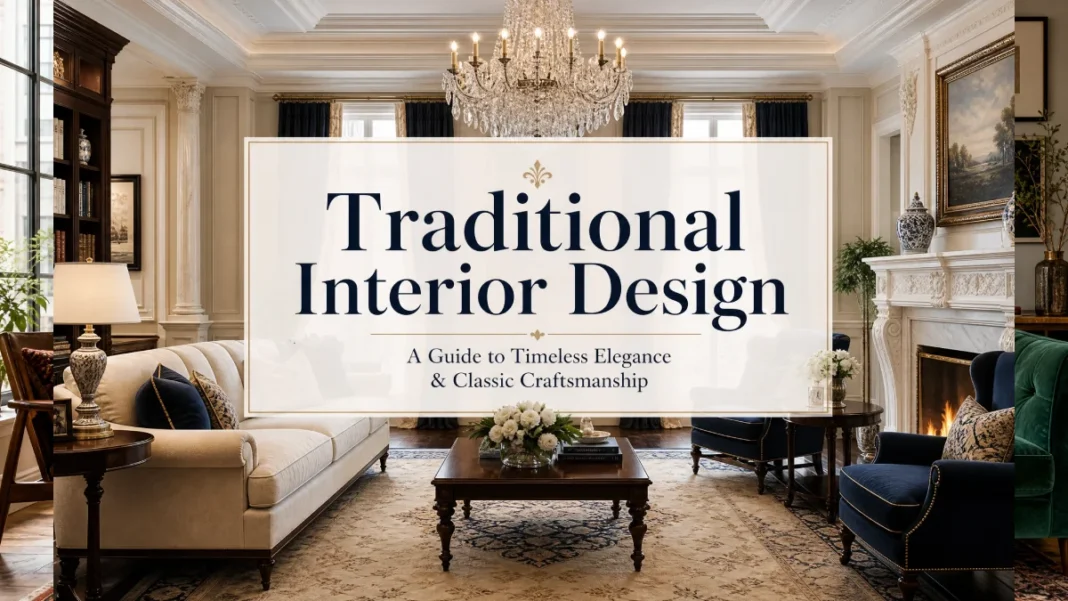
You’ve walked into a room and immediately felt it — that quiet sense of order, the warmth of rich wood, the unspoken invitation to sit down and stay a while. That’s the power of traditional interior design. It never yells for attention. It draws you in with balance, proportion, and pieces that tell a story.
But making it work in your own home can feel daunting. You might worry it’ll look like a museum, or that true traditional style requires a trust fund. It doesn’t. Here’s how to craft rooms that honor classical European roots while feeling fresh, personal, and livable.
You’ll pick furniture with pedigree, build a rich color story, master symmetry, layer patterns without chaos, and blend old and new with a designer’s touch — plus a room-by-room action plan at the end.
The Historical Roots of Traditional Design
Traditional interior design borrows its soul from 18th- and 19th-century European classicism. It draws deeply from the restrained elegance of Robert Adam’s neoclassical interiors, the symmetry of Georgian architecture, the ornamentation of French Rococo, and the disciplined proportions of Palladian villas. You’ll see echoes of ancient Greece and Rome in the columns, pediments, and balanced layouts that define the style.
This isn’t about recreating a period room, though. It’s about understanding why those elements endure. Balanced arrangements feel restful because our brains crave order. Rich materials age beautifully because they’re built for life, not trends. When you incorporate these principles, you’re not decorating — you’re grounding your home in a design language that has spoken across centuries.
Key influences you’ll spot again and again include:
- Georgian symmetry and restraint — matching windows flanking a fireplace, pairs of identical chairs, central focal points.
- French neoclassical details — subtle gilding, Louis XVI–style legs, toile fabrics, and gentle curves.
- English country house comfort — deeper seating, layered textiles, and a slightly more relaxed arrangement of formal elements.
When you understand these roots, you stop seeing traditional style as a set of rules and start seeing it as a toolkit. You can honor the past while creating a home that fits how you live right now.
Key Furniture Styles That Define the Look
Furniture is where traditional design asserts its personality. Three iconic styles form the backbone. You don’t need to be a furniture historian to use them confidently — just recognize their signatures and know where to place them.
Queen Anne (Early 1700s)
Queen Anne pieces bring a graceful, feminine curve to a room. Look for the signature cabriole leg — it bows outward at the knee and tapers inward at the ankle, often ending in a pad or claw-and-ball foot. You’ll find it on wingback chairs, lowboys, and side tables. The silhouette is curvaceous without being heavy. Use a Queen Anne side chair in a reading nook or as an accent in a bedroom to inject history.
Chippendale (Mid- to Late 1700s)
When you want structure and craftsmanship, reach for Chippendale. Thomas Chippendale’s designs blend Gothic, Rococo, and Chinese influences. The telltale signs: pierced back splats on chairs, ball-and-claw feet, and rich mahogany frames. A Chippendale dining chair feels substantial but never clunky. In a living room, a Chippendale camelback sofa anchors the space with architectural presence. This style speaks of confidence and permanence.
Chesterfield (18th Century Onward)
The Chesterfield sofa is the most recognizable piece in traditional design. Deep button-tufting, rolled arms set at the same height as the back, and sumptuous leather or velvet upholstery define it. It’s the ultimate blend of masculine polish and loungy comfort. You’ll often see it in a study, library, or living room where it serves as the grounding element. A Chesterfield in a rich cognac leather wears time beautifully — scratches and patina only improve it.
To help you compare at a glance:
| Style | Era & Origin | Key Characteristics | Best Used In |
|---|---|---|---|
| Queen Anne | Early 1700s England | Cabriole legs, pad/claw feet, curved lines, walnut | Bedrooms, accent seating, entryways |
| Chippendale | Mid-1700s England | Mahogany, ball-and-claw feet, fretwork, Gothic/Chinese details | Dining rooms, formal living rooms |
| Chesterfield | 1700s onward England | Deep button tufting, rolled arms equal to back height, leather/velvet | Libraries, studies, living room anchor pieces |
Don’t feel you must pick just one. A room layered with a Chesterfield sofa, a pair of Chippendale side chairs, and a Queen Anne lowboy feels collected over time, never catalog-bought.
Color Palettes: The Rich, Warm Heart of Tradition
Traditional interiors live in a world of warmth, depth, and subtle contrast. This isn’t the place for stark whites or icy grays. Instead, think of colors that wrap the room like a cashmere throw.
Your foundational palette revolves around:
- Creams and warm ivories on trim and ceilings. Try Benjamin Moore’s White Dove OC-17 — it has a soft yellow undertone that feels lit by candlelight rather than sterile.
- Rich neutrals — deep taupes, warm beiges, and mushroom tones. These replace cold gray as your wall color workhorses.
- Jewel-toned accents — sapphire navy, emerald green, ruby burgundy, amethyst plum. Use them on drapery, upholstery, or a lacquered library wall.
- Gilded or brass touches — metallic warmth shows up in mirror frames, lighting, and hardware, catching the light without glaring.
Here’s a designer trick: paint your trim a shade deeper than the walls for a cocooning effect. A room in Farrow & Ball’s Setting Plaster with Sulking Room Pink trim feels historic yet modern. Don’t be afraid of dark rooms either. A dining room wrapped in deep navy or forest green (try Benjamin Moore’s Hale Navy HC-154 or Caldwell Green HC-124) makes every dinner feel like an occasion.
Use the 60-30-10 rule as your safety net: 60% dominant color (walls, large upholstery), 30% secondary color (drapery, accent chairs), 10% accent (pillows, art, accessories). When you stay inside a warm-toned ecosystem, almost everything you bring home will automatically relate.
Symmetry & Proportion: The Architecture of Balance
If traditional design had a secret handshake, it would be symmetry. Our eyes find balance inherently calming, and this style exploits that to the fullest. You’ll create it most powerfully around a room’s focal point — typically a fireplace, a large window, or a piece of art.
Start here:
- Anchor with pairs. Flank the fireplace with matching bookcases, place two identical sofas facing each other, or set twin lamps on a console table. This repetition signals intention.
- Center the largest piece. In a living room, your main seating group should sit squarely across from the focal point, not floated awkwardly to one side.
- Use the golden ratio instinctively. A coffee table should be roughly two-thirds the length of your sofa. A chandelier’s diameter in inches should roughly equal the room’s length and width added together in feet (so a 12-by-18-foot room takes a chandelier around 30 inches wide). No math panic needed — aim for “visually heavier in the center and balanced at the sides.”
Proportion goes beyond measurements. It governs how forms talk to each other. A delicate Queen Anne side table next to a massive Chesterfield sofa creates a pleasing tension of light versus heavy. You want that interplay. The key is that nothing feels like it’s tipping over or disappearing.
When you can’t achieve perfect symmetry due to an off-center window or an awkward doorway, fake it. Hang a substantial piece of art on the off-center wall and mirror it with a tall plant or an etagere on the other side to create visual weight equality. The brain will read it as balanced.
Pattern & Textiles: Damask, Toile, and Florals
Pattern is where traditional design exhales and shows its softer side. The main workhorses — damask, toile, floral, and chinoiserie — each carry distinct moods. Knowing when to deploy them will save you from a room that feels like a period drama set.
- Damask is formal and lustrous. Its woven, tone-on-tone pattern usually features scrolling leaves or medallions. Use it on drapery or a single accent chair. A silk-blend damask from a house like Schumacher or Brunschwig & Fils in a dining room adds ceremony.
- Toile de Jouy is storytelling in fabric. Originally French, it depicts pastoral scenes, florals, or architectural vignettes in a single color on a cream background. Toile wallpaper in a powder room feels like a jewel box. In a bedroom, toile bedding or a headboard fabric creates gentle whimsy.
- Florals range from chintz to large-scale blooms. Chintz — glazed cotton with bright, detailed flowers — is a traditional English staple. Today, use it on throw pillows or a skirted table rather than an entire sofa to avoid overload.
- Chinoiserie brings an Eastern inflection — pagodas, birds, flowering branches, and hand-painted scenery on wallpaper or fabric. It has been a staple of English and American traditional rooms since the 18th century. A chinoiserie wallpaper in an entryway or behind open shelving adds depth and pattern that reads as collected, not contrived.
How to Mix Patterns Without Chaos
Layering patterns is where your confidence will shine. The rule of three keeps it foolproof:
- Vary the scale. Pair a large-scale damask with a medium floral and a small stripe or check. Your eye needs a place to rest.
- Anchor with a common color. Pull one color from your damask and repeat it in the floral’s background or the stripe’s thread. This unites disparate patterns.
- Separate busy patterns with solids. If you have a patterned sofa and a patterned rug, let solid drapes or a solid accent chair break the visual rhythm.
Try this in your own space: an armchair in a large-scale toile, a cushion in a medium floral that shares the toile’s blue, and a tiny buffalo-check throw. It feels layered, not loud.
The New Traditional: Mastering the Modern-Traditional Mix
New Traditional is the answer for anyone who loves classical bones but doesn’t want to live in a museum. This approach — seen in the work of designers like Bunny Williams and Michael S. Smith — fuses the warmth and permanence of traditional design with the clean lines, negative space, and edited mindset of modern interiors. It’s what gives your home that “collected, not decorated” ease.
You’ll achieve it by creating deliberate tension points:
- Mix eras with confidence. Place a minimalist marble Saarinen-style tulip table in a room with Chippendale chairs. Hang an abstract canvas above a Georgian console. The contrast makes both pieces more interesting.
- Edit ruthlessly. Traditional style can get heavy. New Traditional rooms breathe. Keep surfaces clear, limit tchotchkes, and let each piece have visual elbow room.
- Incorporate modern art and lighting. A Sputnik chandelier over a classic dining table, or a huge color-field painting above a tufted Chesterfield, updates the mood at once. The traditional forms ground the room; the modern accents keep it awake.
- Swap heavy case goods for cleaner lines. Instead of a bulky traditional media cabinet, choose a streamlined credenza in a warm wood or lacquered finish. The warmth remains, but the visual weight lifts.
A quick do / don’t checklist:
- Do mix at least two distinct periods in every room.
- Don’t match your furniture suites — break them up.
- Do use traditional patterns on modern-shaped upholstery (think a tailored, armless slipper chair in damask).
- Don’t let antiques feel precious — use them daily, let them gather a little life.
- Do keep lighting varied: one traditional crystal chandelier, one modern sculptural floor lamp.
The goal is a home that feels inhabited by you, not decorated by a committee. When someone can’t tell if you bought that gilded mirror last year or inherited it, you’ve nailed the balance.
A Room-by-Room Guide to Traditional Elegance
These are the exact moves I use when designing for clients.
Living Room
Start with your focal point — 90% of the time it’s the fireplace or the largest window. Place a pair of Chesterfield sofas or classic rolled-arm sofas facing each other perpendicular to the hearth. Between them, set a substantial wood coffee table. Anchor the seating arrangement with a traditional Persian, Oushak, or Heriz rug — its pattern will hide wear beautifully.
Symmetry is your MVP here. Two matching armchairs at the far end, a pair of table lamps on a long console behind one sofa, and a large gilded mirror or landscape painting over the mantel. Layer in pattern through pillows and drapery, not everything at once. A damask pillow on each sofa and floral curtains pull the whole room together without shouting.
Dining Room
A dining room is where formality feels most at home. Choose a solid wood table — mahogany or walnut — with Chippendale or Queen Anne chairs. If you have a sideboard, mirror its weight on the opposite wall with a large piece of art or a matching china cabinet. A crystal or brass chandelier centered precisely over the table is non-negotiable. Wall sconces on a dimmer add the candlelight effect even when you’re serving takeout.
Paint the room a saturated color. Deep forest green or navy with crisp white wainscoting below a chair rail is a classic traditional formula that makes every dinner feel elevated. Dress the windows in floor-length silk or linen-blend panels with pinch-pleat headers — hang the rod as close to the ceiling as you can to add height.
Bedroom
Your bedroom should feel like a sanctuary, not a set piece. An upholstered wingback or tufted headboard in a soft linen or velvet sets the traditional tone. Use matching nightstands with swing-arm sconces or petite lamps — symmetry here encourages calm. Bedding in crisp white or ivory with a folded floral coverlet at the foot adds the pattern without overwhelming.
A Queen Anne–style upholstered bench at the foot of the bed, done in a contrasting fabric, brings a heritage note and gives you a place to sit. Keep the rest of the room relatively calm — a single antique dresser or a writing desk by the window is often enough.
Home Office or Library
This is where you can go a little deeper into clubby, old-world atmosphere. A Chesterfield sofa in leather or a pair of deep armchairs with an ottoman invites you to stay. Built-in bookshelves flanking a window create architectural credibility. If built-ins aren’t possible, arrange two tall bookcases symmetrically along a wall.
Paint the walls a warm, enveloping hue — think tobacco brown, deep aubergine, or even a moody green. Layer a vintage Persian rug over bare wood floors. Brass library lamps on the desk and a traditional banker’s lamp add the perfect task lighting. Keep the desk itself substantial — a partner’s desk with drawers on both sides works beautifully and reinforces symmetry.
Entryway
Your entry sets the tone for the whole home. Even a small foyer can feel grand with the right choices. Place a wood console or demi-lune table against one wall. Hang a large mirror above it — a gilt or carved wood frame says “traditional” at a glance. Flank the mirror with a pair of small buffet lamps, and center a bowl or a stack of leather-bound books on the table.
If you have the space, add a single Queen Anne–style chair or a small upholstered bench. A classic black-and-white marble tile floor or an oriental runner leads the eye inward. The goal is to make the first impression one of warmth, order, and timelessness — exactly what traditional design does best.
Conclusion
Traditional interior design isn’t about living in the past. It’s about building a home on principles that have endured because they make us feel secure, comfortable, and deeply at ease. You’ve just learned how to bring those principles — from the graceful curve of a Queen Anne leg to the balanced calm of perfect symmetry — into your life with clarity and confidence.
Start where the impact is biggest. Paint one room a rich, enveloping color. Swap out a generic lamp for a pair that flanks a mirror. Visit an antiques shop or an online auction and find a single Chippendale-style chair that speaks to you. Traditional style is built one thoughtful piece at a time, not overnight.
What’s the one room in your home you’ve been longing to feel more grounded and elegant? Tell me in the comments — I’d love to hear what you’re planning, and I’ll jump in with specific suggestions.

