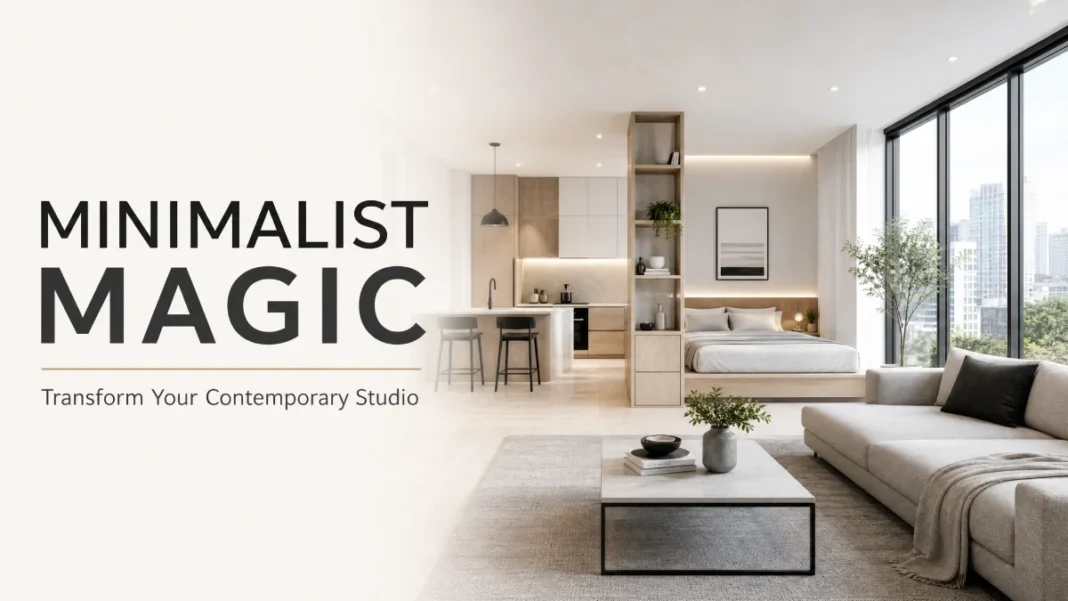
You’ve seen those images—airy studios where morning light washes over a clutter-free desk, and the only thing on the nightstand is a single ceramic cup. You crave that kind of calm. But your own studio feels more like a game of Tetris with a lease.
Living in 500 square feet (or less) doesn’t mean you have to give up on style or sanity. You can create a home that feels spacious, intentional, and entirely yours. This is how to create minimalist magic in a contemporary studio apartment—without rigid rules or cold, impersonal spaces.
I’ll walk you through a clear philosophy, a curated essentials list, storage solutions that work, and a decluttering method you can complete in a single afternoon. By the end, you’ll see your studio not as a limitation, but as a canvas for a beautifully edited life.
Why Minimalism Is a Studio Dweller’s Best Friend
Minimalism is not about owning as little as possible. It’s about owning only what serves you—and letting go of the rest. In a studio, this matters more than anywhere else. Because your living, sleeping, and dining zones all share the same footprint, every object carries an outsized visual weight.
Think of visual weight as the attention an object demands. A bulky armchair shouts. A sleek floor lamp whispers. In a small space, you want more whispers. Minimalism helps you pare back so that the few pieces you do have can breathe. This creates negative space—the empty areas around objects that make a room feel calm and open. The Japanese call this concept ma (間): the meaningful pause between objects that gives each one room to exist. Without negative space, even a perfectly organized studio can feel chaotic.
Instead of filling every corner, ask yourself: Does this item earn its square footage? If it doesn’t, it’s time to let it go. This mindset shift is the foundation. Once you embrace it, every design decision becomes easier.
The Only Essentials You Actually Need
You don’t need a 50-item starter list. You need only the pieces that support your daily life. I once worked with a client in a 375-square-foot studio. She halved her belongings and kept only one set of dishes. She told me it was the first time she felt like she wasn’t being suffocated by her own home. That’s the power of editing down to what truly matters.
Here’s a refined, realistic essentials list for a studio apartment—items that pull double duty whenever possible.
- A high-quality mattress or sofa bed: If space is tight, a daybed or a streamlined sofa bed like the IKEA Nyhamn gives you seating by day and a real mattress by night. Skip the futon; it rarely does either job well.
- One multipurpose table: A gateleg table (IKEA Norden) can act as a dining table, desk, and buffet. Fold it down when you need floor space.
- 2-4 stackable or folding chairs: Keep two out for daily use and store the rest. They tuck away nearly invisibly.
- Two sets of bedding: One on the bed, one in the laundry. That’s it. No linen cabinet required.
- A capsule kitchen: A single 10-inch sauté pan, a 2-quart saucepan, a chef’s knife, a cutting board, two plates, two bowls, two sets of flatware, and a few mugs. If you cook often, add a half-sheet pan and a mixing bowl that nests.
- A capsule wardrobe: Cull your closet until everything fits in one small dresser or a single hanging rail. Use slim velvet hangers to save space.
- Two light sources: A sculptural floor lamp (like a tripod lamp) for ambient glow and a clip-on task light for focused desk work. Designers call this layering—ambient light sets the mood while task light handles function. Overhead fixtures alone create harsh shadows and kill coziness.
- Closed storage: A sideboard or a dresser with drawers. Use it as a TV stand, entryway catch-all, and clothing storage all at once. The IKEA Bestå system with doors or Muji’s stackable storage cubes work beautifully.
The “Everything Has a Home” Storage Philosophy
Clutter isn’t a stuff problem—it’s a home problem. Researchers at UCLA found that people in cluttered homes had higher cortisol levels throughout the day, proof that visual chaos isn’t just an aesthetic issue—it’s a health one. When an item doesn’t have a designated spot, it floats. The mail lands on the kitchen counter, the yoga mat leans against the wall, and the spare cables become a permanent desk resident.
The Rule
Everything must have a home. And that home must be so easy to access that putting things back feels effortless. I call this the one-touch rule. You should be able to return an item to its home in a single motion—no unstacking, no unlatching of tricky lids.
In a studio, your best storage solutions are the ones that hide and integrate. Here’s how to apply the philosophy:
- Under-bed drawers: A bed with built-in storage like the IKEA Brimnes or a platform frame with rolling bins underneath swallows out-of-season clothing, shoes, and luggage.
- Storage ottomans and benches: Use a lift-top ottoman as a coffee table and stash blankets, remotes, and chargers inside. A slim storage bench at the foot of the bed holds linens.
- Wall-mounted cabinets: Go up. Floating cabinets above the desk or sofa keep daily items hidden while preserving floor space. If you’re renting, use removable adhesive shelves or lean a tall ladder shelf against the wall.
- Drawer organizers within drawers: Even a “home” can become chaotic. Use small bamboo trays or felt bins to separate socks from tech, utensils from napkins.
- Pouches for cords: Never let a loose cord live without a pouch home. Label them “chargers,” “audio,” “travel adapters,” and drop them in a single designated drawer.
Make it a ritual: every evening, do a 5-minute sweep and return every stray item to its home. It’s meditative and keeps visual noise at zero.
Creating Visual Calm Through Design
A studio feels restful when the eye has nowhere to snag. That means you need a backdrop of deliberate quiet. I’ll break this into three layers: palette, silhouette, and hidden storage as a deliberate design tool.
The Power of a Neutral Palette
Color sets the emotional temperature. A neutral base—warm whites, soft greiges (that mix of gray and beige), and light taupes—makes walls visually recede, expanding your space. Try Benjamin Moore’s White Dove OC-17 or Sherwin-Williams Alabaster SW 7008 on walls, trim, and even the ceiling. Painting everything the same color blurs boundaries and erases the boxy feel of a studio.
A friend of mine painted her entire 400-square-foot rental in White Dove and swapped her dark sofa for a light linen one. She said it felt like she’d added 100 square feet. She hadn’t, but the perception was everything. That’s the power of a neutral envelope.
Layer in texture to prevent the room from feeling cold. Think a chunky knit throw, a nubby linen duvet, a jute rug underfoot. These materials add depth without visual clutter. If you crave color, introduce one muted accent—a dusty blush pillow or a sage lumbar cushion—and repeat it in a single piece of art. That’s enough.
Clean Lines and Simple Silhouettes
Furniture with thin legs, low profiles, and straight, unfussy edges creates visual lightness. Mid-century modern designs were built on this principle—their tapered legs and floating forms were made for small spaces. The more floor you can see underneath a piece, the larger the room feels. Swap a solid platform bed for a frame with tapered legs. Choose a wall-mounted nightstand instead of a chunky table. Pick a sofa with a slim arm profile, like the Article Sven or a vintage-inspired mid-century style.
Avoid ornate carvings, rolled arms, and heavy skirting. They anchor the eye and make the footprint feel cramped. Even your window treatments matter. Replace heavy drapes with sleek roller shades or sheer linen panels that let light pass through. This keeps the look airy and uncluttered.
Mastering Hidden Storage as a Design Tool
I’ve already talked about the philosophy, but let’s focus on how hidden storage shapes the room’s calm. Closed storage is your greatest ally. Every time you swap an open shelf for a cabinet with doors, you remove an opportunity for visual chaos.
Use a media console with doors to hide routers, gaming consoles, and cords. If you must have open shelves, limit them to one small stretch and style them with a stack of two art books, a ceramic vessel, and a trailing pothos—that’s it. Then step back and see: the closed storage has erased the “busy” from your peripheral vision. That’s the magic.
Personal Expression Without the Clutter
Minimalism gets a bad rap for being soulless. It’s not. It simply asks you to choose a single voice instead of a shouting chorus. The way to inject soul into a studio is with a statement piece. One thing that captures your personality and holds the room together.
This could be:
- A large-scale abstract canvas hung above your sofa or bed. Let it be bold—a deep inky blue, a photograph you took while traveling.
- A sculptural pendant light that draws the eye up and becomes the room’s jewelry.
- A vintage Persian rug with faded, moody colors that anchor your entire neutral palette.
- A wall-mounted, floor-to-ceiling mirror with a thin black frame. It doubles the light and functions as art.
The rule is this: the statement piece must have room to breathe. Don’t crowd it with competing accessories. If you choose the painting, let the wall behind it be bare. If you go with the rug, let the furniture float on it without a sculptural coffee table vying for attention. The quiet around the statement lets it sing.
You can also add a touch of life with a single fiddle leaf fig, a snake plant, or a trailing pothos in a simple, textured planter. That hint of green does wonders.
Your Step-by-Step Decluttering Method (The Studio Reset)
You have the philosophy and the design plan. Now it’s time to make your space match your vision. I’ve used this exact method with dozens of clients in studio apartments. It’s gentle, fast, and permanent.
Here’s the Studio Reset:
1. Empty one zone at a time
Don’t pull apart the whole apartment. Start with your wardrobe area or the kitchen counter. Remove every item and place it on a clean surface. Seeing the space resets your brain.
2. Sort into three piles: Keep, Donate, and Maybe
Pick up each object and ask: Have I used this in the last six months? Does it make my daily life easier or more beautiful? Be ruthless. The maybe pile goes into a box sealed with tape. Write today’s date on it. If you haven’t opened it in 30 days, donate the whole box unopened.
3. Assign a home immediately
Before you put a single kept item back, designate its exact home. Use the one-touch rule: if the home requires stacking or digging, rethink it. Add drawer dividers, hooks, and labeled bins so nothing has an excuse to wander.
4. Adopt the one-in, one-out rule
From this moment forward, whenever you bring something new into the studio, something old must leave. Bought a new sweater? Donate one. New coffee mug? An old one goes. This maintains equilibrium effortlessly.
5. Schedule a 15-minute evening reset
Every evening, set a timer and put every misplaced item back in its home. Fold the throw, clear the desk, stash the shoes. This tiny habit prevents weekend-long cleaning marathons.
6. Digitize paper and sentimental clutter
Snap photos of cards, tickets, and artwork. Store them in a digital album called “Keepsakes” using Google Photos or Apple Photos so you can search and revisit them anytime. Recycle the originals. For essential documents, use a single slim accordion folder that slides under the bed.
7. Test and wait
After finishing a zone, live with the emptiness for at least a week. You may discover you need nothing else. Often the discomfort isn’t from lack, but from the unfamiliarity of calm.
Repeat this process zone by zone until your entire studio feels as serene as those images you once pinned.
Conclusion
Minimalist magic isn’t about owning a set number of things. It’s about creating a home where every item supports your life instead of stealing your peace. When you pare down to the essentials, give everything a proper home, and let one personal piece stand proud, your studio becomes a retreat—not a compromise.
Start small. Pick one drawer tonight and use the Studio Reset. Notice how different it feels to open it and see only what you need. That feeling is addictive. Soon, you’ll want it everywhere.
I’d love to see your transformation. Tag @obviousluxe and share your before-and-after. Or drop a comment below and tell me your one statement piece. Let’s make small-space living the most luxurious thing you’ve ever done.

